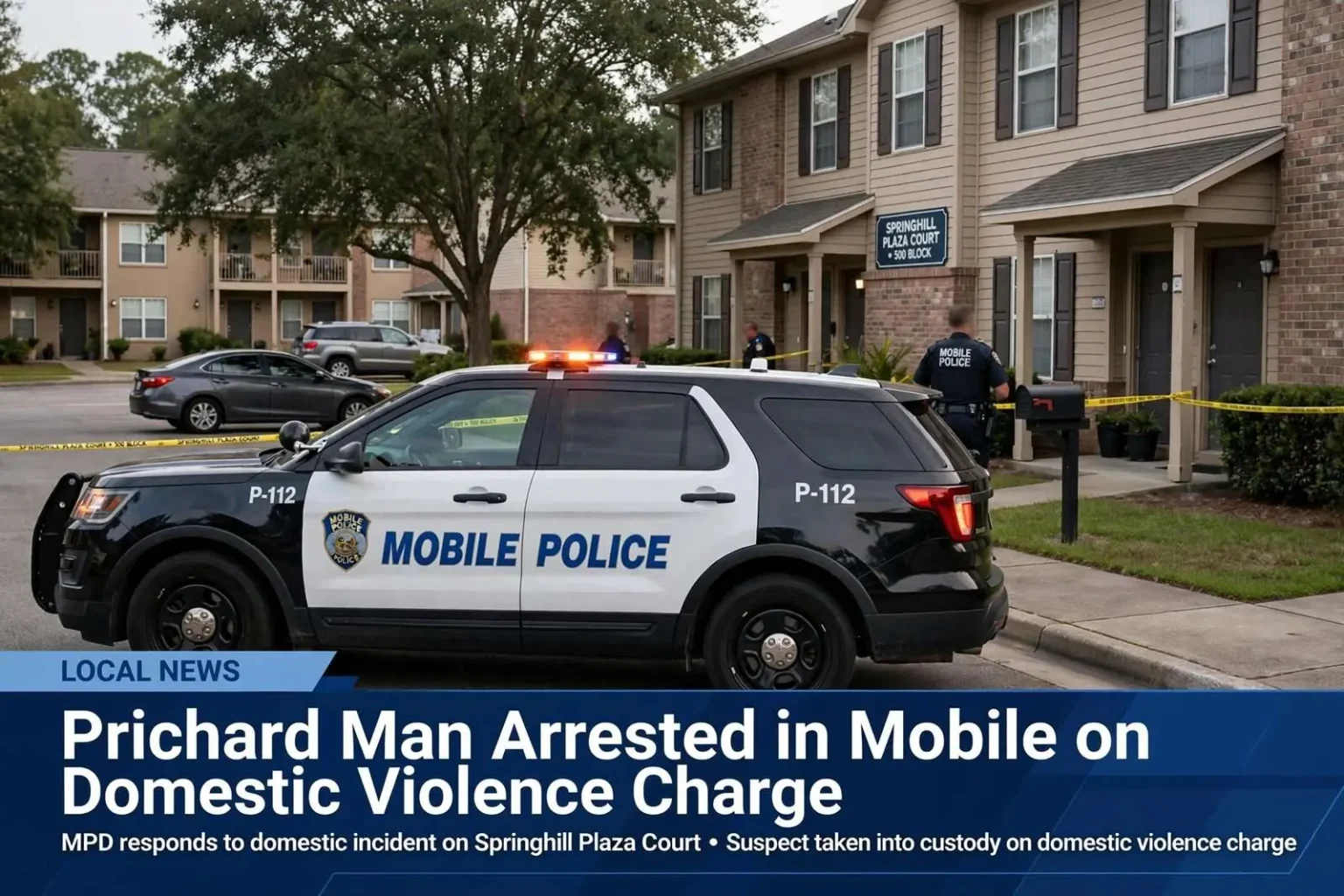
A Prichard man has been arrested after allegedly assaulting a woman he knew, according to the Mobile Police Department. According to an MPD news release, officers responded to the 500 block of Springhill Plaza Court for a report of a domestic incident. When officers arrived, they found a woman who had been physically assaulted by a man she knew. The suspect, identified by police as a Prichard resident, was taken into custody at the scene and booked on a domestic violence charge.
The response unfolded in a residential area near the Springhill corridor in west Mobile, an area of apartments and townhomes where MPD officers answer a steady stream of calls. Domestic incidents are among the most frequent and most dangerous calls patrol officers handle, requiring them to separate parties, document injuries, collect statements and determine whether an arrest is legally mandated under Alabama’s domestic violence laws. In this case, the department said the evidence at the scene supported taking the suspect into custody.
What Alabama’s Domestic Violence Law Provides
Under Alabama law, domestic violence offenses are graded by the seriousness of the injury and the means used, and a first-degree charge is a felony that can apply when a victim suffers serious physical injury or a weapon is involved. Lower-degree charges cover assaults causing lesser injuries. Courts also operate protective-order systems that can bar a defendant from contact with the victim, and violation of a protective order is itself a criminal offense. Arrests in domestic cases are governed by statewide policy that directs officers to arrest when there is probable cause, regardless of whether the victim asks for it.
Prosecutors in Mobile County handle these cases through the District Attorney’s domestic violence units, and convicted offenders can face sentences that include prison, mandatory batterer intervention programs and supervised probation. The law’s design reflects what research and court experience have shown across the country: domestic assaults are among the most likely offenses to repeat and to escalate, which is why Alabama removed much of the discretion officers once had to simply separate the parties and move on.
The Agencies Behind Day-to-Day Public Safety
The incident underscores the kind of day-to-day public safety work that residents of Mobile and the surrounding communities have come to expect from their local law enforcement agencies. Residents across Mobile County and Baldwin County rely on a network of municipal police departments, the Mobile County Sheriff’s Office, the Baldwin County Sheriff’s Office, and state troopers to handle day-to-day calls. Major cases are typically handled by the investigative divisions of those agencies, often working in coordination with one another.
Mobile-area news outlets and the police agencies themselves frequently release updates on investigations, arrests, and charges, and the public can typically follow developments through official statements and court records. In domestic cases, agencies generally release limited information — the location, the charge and the arrest — because the identities of victims are protected and the details of the relationship are often sensitive. Court filings later become the public record of what evidence prosecutors present.
How the Mobile Police Department Works
The Mobile Police Department is the primary law enforcement agency for the city of Mobile. It operates from headquarters in downtown Mobile and provides patrol, investigative, and specialized services across the city’s roughly 180 square miles. The department is organized into precincts covering the city’s geographic districts, with patrol officers answering first calls and detectives in investigative units handling follow-up on burglaries, assaults, robberies and homicides. Specialized units address traffic enforcement, school resource duties, and particular crime patterns.
MPD is one of the larger municipal departments in Alabama, policing a city of about 190,000 residents that anchors the Gulf Coast between New Orleans and the Florida panhandle. Its officers work within a court system that includes Mobile County District Court for misdemeanors and Mobile County Circuit Court for felonies, both located in the Government Street complex downtown. Arrests made by MPD officers typically move through those courts within days, and charging decisions rest with the Mobile County District Attorney’s Office.
Prichard and Its Place in Mobile County
Prichard is a working-class city in north Mobile County, just north of downtown Mobile across Three Mile Creek. It is one of the older communities along U.S. Highway 45 and is part of the Mobile metropolitan statistical area. Founded and incorporated in the early twentieth century as an industrial town serving the railroads and shipyards, Prichard grew with the same shipbuilding economy that shaped Mobile itself, and its neighborhoods of modest homes date largely from those decades of expansion.
The city operates its own police force and municipal government, but its proximity to Mobile means arrests and incidents often cross jurisdictional lines — a Prichard resident arrested in Mobile by MPD is a routine example. Cases arising in one city are prosecuted by the same county District Attorney, held in the same courthouses, and housed, when sentences require it, in the same county and state correctional facilities. The two cities share schools’ attendance zones in some areas, utilities in others, and an unbroken stretch of neighborhoods along the Highway 45 corridor.
Alabama’s Public Safety Structure
Alabama is a southeastern U.S. state bordered by Mississippi, Tennessee, Georgia, Florida, and the Gulf of Mexico. Its state capital is Montgomery, its largest city is Birmingham, and Mobile serves as the major urban center of the lower Gulf Coast. Law enforcement in the state is layered: municipal police handle city calls, county sheriffs handle unincorporated areas and small towns without their own forces, and the Alabama Law Enforcement Agency provides state troopers and specialized investigations. The layering means a single incident can involve several agencies — as this one did, drawing an MPD response to a suspect from a neighboring city.
Local and state government decisions frequently shape how Mobile, Baldwin County, and the broader region grow and govern themselves. City and county governments set law enforcement budgets, court staffing and jail capacity, and those decisions determine how quickly calls like the one on Springhill Plaza Court are answered and how cases move once an arrest is made. For residents, the practical takeaway of an arrest like this one is the same as it has always been: an incident reported, officers dispatched, a suspect charged, and a case headed to the county courts where it will be resolved on the record.
What Happens After an Arrest
Following an arrest on a domestic violence charge, the suspect is booked into the Mobile County Metro Jail, appears before a district judge for an initial hearing, and may face conditions of release that include no contact with the alleged victim. The case then proceeds through the District Attorney’s screening process to a trial setting or a negotiated disposition. Victims are connected with advocates who can help them obtain protective orders and navigate the court process.
No additional details about the Springhill Plaza Court incident — including the identities of the individuals involved — were included in the department’s release, consistent with the department’s practice in domestic cases. The charge will be documented in Mobile County court records, where the outcome of the case will ultimately be recorded.
The Springhill Corridor Response
The 500 block of Springhill Plaza Court sits in the broader Springhill area of west Mobile, a part of the city where apartment complexes and townhome communities line the streets off Airport Boulevard and Union Avenue. Calls to that corridor routinely involve MPD’s western precinct patrol units, and domestic disturbances rank among the most common calls for service there, as they do citywide. Officers arriving on a domestic call follow a set sequence: secure the scene, check for injuries, interview the parties separately, identify witnesses, photograph any injuries or damage, and determine whether the legal standard for arrest has been met.
Alabama’s mandatory-arrest orientation in domestic cases reflects decades of national research showing that when officers simply separate parties without an arrest, assaults are more likely to recur. State law and department policy direct that officers make an arrest when the evidence supports probable cause, and the MPD release in this case indicates that standard was met. The suspect was booked at the scene, meaning the woman received immediate protection without having to seek it herself, and the case moved directly into the criminal justice system rather than ending at the front door.
Victim Services in Mobile County
Victims of domestic violence in Mobile County have access to a network of support services that operate alongside the criminal case. The District Attorney’s Office staffs victim service officers who explain court dates, protective orders and the defendant’s release conditions. The Lifelines Counseling Services crisis line and the area’s domestic violence shelter network provide emergency housing, counseling and safety planning for victims who need to separate from an abuser. Courts can issue protective orders the same day a petition is filed, and violations of those orders trigger automatic criminal charges.
Advocates stress that the most dangerous period for a domestic violence victim is often immediately after an arrest or separation, which is why safety planning and protective orders accompany nearly every prosecuted case. The systems that responded to the Springhill Plaza Court call — patrol response, arrest, booking, victim contact — are the first links in a chain designed to keep that danger window managed and the case on a documented track.
The Numbers Behind the Pattern
Domestic violence calls make up a substantial share of police work across the Gulf Coast, and they strain agencies in ways residents rarely see. Each call requires a minimum of two officers under many department policies, both for officer safety and for independent witnesses to statements. Follow-up takes detectives’ time even when the case ends in a plea. And the cycle often repeats: the same addresses and the same parties generate repeated calls, which is why departments track domestic calls by address and coordinate with prosecutors and advocates on repeat victims.
For Mobile and its surrounding cities, the networked response — municipal police, county sheriff, state investigators, prosecutors, advocates and shelters — is the practical architecture of public safety. An arrest like the one on Springhill Plaza Court is where that architecture becomes visible: one call, one address, one suspect taken from a neighbor’s doorway, and a case that will be documented in the courts of a county where the cities of Mobile and Prichard share the same system from booking to final disposition.