
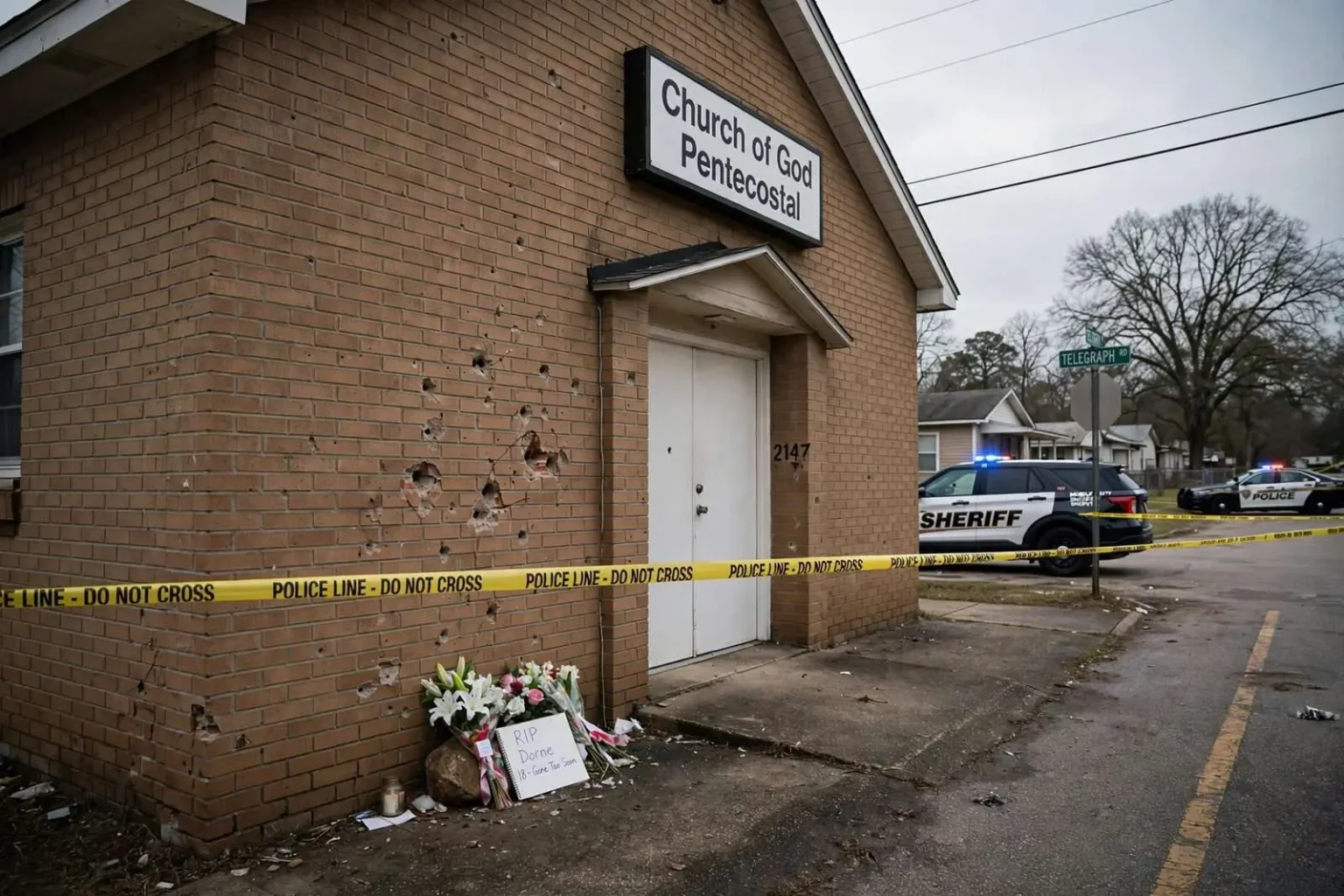
PRICHARD, Ala. — A Prichard man is charged with murder in the weekend shooting death of an 18-year-old in Mobile’s Toulminville community, and authorities say he surrendered after a lengthy standoff. Prichard police announced overnight that 24-year-old DeJuan Crenshaw was in custody at Metro Jail on a murder charge.
The victim, 18-year-old Dorne De’Wayne Wheeler, was shot and killed Saturday along Telegraph Road outside a Church of God Pentecostal congregation. According to police, Wheeler was walking along the road when shots rang out, and he ran toward the church, where he was struck and killed. Witnesses reported hearing more than a dozen gunshots Saturday. Bullet holes were visible in the side of the church building, though no one was inside when the shooting occurred.
According to a release from the Prichard Police Department, officers along with U.S. Marshals and SWAT units from the Mobile Police Department and the Mobile County Sheriff’s Office responded Tuesday night to a location in Toulminville to apprehend Crenshaw. After what officials described as a somewhat lengthy standoff, he gave up peacefully and was taken to Prichard police headquarters, where he was questioned. Police said Crenshaw confessed to the shooting and apologized to Wheeler’s family before being booked into Mobile Metro Jail. Investigators have not disclosed a motive.
The Toulminville neighborhood, where both the shooting and the Tuesday standoff took place, is one of Mobile’s oldest communities. Centered along St. Stephens Road in the city’s north-central section, it grew up around an antebellum estate and developed through the twentieth century into a residential district of craftsman houses, churches and small businesses, and it remains a hub of north Mobile life. Telegraph Road runs through the heart of that section, a corridor of homes and congregations where a weekend afternoon shooting — and a midweek standoff — lands in the middle of daily life.
The geography of the case spans only a few miles but two jurisdictions. Prichard, one of Mobile County’s older cities, grew as an industrial and railroad town along the mobile River’s north side, and its neighborhoods run directly into Mobile’s northern city limits with no visible boundary between them. Residents cross the line daily for work, school and worship — which is why a Prichard man can be a familiar figure on Toulminville streets, and why police in both cities treat the corridor between the two as a single zone when they hunt a suspect.
Telegraph Road, where Wheeler was shot, threads through that corridor’s southern reaches. It is a residential street lined with modest homes and churches, the kind of block where a Saturday afternoon shooting shatters the ordinary rhythm of porch conversations and youth ballgames. The Church of God Pentecostal congregation whose building took bullets stands along the route, and its presence — quiet, well kept, central — made the stray gunfire all the more jarring for neighbors who gathered afterward to look at the holes in the brick.
Prichard, the suspect’s home city, sits just north of Mobile’s city limits and shares a long border and a deep tangle of family and commercial ties with the neighboring city. Its police department handles a steady share of the region’s violent-crime workload, and its detectives frequently work hand in hand with Mobile police and county agencies when suspects and crime scenes fall on opposite sides of the municipal line, as they did in this case — a Prichard suspect, a Mobile crime scene, and a regional manhunt to close the gap.
How the arrest came together
The multi-agency response that ended the case reflects how fugitive work is done in the Mobile area. The U.S. Marshals Service operates a regional fugitive task force based in the city, combining federal deputies with officers lent by local departments, and it has become the standard route for locating suspects wanted in violent cases. Local patrol officers supply street-level intelligence; marshals bring databases, surveillance resources and the authority to track a fugitive across jurisdictional lines; and SWAT units stand ready for exactly the kind of fortified, uncertain situation a murder suspect can present.
That structure was on display Tuesday night. Officers surrounded the Toulminville location where Crenshaw was believed to be, and rather than force an entry, negotiators waited. Standoffs of that kind — with a suspect inside and officers holding the perimeter — are resolved by patience more often than by force, and the outcome officials described was the one investigators prefer: a suspect who gave up peacefully, with no shots fired and no injuries beyond the weekend’s original toll.
The booking into Mobile Metro Jail put Crenshaw into the county’s central intake facility, where he would await an initial court appearance on the murder charge. In Alabama, murder is a Class A felony carrying a sentence of 10 to 99 years or life imprisonment, and cases from Mobile County are prosecuted by the Mobile County District Attorney’s Office. A confession to police, such as the one investigators described, becomes evidence subject to the usual courtroom challenges, and the case will move through the standard sequence: probable-cause hearing, grand jury review, and — if indicted — arraignment and trial.
Investigators have not disclosed a motive, and the gap between the arrest and a public accounting of why the shooting happened leaves the neighborhood’s questions unanswered. Detectives will continue to work the case — canvassing for additional witnesses, processing the bullet evidence from the church wall, and tracing the weapon — even after an arrest, because a murder prosecution requires the full reconstruction of Saturday’s events along Telegraph Road.
The detectives’ overnight announcement, naming Crenshaw and confirming the booking, closed the manhunt phase within roughly three days of the shooting — a pace the department credited to the witness reports that came in from the weekend and to the coordination among the four agencies involved. Each step of the timeline, from Saturday’s gunfire to Tuesday’s surrender, now forms the skeleton of the state’s case, and each will be examined in court as the prosecution moves forward.
Confession evidence, meanwhile, will face the scrutiny the courts require. Defense attorneys routinely challenge the circumstances of custodial statements — the questioning’s length, the warnings given, the suspect’s frame of mind — and a judge will sort what is usable before any trial. The apology investigators said Crenshaw offered to Wheeler’s family, while it may speak to remorse, does not substitute for proof; the state must still establish beyond a reasonable doubt every element of the murder charge, from the identification of the shooter to the reconstruction of the shots fired on Telegraph Road.
A community counting its losses
For the church congregation whose building absorbed some of the gunfire, the episode was a violation of a place of refuge. No one was inside when the shots were fired, which is the only reason the church did not add its own casualties to the weekend. Congregations along north Mobile’s corridors have repeatedly found their buildings nicked by stray rounds in recent years, and pastors in those communities have spoken of services held under a new awareness of what passes in the street outside.
Wheeler’s death at 18 placed him among the young victims who define the region’s gun-violence toll. Mobile County has recorded scores of shootings in recent years, and the victims in Toulminville, Prichard and the surrounding neighborhoods skew young — teenagers and men in their twenties, killed on streets where they grew up. An 18-year-old walking along a road on a Saturday afternoon had, by every account of the investigation, no connection to the gunfire until it reached him, and the dozen-plus shots witnesses reported hearing suggest the volume of fire left little room for anyone nearby to escape.
The police department’s message to the public in cases like this one is consistent: witnesses matter. Homicide investigations move on what residents saw and heard, and the departments involved in the weekend case relied on the reports of neighbors who called in what they witnessed on Telegraph Road. Tips can be delivered anonymously through area tip lines, and detectives stress that even partial details — a direction of travel, a vehicle description, the sound of the shots — can complete a timeline.
The standoff’s peaceful ending, after the weekend’s violence, drew quiet relief from the officers involved. A murder suspect with nothing left to lose behind a door, a church-lined street outside, and a perimeter of SWAT officers and marshals is the recipe for a second tragedy; investigators and neighbors alike knew what the alternative could have looked like. That Crenshaw surrendered, was questioned at Prichard police headquarters, and was booked into Mobile Metro Jail by Wednesday morning meant the case would be decided in a courtroom rather than on a Toulminville street.
What remains is the slower machinery of justice and the neighborhood’s own recovery. A confessed suspect will face the courts; the church on Telegraph Road will repair its wall; and the family of Dorne De’Wayne Wheeler will carry the loss that no arrest reverses. For Toulminville, the weekend offered both a familiar grief and a familiar lesson: the region’s violent-crime system — patrol officers, marshals, SWAT, homicide detectives and prosecutors — works, and it worked again this week, but it works after the fact, one case at a time, in the wake of what the streets have already lost.


