
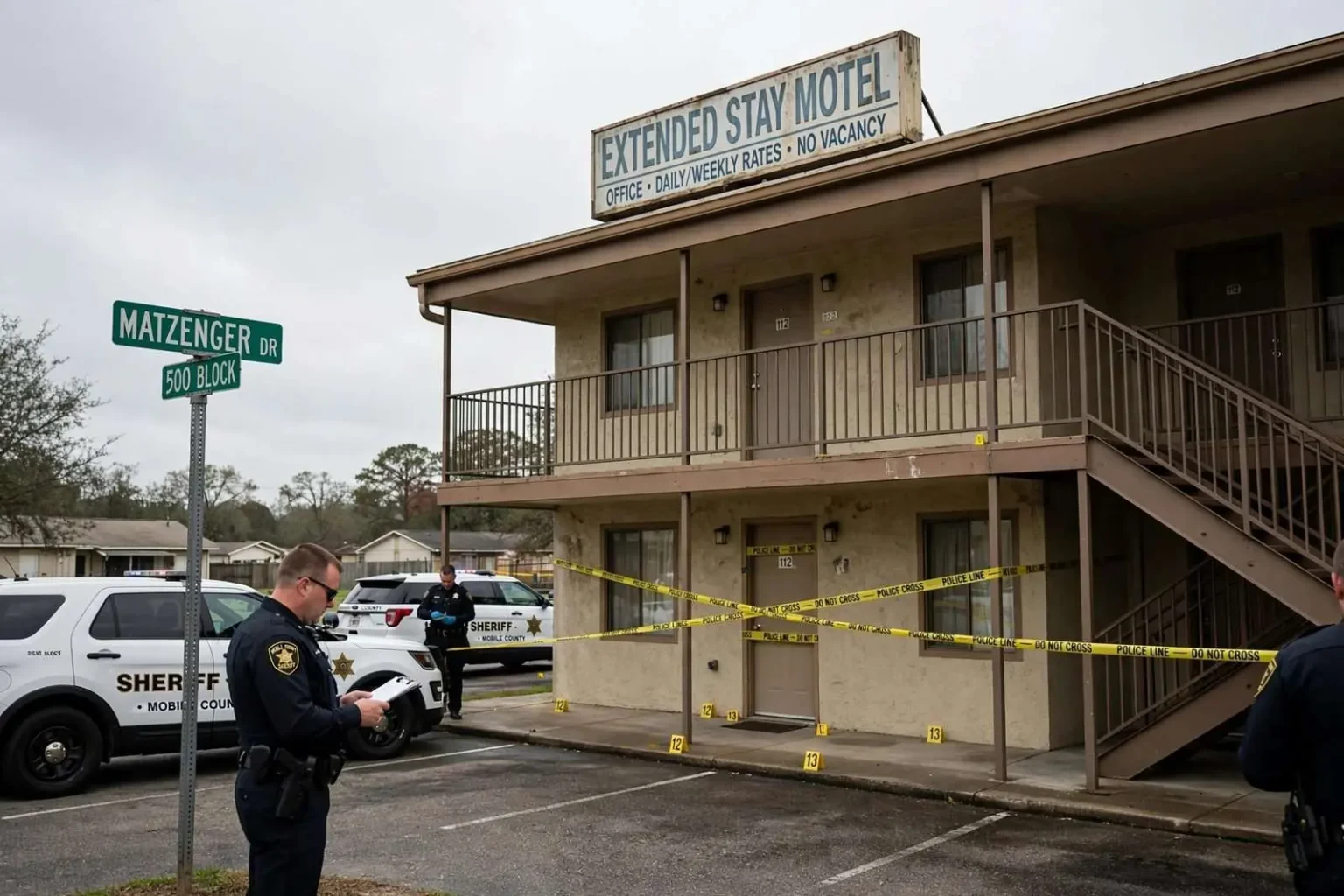
A Prichard man has been sentenced to 20 years in prison in connection with the July 4, 2025, shooting death of a woman he initially claimed had threatened him with a machete. Walter Thames, 76, was convicted of provocation manslaughter in the death of 65-year-old Patricia Odoms and received the maximum sentence available for the offense, closing a case that investigators said was defined not only by the killing itself but by the defendant’s effort to disguise what happened.
According to police, Thames was living at an extended stay motel on Matzenger Drive at the time of the shooting. Investigators said he shot Odoms with a shotgun at the motel and then staged the scene with a machete in an attempt to make the killing appear to be self-defense. That staging effort became a central theme of the prosecution, which argued that the physical evidence did not match the account Thames initially gave and that the machete had been positioned to support a story of imminent danger that never actually existed.
“Patricia Odoms lost her life because of the defendant’s actions, and we are pleased that he has been held accountable to the fullest extent of the law,” Mobile County District Attorney Keith Blackwood said following the sentencing. The statement from the prosecutor’s office underscored the view that the staged scene — and the initial claim that the victim had armed herself — made the case one that demanded the harshest available outcome rather than a reduced plea arrangement.
How Investigators Unraveled the Self-Defense Story
Staged crime scenes are among the most challenging investigations homicide detectives confront, because the first hours of such cases are shaped by the narrative the surviving party presents. In this case, investigators processed the motel unit, examined the position of the machete, and tested whether the physical evidence was consistent with a sudden, armed confrontation. Prosecutors presented that work to the jury as proof that the scene had been arranged after the shooting rather than during a struggle, converting the defendant’s own account from a defense into evidence of concealment.
The Fourth of July date added a layer of complexity that such cases often carry, since holiday fireworks and heightened activity around extended stay properties can complicate witness recollection and timing. Detectives ultimately assembled a timeline that allowed prosecutors to argue the shooting was not the spontaneous act the defense claimed, a conclusion the jury accepted in returning the provocation manslaughter verdict.
The Charge and the Maximum Sentence
Provocation manslaughter, sometimes described as heat-of-passage manslaughter, occupies a middle tier of Alabama’s homicide statutes: the state proved the defendant caused the victim’s death, but under circumstances the law treats as less culpable than intentional murder. The offense is a felony carrying a maximum term of 20 years in prison, which is why the sentence imposed represents the fullest punishment the law allows for the conviction. Judges in such cases weigh the facts of the killing, the defendant’s conduct after the fact and his criminal history when deciding where within the range the sentence should fall.
Court records show Thames had a criminal history dating back to 1985, with previous arrests including assault, domestic violence, menacing, criminal possession of a forged instrument, carrying a pistol without a permit and public intoxication. That four-decade record, spanning offenses against persons as well as property and weapons violations, formed part of the sentencing picture and supported the prosecution’s argument that the maximum term was warranted. A record of that length also matters under Alabama sentencing practice, where repeat offenders generally face stricter treatment than first-time defendants.
Prichard and the Motel Setting
The shooting occurred in Prichard, a city of roughly 20,000 residents in Mobile County that borders Mobile’s northern city limits. Prichard has worked for years to address violent crime through cooperation between its own police department, the Mobile County District Attorney’s Office and neighboring agencies, and extended stay motels along the area’s commercial strips have repeatedly surfaced in local crime reporting as locations where transient living arrangements can place residents and visitors at elevated risk. The Matzenger Drive area, like much of the city, is covered by a mix of local patrol and county-level investigative resources when major felonies occur.
About the Mobile Police Department
The Mobile Police Department is the law enforcement agency responsible for policing Alabama’s third-largest city. MPD investigates crimes ranging from property offenses to violent felonies, and it routinely asks members of the public to share tips that may aid an investigation. The department works alongside the Mobile County District Attorney’s Office, which prosecutes state criminal cases, and with state and federal agencies on matters that cross jurisdictional lines.
Residents can report non-emergency information through the department’s tip line and through national crime-reporting programs. In homicide cases such as this one, cooperation among municipal departments is routine: a crime that begins with one agency’s patrol response often passes to joint investigators, forensic technicians and prosecutors who handle the county’s most serious offenses. The District Attorney’s Office, led by Blackwood, has made violent-crime prosecution a signature priority, and cases involving staged scenes or misleading statements to police are typically pursued aggressively.
About Alabama’s Courts
Alabama’s judicial system includes trial courts, the Court of Civil Appeals and Court of Criminal Appeals, the state Supreme Court, and a network of district and circuit courts that handle matters ranging from traffic offenses to capital murder. Felony prosecutions in Mobile County begin in Mobile County District Court for preliminary proceedings before moving to Circuit Court, where jury trials are held and sentences are imposed. The Court of Criminal Appeals reviews challenges to convictions and sentences in felony cases, and defendants retain further appellate rights through petition for certiorari to the Alabama Supreme Court.
A case like Thames’s typically spends more than a year moving from arrest to sentencing, passing through grand jury review, arraignment, motion practice and trial before a judge imposes punishment. The 20-year sentence in this case, at the ceiling of the offense range, reflects both the jury’s verdict and the sentencing factors the court weighed — including the staged scene and the defendant’s criminal history dating back to 1985.
What Comes Next
With sentencing complete, the case moves into the post-judgment phase, where the defendant may pursue an appeal, and the sentence will be administered through the Alabama Department of Corrections. For the victim’s family, the verdict and maximum sentence represent the conclusion of a process that began with a holiday-weekend shooting at a Matzenger Drive motel and ended with a jury’s rejection of the self-defense claim. Prosecutors in Mobile County say cases in which crime scenes are manipulated remain among the most serious they handle, precisely because they mislead investigators and delay accountability for the person whose life was taken.
The Human Cost Behind the Verdict
Patricia Odoms was 65 years old, and the circumstances of her death — on a holiday weekend, at the hands of a man who then arranged the scene to cast himself as the victim — left investigators and prosecutors alike describing the case as particularly troubling. In the months between the July 4, 2025, shooting and the sentencing, her family followed the case through each stage of the criminal process, from the initial investigation at the Matzenger Drive motel through trial and the imposition of the maximum term. Advocates for victims of violence in Mobile County note that staged-scene cases tend to prolong grief for families, because early reports often repeat the surviving party’s account before forensic work corrects the record.
The outcome also reflects the work of the Mobile County District Attorney’s Office, which prosecutes the county’s homicide cases and has emphasized accountability in cases involving elderly defendants just as it does for younger ones. The office’s trial team presented the physical evidence, the defendant’s initial statements and the record of his four-decade criminal history, and the jury’s verdict of provocation manslaughter preserved the distinction the defense sought while still confirming responsibility for the death.
A Larger Pattern: Staged Scenes and False Claims
Law enforcement officials across Alabama regularly caution that initial accounts from people found at a death scene — particularly when that person later becomes a suspect — must be tested against forensic evidence rather than taken at face value. Claiming that a victim was armed, as Thames did with the machete story, is a recognized pattern in staged homicides, and investigators are trained to look for inconsistencies such as the absence of defensive wounds, the position of claimed weapons, and evidence of movement after a shooting. When those inconsistencies emerge, prosecutors can use them to dismantle a self-defense claim and to argue that the staging itself demonstrates consciousness of guilt.
For residents of Prichard and the wider Mobile County area, the case is a reminder that violent crime on the county’s northern side is investigated with the same forensic rigor applied in the city of Mobile, and that claims made in the first hours after a killing rarely survive contact with ballistics, scene reconstruction and witness interviews. The 20-year sentence now on the books in this case represents the maximum the provocation manslaughter statute permits; had the jury accepted the prosecution’s view that the killing rose to the level of intentional murder, the exposure would have been substantially greater.
As the case moves toward appeal or the start of the sentence, the Mobile County District Attorney’s Office says its message is unchanged: those who take a life and then attempt to obscure their responsibility will be pursued to the fullest extent the law provides, whatever their age or the setting in which the crime occurred.


