Prichard Hosts National Night Out to Build Police-Community Ties
Prichard held its annual National Night Out event at Prichard Stadium, offering food and activities to strengthen police-community ties citywide.
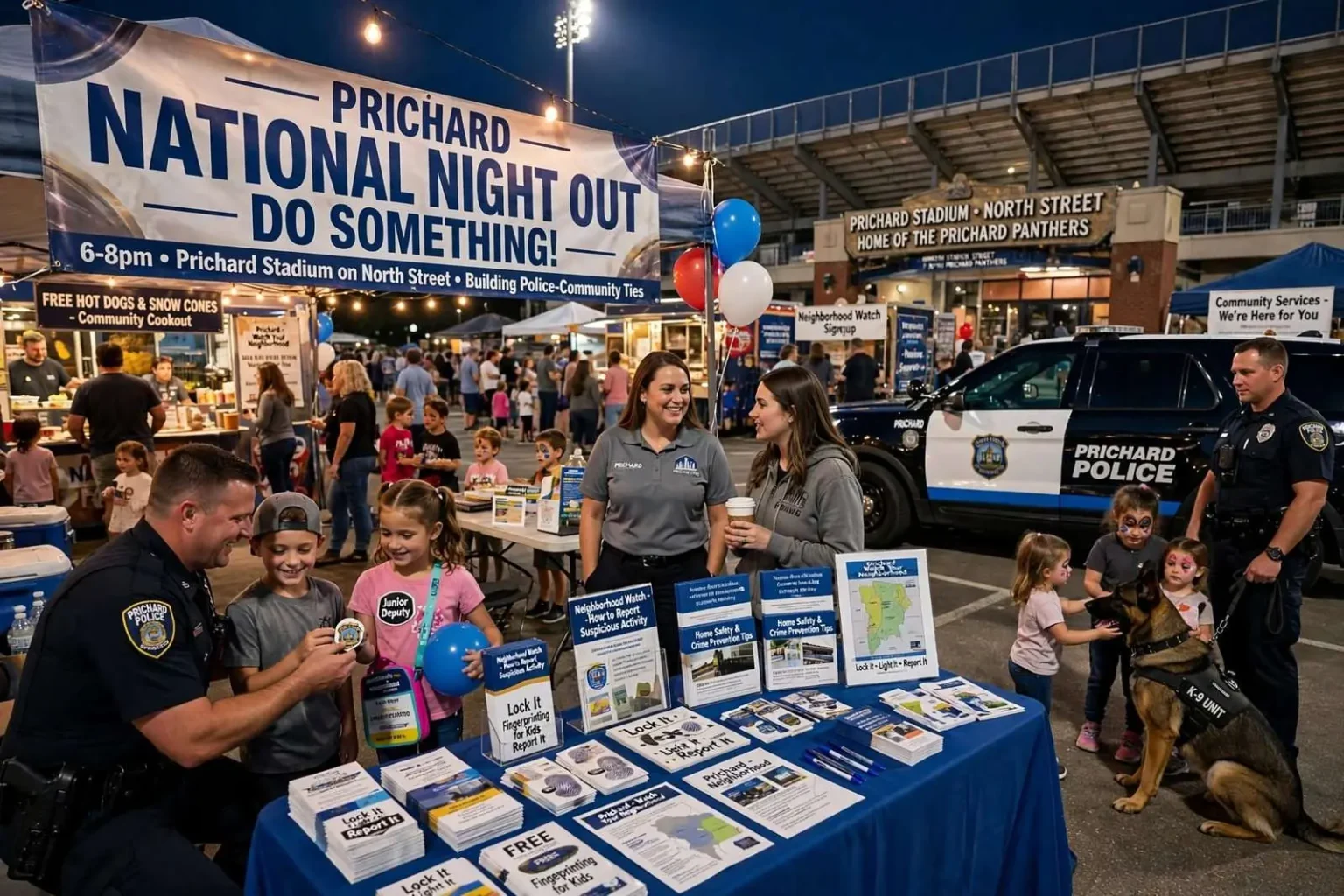
Prichard officials invited residents to join police and city staff this week for the city’s annual National Night Out event, part of a nationwide campaign aimed at strengthening relationships between law enforcement and the communities they serve. The event ran under the theme “Do Something!” and was held from 6 to 8 p.m. at Prichard Stadium on North Street, where authorities offered food, activities and crime prevention information to attendees.
National Night Out has grown into one of the largest community-building campaigns in the United States since its founding in the early 1980s, when a Pennsylvania man named Matt Peskin launched what began as a modest effort to get neighbors to turn on porch lights and spend an evening outside together. Four decades later, the event draws tens of millions of participants across thousands of communities each year, with police departments using the evening to step out of patrol cars and meet residents on neutral, friendly ground.
City officials said the event was designed to give community members a chance to engage directly with police in a casual setting, away from the context of emergency calls or enforcement actions. A city spokeswoman said the gathering was intended to help make Prichard “a safer and vibrant community” by fostering trust and open communication between residents and the officers who patrol their neighborhoods.
Prichard’s event was one of roughly 16,500 similar gatherings held in cities across the country as part of the 31st annual National Night Out, a campaign that began in the early 1980s and has grown into one of the most widely observed community policing events in the nation. The national campaign is coordinated by an association focused on neighborhood crime watch programs, with support from a range of corporate sponsors that provide resources for local events.
Why National Night Out Matters in Prichard
Cities of all sizes typically use the evening to showcase community policing initiatives, introduce residents to patrol officers and specialty units, and distribute information about home and neighborhood safety. Displays often include patrol vehicles, K-9 demonstrations when departments field them, fingerprint kits for children, and booths where residents can sign up for neighborhood watch programs or learn how to report crimes anonymously.
For Prichard, a city that has periodically grappled with public safety and staffing challenges within its police department, officials framed the event as part of an ongoing effort to rebuild trust and visibility between officers and the neighborhoods they serve. Prichard, a city of roughly 22,000 residents squeezed between Mobile and Chickasaw along the Gulf Coast, has seen its police department weather budget pressures and turnover that make community relationships both harder to maintain and more important to preserve.
The “Do Something!” theme reflected the campaign’s core message that public safety is a shared responsibility. Organizers of National Night Out events across the country use the theme to push back against the bystander effect — the tendency of residents to assume someone else will report the suspicious car, the vacant house being stripped of copper, or the drug activity on the corner. In a city Prichard’s size, where neighbors know each other, that call to action carries particular weight.
Community Policing in the Mobile County Context
Similar events have become an annual fixture in cities throughout Mobile County, including in Mobile and other municipalities, as part of broader efforts to encourage community engagement with local law enforcement. On a typical National Night Out evening, the county’s departments — from the large Mobile Police Department to small town forces across the county — host block parties, cookouts, and stadium gatherings where the day’s usual adversarial dynamics are set aside in favor of conversation.
The regional participation matters because crime does not respect municipal lines. Prichard’s borders touch Mobile, Chickasaw, and unincorporated Mobile County, and issues like burglary, drug activity, and youth crime flow across those boundaries. An evening that builds trust between residents and officers in one city strengthens the network of cooperation that police across the county rely on when cases cross jurisdictions — witnesses who will talk, tips that come in, and neighborhood watch groups that share information.
Prichard Stadium, the event’s host site on North Street, has long served as one of the city’s central gathering places, making it a natural venue for an event meant to draw families rather than just the civically engaged few. Events staged at familiar recreation sites tend to attract children and parents who might never attend a city council meeting or a formal police forum — precisely the audience community policing outreach hopes to reach.
The Challenges Behind the Outreach
Prichard’s push to rebuild trust comes against real headwinds. The city has in recent years struggled with the kind of fiscal constraints that hit small Alabama municipalities hard, and its police department has at times operated below full strength, stretched patrols, and relied on mutual aid from neighboring agencies. Departments in that position find community events doubly important: each positive contact with a resident is an investment in the cooperation that stretches thin patrol coverage further.
Research on community policing consistently finds that residents’ willingness to report crime, serve as witnesses, and work with investigators depends far more on day-to-day relationships with officers than on formal programs alone. A child who climbs on a patrol truck at National Night Out, or a homeowner who meets the officer who covers her street over a plate of food, is measurably more likely to call when something is wrong. That is the mechanism officials cite when they defend spending an evening on hot dogs and face painting.
National Night Out also functions as a recruiting showcase for departments struggling to fill positions. Young people who encounter officers in a positive setting are more likely to consider law enforcement careers, and departments across Mobile County have used the event to distribute hiring information alongside crime prevention materials. For a department like Prichard’s, every recruit matters.
What Residents Took Away
For the residents who came out to Prichard Stadium, the evening offered the simple things the campaign was built on: food, activities for children, and the chance to put faces with badges. Organizers distributed crime prevention literature covering home security, neighborhood watch formation, and how to report suspicious activity — practical tools that translate the “Do Something!” slogan into specific behaviors.
City officials have long said the measure of the event is not the turnout on a single Tuesday night in August but the follow-through: neighborhood watch groups that keep meeting, residents who call in tips, and officers who follow up on concerns first raised over a folding table. Prichard’s annual observance remains one of the city’s most visible commitments to that ongoing work, and officials closed this year’s edition with the same invitation they extend every August — come out next year, meet your officers, and do something.
Safety Information Residents Took Home
The crime prevention materials distributed at events like Prichard’s cover the practical basics that neighborhood organizations say make the difference year-round: locking vehicles and removing valuables, lighting homes and driveways, recording serial numbers on electronics and tools, and forming block-level watch groups with a designated contact who communicates directly with the department’s community services officers. Officers staffing the booths answered questions about everything from suspicious-vehicle reporting to how the department handles domestic violence calls.
Children’s activities are a deliberate part of the formula as well. Fingerprint kits, bicycle safety demonstrations, and the chance to explore patrol vehicles give young residents a positive, memorable interaction with police at an age where those impressions form. Departments across the country credit that early-contact strategy with building the reserve of goodwill that pays off a decade later when those children are teenagers who see officers as approachable rather than adversarial.
An Annual Fixture on the Gulf Coast Calendar
Prichard has hosted National Night Out events for years, and the first Tuesday in August has become a standing date on the civic calendars of cities across Mobile County and Baldwin County alike. In smaller municipalities, the events often double as de facto town halls, where the mayor, council members, and department heads mingle with residents alongside the police — giving the evening a civic dimension that goes beyond law enforcement alone.
The 31st annual edition of the campaign that Prichard joined reflects how durable the idea has proven. What started with neighbors turning on porch lights in a Philadelphia suburb evolved into a national network of block parties backed by corporate sponsors and coordinated from a single national office. Communities register each year, receive planning kits, and compete informally for recognition of the best-organized events, giving even small cities a framework that costs little but delivers consistent visibility.
For Prichard officials, the message they hoped residents carried home from Prichard Stadium was the one written into the theme: safety is something the community does, not something that is done for it. The two hours of food, activities, and conversation at North Street’s stadium were designed as the annual reminder of that partnership — and an open invitation for residents to keep practicing it long after the booths came down.