Project Search Graduates Land Jobs at Downtown Mobile Hotels After Year-Long Training Program
Thirteen students with special needs graduated from Mobile County's Project Search program after a year of hands-on job training at the Battle House and Renaissance Riverview Plaza hotels, with five already hired.
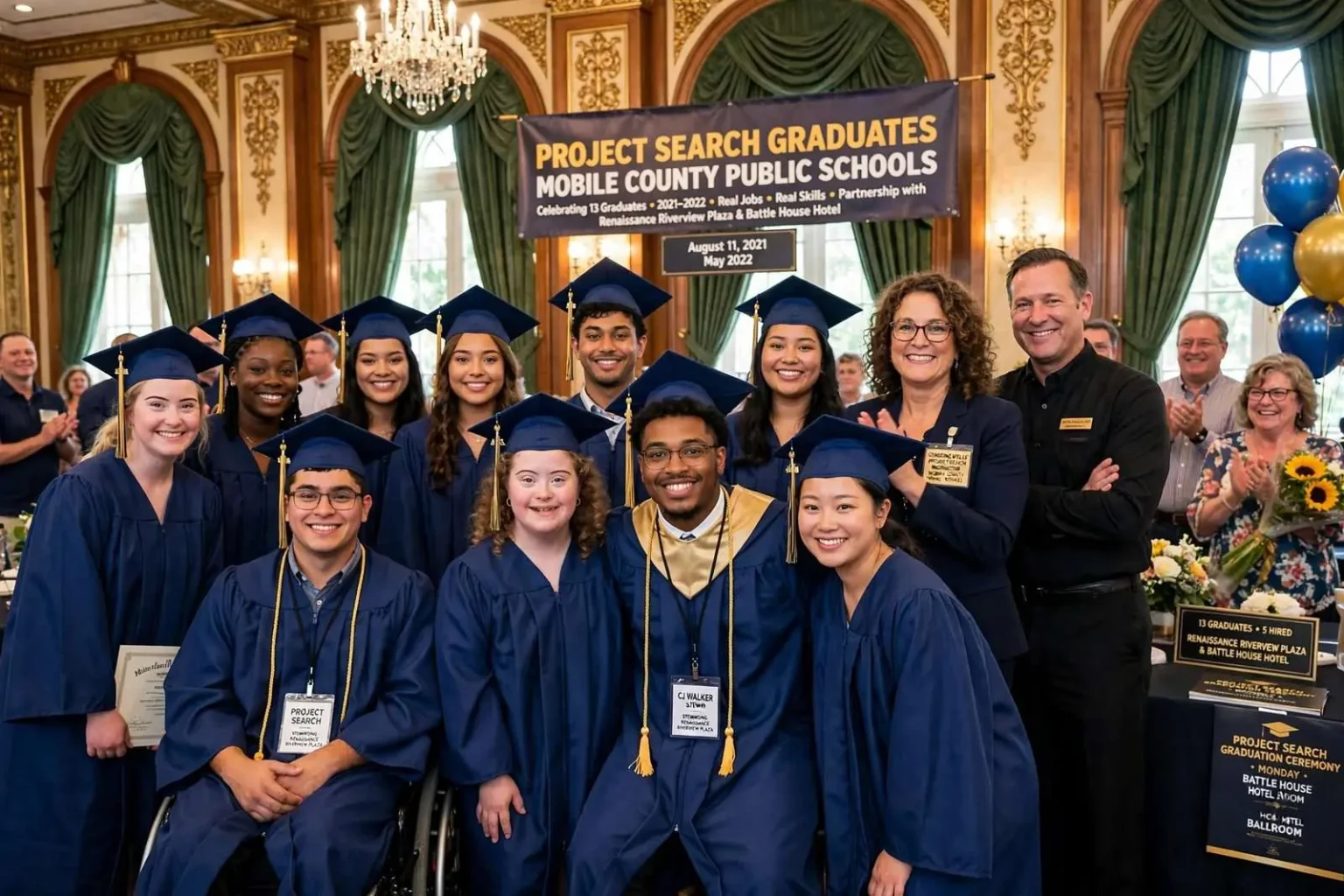
Inside a ballroom at Mobile’s Battle House Hotel, friends and family gathered on a Monday to celebrate a milestone: 13 graduates completing Project Search, a Mobile County Public School program designed to help students with special needs prepare for the workforce. The ceremony capped a school year in which the graduates traded classrooms for the corridors, kitchens and conference floors of two of downtown Mobile’s largest hotels.
Over the course of the school year, the graduates spent their time working and learning job skills at two Downtown Mobile hotels, the Renaissance Riverview Plaza and the Battle House. The pairing gave students exposure to the full rhythm of large-scale hotel operations, from early-morning housekeeping rounds to the evening rush of banquet service, in two properties that anchor the city’s convention and visitor economy.
The goal of the program is to give students with special needs hands-on training in real workplace settings, building the kind of experience and confidence that can translate directly into employment after graduation. Rather than simulating job skills in a classroom, Project Search places students inside actual businesses, where the expectations, routines and social demands of a working environment become part of the daily curriculum.
The ceremony itself carried a meaning beyond the individual diplomas. For the families in that ballroom, watching a son or daughter complete a year of real employment training represents an answer to a question many parents of children with special needs carry for years: what happens after school ends? Monday offered a visible, working reply from 13 young people who had proven the answer could be a job.
“This program was amazing,” said CJ Walker, one of the Project Search graduates. “It was amazing since August the 11th 2021.” His dates bookend the program precisely — the first day of the school year through Monday’s celebration — and his enthusiasm reflected the sense of ownership the graduates develop over their workplaces during nine months of immersion.
Walker’s journey through the program illustrates how it is designed to work. He began in the hotel’s housekeeping department, working alongside a mentor to learn how to properly clean rooms. Housekeeping is among the most physically demanding and detail-driven jobs in any hotel, and mastering it — cart setup, room sequence, inspection standards — builds exactly the kind of workplace discipline employers look for.
He performed well enough that the hotel later hired him to work in the restaurant instead, where he now works as a steward. The move from trainee to paid employee across departments demonstrates the core promise of the model: when students prove themselves in one role, employers discover capabilities that open other doors.
“I am in the kitchen as a steward and so I wipe the dishes and I check the pots and pans, dirty dishes and plates and silverware,” he said. It is the work of a real job with real standards, in a kitchen that serves a historic hotel’s restaurants and banquets, and Walker described it with the matter-of-fact pride of someone who knows his work matters to the operation.
Participants in the program spent the majority of the school year actually working inside the hotels, while the remaining time was spent with Project Search instructors covering additional job skills. The balance is deliberate: most of the learning happens on the floor, under the same supervisors and coworkers who would manage any new employee, while classroom sessions reinforce the softer skills — communication, punctuality, workplace problem-solving — that determine whether a job lasts.
Of the 13 students who completed the program this year, five have already been hired at the two hotels where they trained. A placement rate near 40 percent within the program year itself is the kind of outcome that employment programs for people with disabilities rarely achieve, and additional hires often follow in the months after graduation as employers finalize their staffing plans.
“That’s why we work with them all year about is to get them employment and it’s awesome to watch them grow in this process and get their jobs,” said Christine Wells, a Project Search instructor. Her description captures the dual arc of the program year: the practical work of building employment, and the visible transformation of students who arrive uncertain and leave as working members of a staff.
A national model with a decade in Mobile
Project Search is a nationwide program, operating in more than 200 locations across 43 states. Founded in Cincinnati and built around the idea that businesses, schools and disability services agencies should share the work of preparing young people for employment, the model has been adopted by hospitals, hotels, government offices and corporations around the country.
It has had a presence in Mobile County for the past decade, though this marks the first year the program has placed students at the two downtown hotels. The partnership with the Renaissance Riverview Plaza and the Battle House gave the local program one of its most high-profile business settings to date, and gave the hotels a structured pipeline of motivated trainees for departments that constantly need reliable hands.
For the hospitality industry, the fit is natural. Hotels run on clearly defined tasks, teams that depend on one another, and a constant demand for dependable workers in housekeeping, stewarding, laundry and food service. Those same characteristics — defined routines, visible results, supportive teams — are exactly what make hotel departments effective training environments for workers with intellectual and developmental disabilities.
The Battle House itself carries weight in Mobile’s history. The hotel traces its roots to the mid-nineteenth century and reopened in its modern form in 2008 after a celebrated restoration, making Monday’s ceremony one more event in a ballroom that has hosted the city’s gatherings for generations. Graduating a class of new workers inside those walls connected the program to downtown Mobile’s ongoing story.
The stakes for graduates of programs like this one are substantial. National employment statistics have long shown that working-age adults with disabilities are employed at far lower rates than their peers without disabilities, and that the gap widens for young adults just entering the labor market. Programs that produce actual jobs — not just certificates — attack that gap at the moment it opens, between leaving school and finding a first employer.
School systems have a structural reason to invest in such programs as well. Federal special education law emphasizes transition planning, requiring schools to prepare students with disabilities for life after graduation, and employment-focused models like Project Search have become among the most effective tools school districts have for meeting that obligation in a measurable way.
The mentors and managers inside the hotels get something out of the arrangement too. Supervisors who train Project Search interns consistently report that the structured coaching the program requires makes their whole teams better at communicating and delegating, and coworkers frequently describe the pride of watching a trainee they mentored join the payroll. The five graduates already hired will now be colleagues, not visitors.
Employers across the region will be watching the results as well. Downtown Mobile has invested heavily in its hospitality corridor in recent years, and a demonstrated pipeline of well-trained, job-ready workers with special needs gives other businesses — restaurants, offices, retailers — a working example to copy. Programs like this one tend to expand the way the hotel partnership did: one employer takes the chance, succeeds, and the model spreads.
Monday’s celebration followed the shape of a graduation even though none of it happened on a school campus. Families filled the ballroom, instructors spoke about individual students’ growth, and the hotels’ own leadership had reason to take the stage — the properties were, in effect, hosting a commencement for their newest employees.
What comes next for the graduates
For the five already hired, the transition from intern to employee means real wages, real schedules and the independence that comes with both. A paycheck from a downtown hotel changes more than a young worker’s bank account; it changes how the whole family plans for the future, from transportation to living arrangements to long-term goals.
For the other eight graduates, the search for employment continues with a significant advantage: nearly a year of verified work experience, references from supervisors at two major hotels, and a program staff that remains invested in their placement. Employment specialists connected to Project Search typically keep working with graduates until jobs are secured, extending the program’s support beyond the ceremony itself.
Walker’s advice to students considering applying in future years was embedded in his own story — start where you are, do the work in front of you, and let the results speak. A student who arrived in August knowing little about the hotel industry finished it as a steward in a landmark restaurant kitchen, one of 13 graduates whose year at the Renaissance Riverview Plaza and the Battle House ended with the whole city watching them move forward.