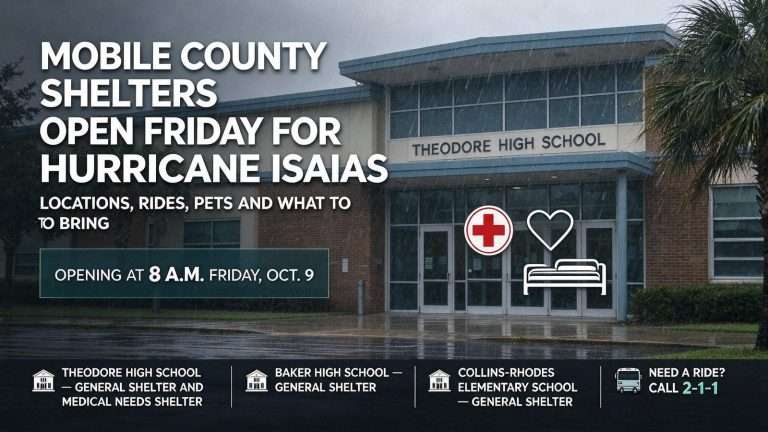
Red Cross Opens Storm Evacuation Shelter at Theodore High School
The American Red Cross opened a storm evacuation shelter at Theodore High School with staffing, meals, and damage teams on standby.
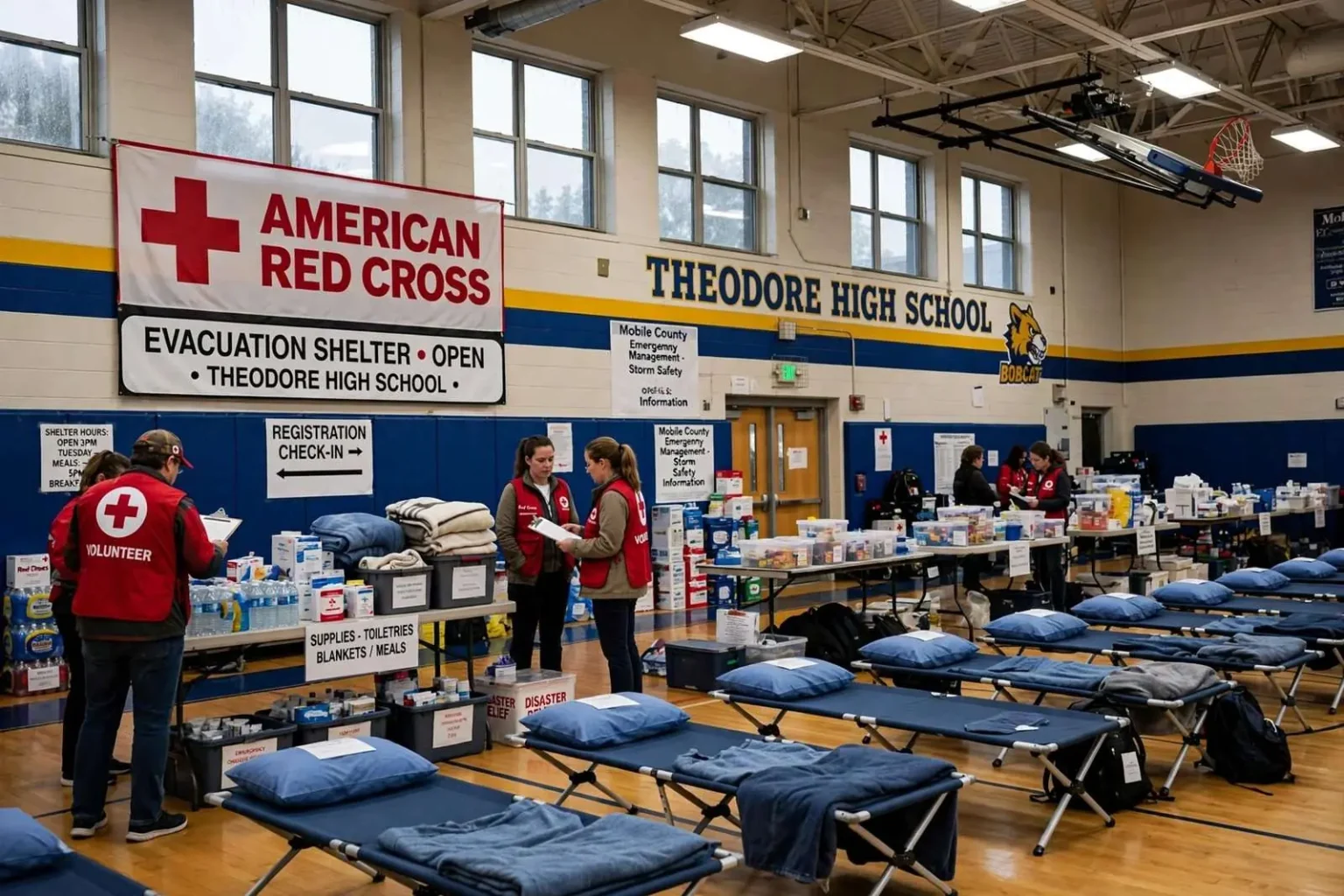
The American Red Cross opened an evacuation shelter at Theodore High School as a Gulf storm system threatened the Alabama coast, giving residents in low-lying areas a place to ride out the weather. The opening put one of the region’s largest public schools into its secondary role as a refuge — a function Gulf Coast schools have performed for generations, when tropical weather turns the communities nearest Mobile Bay into places to leave rather than places to stay.
Doors at the school opened at 3 p.m. on a Tuesday afternoon, with shelter staffing already in place, according to the organization’s announcement. The timeline reflects the way Red Cross shelter operations are built to move. Volunteers and staff pre-position before a shelter opens, cots and supplies are staged in advance, and the decision to open comes when forecast timing makes the facility’s location and capacity the right answer for the population it serves. By the time the doors opened Tuesday, the operation was already running.
Officials said impacts from the storm overnight would determine how long the shelter stayed open. That uncertainty is built into every coastal shelter activation. A system that tracks east or weakens overnight can allow the shelter to close within a day; a slow-moving or strengthening system can keep it operating for days, feeding and housing hundreds of evacuees whose neighborhoods are flooded or without power. The staffing plan, like the doors, stays open as long as the situation requires.
Why Theodore High School
The choice of Theodore High School follows the logic that governs shelter siting across the Gulf Coast. Theodore sits south of Mobile along the western shore of Mobile Bay, in one of the parts of Mobile County most exposed to storm surge and flash flooding from Gulf systems. Its low-lying neighborhoods are among the first places county officials watch when tropical weather enters the Gulf, and the high school — a large, modern, publicly owned building set back from the flood-prone corridors — offers the combination a shelter needs: capacity, kitchens, restrooms, backup infrastructure and a location residents can reach without driving far.
Schools have long anchored the region’s shelter network for the same reasons. Public school buildings are constructed to demanding structural standards, they sit on high ground relative to the neighborhoods around them, and their cafeterias and gymnasiums convert quickly into feeding and sleeping operations. On the Gulf Coast, the arrangement is so familiar that residents typically know which schools in their area serve as shelters before a storm ever forms.
For evacuees, a neighborhood shelter removes the hardest part of an evacuation decision. Residents of low-lying areas often hesitate to leave because travel — to hotels, to family inland, out of the region entirely — is expensive and uncertain. A shelter within a short drive lets a family ride out the storm in safety without leaving the county, keeping jobs, pets and familiar ground within reach while the weather passes.
Meals and storm response staged
A feeding plan was set to activate for dinner the following evening, along with breakfast Wednesday if the shelter’s timeline extended that far. Feeding operations are among the largest logistical components of any Red Cross shelter. Cots and blankets solve the problem of where evacuees sleep; meals solve the problem of what hundreds of people eat, twice or three times a day, in a building whose kitchen may or may not be staffed by its usual crew. Mobile feeding units, local partners and Red Cross volunteers coordinate those deliveries in advance so that meals arrive on schedule whether the shelter holds a few dozen residents or several hundred.
Red Cross teams also planned to staff the Division A Emergency Operations Center if it activated, and to support the Mobile County EOC starting the next afternoon. The presence of Red Cross liaisons inside emergency operations centers is a standard feature of Gulf Coast storm response. The EOC is where county emergency management, sheriff’s deputies, fire services, public works and state agencies coordinate; a Red Cross seat at the table lets shelter operations — openings, closures, capacity, feeding — adjust in real time to what road crews and first responders are seeing in the field.
Damage assessment teams were placed on standby to begin work as soon as the weather cleared Wednesday. Assessment is the first step in every recovery: trained volunteers move through affected neighborhoods, documenting damaged homes and unmet needs so that assistance can flow to where it is actually required. The standby posture matters because the information is most valuable when it arrives quickly — while evacuees are still in shelters and emergency managers are still deciding what the next day’s response looks like.
Reading the storm
The shelter opening was part of a broader coastal preparation effort as forecasters tracked tropical development in the Gulf of Mexico. Gulf storms are notoriously difficult to pin down in their early days — the same system that forecasters initially project toward one stretch of coastline can drift hundreds of miles before landfall — and the region’s response doctrine is built around that uncertainty. Preparations begin on the forecast, not on the guarantee: shelters stage, crews mobilize and officials brief the public on the assumption that the track will be wrong in some direction that matters.
That posture has been refined by decades of Gulf Coast hurricanes, from the major storms that reshaped the coast to the smaller systems that flood neighborhoods without making national news. Mobile County’s emergency management structure — county and municipal emergency agencies, the EOC, pre-identified shelters, mutual aid from neighboring counties — exists precisely so that a storm watch does not have to be improvised. When the Red Cross opens a shelter at Theodore High School on a Tuesday afternoon, it is the visible tip of a plan that was written years ago and rehearsed repeatedly since.
The forecast context also shapes the public messaging. Officials urging Mobile County residents in flood-prone spots to take the storm seriously and know their evacuation options are addressing the region’s most persistent preparedness problem: the residents who live in surge zones but have ridden out previous storms and see no reason to leave this time. Emergency managers describe that habit — riding it out — as the behavior they most want to change, because surge and freshwater flooding are the region’s deadliest storm hazards, more lethal than wind.
Knowing your evacuation options
For residents of low-lying areas, the practical advice is straightforward. Know in advance whether your home sits in an area that floods when Gulf systems arrive — county evacuation zone maps are published and searchable, and the zones are based on surge vulnerability rather than property lines. Know where you would go: the neighborhood shelter, a relative’s house on higher ground, or a hotel inland. Keep a kit assembled — medications, documents, phone chargers, several days of water and food — so that the decision to leave can be executed in minutes rather than hours.
The shelter itself is the backstop, not the first choice. Red Cross shelters provide for basic needs — a cot, meals, information — but emergency managers consistently urge residents who have friends or family on higher ground to go there instead, saving shelter capacity for those who have nowhere else. The system works as a cascade: home if it is safe, family or friends if it is not, and the school gymnasium as the floor beneath everyone who has neither.
Volunteers behind the cots
The staffing that made the Tuesday opening possible represents the other half of the Red Cross’s coastal preparation. Shelter operations depend on trained volunteers — shelter managers, registration teams, health services workers, feeding crews — many of whom take disaster-response training and remain on call through hurricane season. When a storm enters the Gulf, those volunteers adjust their own lives: some drive toward the coast from inland chapters, some leave their own homes prepped and ready, and all of them work the long shifts that keep a shelter running through the night its community needs it.
The organization’s coordination with local government multiplies that capacity. The school system provides the building, county emergency management provides the operational picture, and local partners — churches, civic groups, restaurants and businesses — supply everything from extra meals to donated supplies. A shelter at Theodore High School is best understood as a coalition assembled in advance, with the Red Cross holding the pieces together once the doors open.
What happens after the wind stops
The day after a storm is when the response shifts. If the shelter’s evacuees come from flooded neighborhoods, Wednesday brings the first real information about what they are going home to — the damage assessment reports, the power outage maps, the photographs from first responders working the flooded roads. Shelter staff begin planning the transition from emergency housing to recovery casework, connecting displaced families with the assistance programs and community resources that carry them past the first week.
For the volunteers and officials involved, the Tuesday-to-Wednesday sequence is the routine they train for: open the shelter, feed the evacuees, staff the EOC, assess the damage, adjust. Whether this storm turns out to be a close call or a damaging landfall, the machinery put in place this week — cots at Theodore High School, meals staged for dinner and breakfast, assessment teams on standby — is the Gulf Coast’s standing answer to the question every hurricane season asks, and the reason residents of low-lying Mobile County can treat an evacuation order as a plan rather than a panic.