Red tide detected in Gulf waters off Baldwin County shore
The Alabama Department of Public Health says red tide cells have been found in water samples near Orange Beach and Gulf Shores.
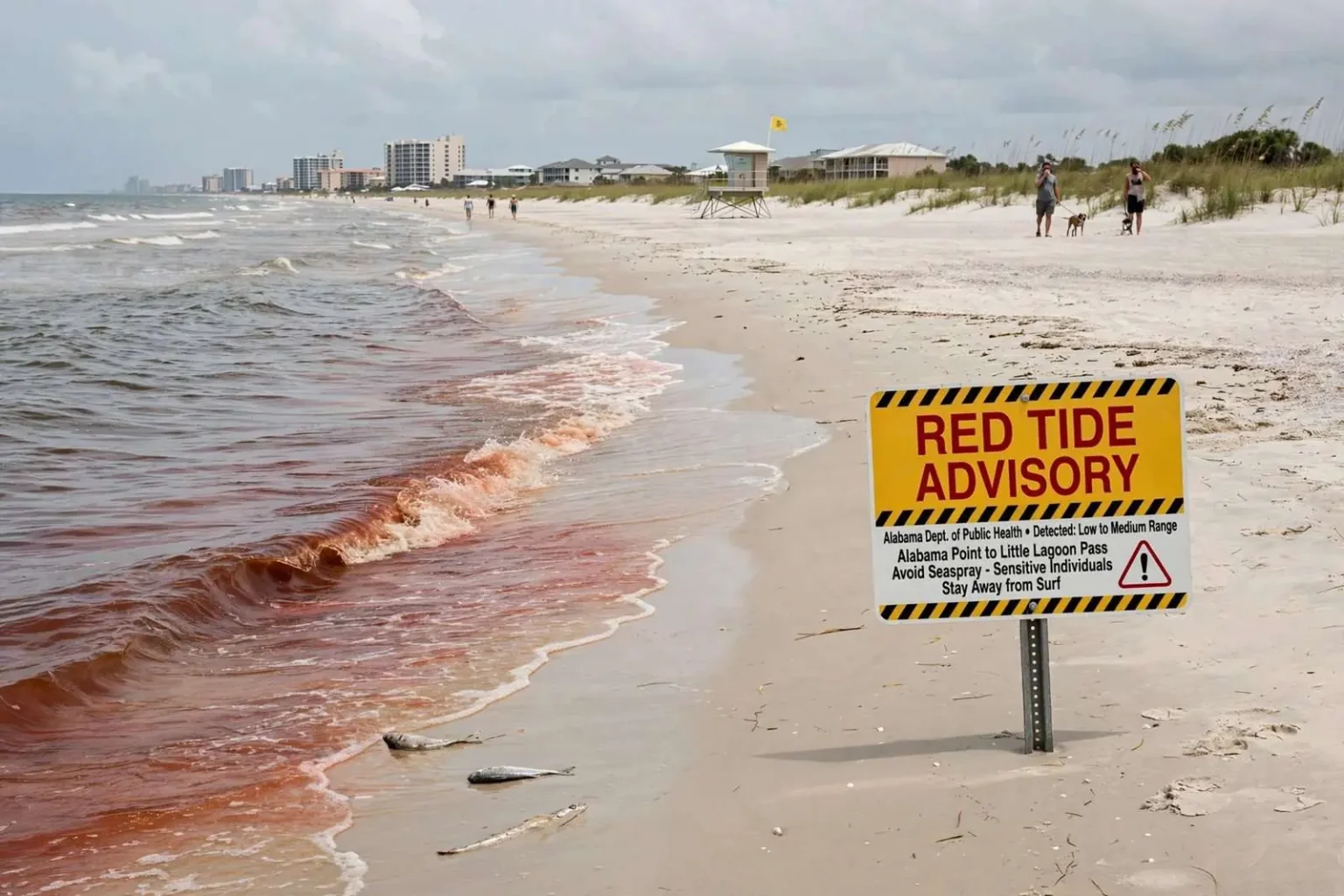
The Alabama Department of Public Health says red tide has been detected in water samples taken near Orange Beach and Gulf Shores. According to ADPH, samples collected from Alabama Point to Little Lagoon Pass showed the presence of red tide cells in the “low to medium range,” placing the coastal stretch that anchors Baldwin County’s beach tourism on the watch list even as the season continues drawing swimmers and anglers to the water.
Health officials are warning people with respiratory issues, or anyone experiencing throat, nose or eye irritation, to avoid any mist from the water. The advice reflects how red tide actually affects people: the organisms themselves are microscopic, but their toxins can become airborne in sea spray along the surf line, where winds blowing onshore carry the irritant to anyone on the beach — even those who never touch the water.
What red tide is
Red tide is a term for blooms of certain microscopic algae, most notably the dinoflagellate Karenia brevis in the Gulf of Mexico, that occur naturally in salt water. The organisms produce a powerful neurotoxin, brevetoxin, that affects the nervous systems of fish and can sicken people who inhale or, more rarely, consume contaminated seafood. At high concentrations the algae discolor the water in rust or reddish tones, which gave the phenomenon its name, though significant blooms can occur without any visible change in water color at all.
Along the Gulf Coast, blooms typically originate offshore in the eastern Gulf and are carried toward shore by winds and currents. When a bloom reaches the surf zone, wave action breaks the cells apart and releases the toxin into the air and water. That is why the effects of red tide are often described by beachgoers as feeling like a sudden allergy attack: a tickle in the throat, a runny nose, watering eyes and a dry cough that eases when the person moves away from the shoreline and returns when they come back to the beach.
Health guidance for residents and visitors
The Alabama Department of Public Health’s warning focuses on the mist from the water. People with asthma or other chronic respiratory conditions are the most vulnerable to airborne brevetoxin, and health officials recommend that they stay away from the beach during a bloom, or at minimum avoid the surf line where spray is heaviest. Anyone who develops throat, nose or eye irritation while at the beach should leave the immediate shoreline area, and symptoms typically subside once away from the mist.
For most healthy people, brief exposure causes short-lived irritation rather than lasting harm, and health authorities generally consider swimming in red tide water safe for most individuals, though some swimmers experience skin and eye irritation. Sensitive individuals — those with asthma, emphysema or other lung conditions, along with the very old and very young — are the groups for whom officials consistently advise caution.
Seafood safety is a separate concern. Recreational shellfish harvesting is regulated in Alabama waters, and commercially sold shellfish are tested and processed under monitoring programs before reaching the market, so red tide warnings are not a reason to avoid restaurant seafood. The toxin does not affect finfish flesh in ways that make properly handled fish unsafe to eat, though officials advise against harvesting or eating fish found dead on the beach during a fish kill.
Red tide has caused widespread problems along Florida’s coast over the summer, with large fish kills and noxious odors affecting beaches from Miami to Pensacola Beach. The Florida bloom has been severe enough to blanket some beaches with dead fish and drive visitors away from shorelines that anchor the state’s tourism economy, and the detection in Alabama waters raises the question every Baldwin County beach town watches each summer: whether the bloom will strengthen locally or drift back offshore.
The movement of a bloom is governed by wind and current, which makes forecasting its local intensity difficult. A persistent onshore wind piles the organisms against the coast and concentrates the airborne toxin along the beach, while an offshore or alongshore wind can clear the air within days. That variability is why conditions can change noticeably between a Tuesday and a Friday on the same stretch of sand.
How the monitoring works
Sampling along the coast is a routine part of how Alabama manages the risk. Water samples collected from Alabama Point — the pass that marks the boundary between Perdido Bay’s outlet and the Gulf at the Florida line — westward to Little Lagoon Pass near the western end of Gulf Shores are examined for the concentration of red tide cells. The “low to medium range” classification from the current samples indicates a bloom present at levels that can cause irritation for sensitive individuals, short of the high concentrations associated with major fish kills.
The effects on marine life depend on both concentration and duration. Fish kills occur when the toxin in the water overwhelms fish, which cannot escape a bloom the way people can walk off a beach. During significant blooms, Gulf Shoreline cleanup crews and municipal workers collect dead fish from the sand, and the smell of a substantial fish kill can carry well inland on an onshore breeze.
What it means for the beaches
For the communities of Gulf Shores and Orange Beach, a red tide detection is an economic concern as much as a health one. The Baldwin County beach towns host millions of visitors in a typical year, and the summer season is the heart of the calendar for the condominium, restaurant and charter fishing businesses that line the coast. Beach conditions pages run by local tourism officials, along with state monitoring updates, give visitors a way to check conditions before making the drive down the Fort Morgan Peninsula or onto the island.
Local officials’ usual posture during a low-to-medium bloom is caution rather than closure: beaches remain open, swimming is generally unaffected, and the practical advice is aimed at people with respiratory sensitivities and at keeping pets away from contaminated water and dead fish. Dogs that swim in red tide water or ingest dead fish can become seriously ill, so pet owners are advised to keep animals out of the surf during a bloom and rinse them off after any beach trip.
Boaters and anglers have more flexibility than beachgoers, since the airborne toxin concentrates along the breaking surf. Fishing a few hundred yards offshore often means clearer air, though anglers should avoid fishing in areas of discolored water or active fish kills and should never harvest or eat dead or dying fish.
The Alabama Department of Public Health continues to monitor the situation, and updates on sample results from the coast are released as new data comes in. In the meantime, officials’ guidance remains straightforward: people with respiratory issues, or anyone experiencing throat, nose or eye irritation at the beach, should avoid the mist from the water, and everyone should stay informed as conditions evolve along the coast from Alabama Point to Little Lagoon Pass.
Red tide is not new to the northern Gulf Coast. Blooms have been documented in the region for well over a century, appearing in some years and absent in others, with no reliable annual pattern. Scientists have linked the intensity and duration of individual blooms to a combination of factors — sea surface temperatures, salinity, winds and currents, and the nutrients available offshore — but no single cause has been identified, and blooms can intensify or dissipate quickly once they reach the shallow coastal waters along Baldwin County.
The geography of the Alabama coastline shapes how the phenomenon is experienced. The state’s beachfront runs along the Gulf from the Fort Morgan Peninsula, past the jetties at Perdido Pass, to the west end of Gulf Shores, and it is bracketed by the two passes named in the sampling program: Alabama Point on the east and Little Lagoon Pass on the west. Between them lies the developed beachfront of Gulf Shores and Orange Beach, where the surf zone is where residents and visitors most directly encounter the effects of a bloom.
Practical tips during a bloom
Residents and visitors can take a few simple steps to reduce exposure while a bloom is present. Check current beach conditions before heading out, and choose the time of day when winds are lightest, since a calm morning often means less spray. People who must be on the beach during a bloom — lifeguards, beach vendors, construction crews working near the shore — can reduce irritation by staying back from the waterline and taking breaks indoors. Contact lens wearers may find that glasses are more comfortable in the aerosolized toxin, and anyone who feels irritation coming on should simply move away from the surf.
Visitors staying in beachfront accommodations have the option of keeping windows closed and air conditioning running during peak spray periods, since the irritant is carried in the mist rather than in the general air. Those symptoms that do develop — coughing, sneezing, watery eyes — generally resolve quickly with fresh air away from the beach, and anyone with a respiratory condition who experiences worsening symptoms should follow their usual medical guidance.
The bottom line for the coast is watchfulness rather than alarm. The current detection spans Alabama Point to Little Lagoon Pass at low to medium concentrations, the health warning is aimed at the most sensitive beachgoers, and the same wind shifts that carried the bloom in can carry it out. Check conditions before a beach day, heed the advice about mist if you are sensitive, and keep pets out of the surf until the bloom passes.