River Falls police chief arrest: Covington County jail lists three tampering counts
River Falls' police chief was booked into the Covington County jail Monday on three counts of tampering with government records. Bail was set at $9,000, and the allegations are not yet public.
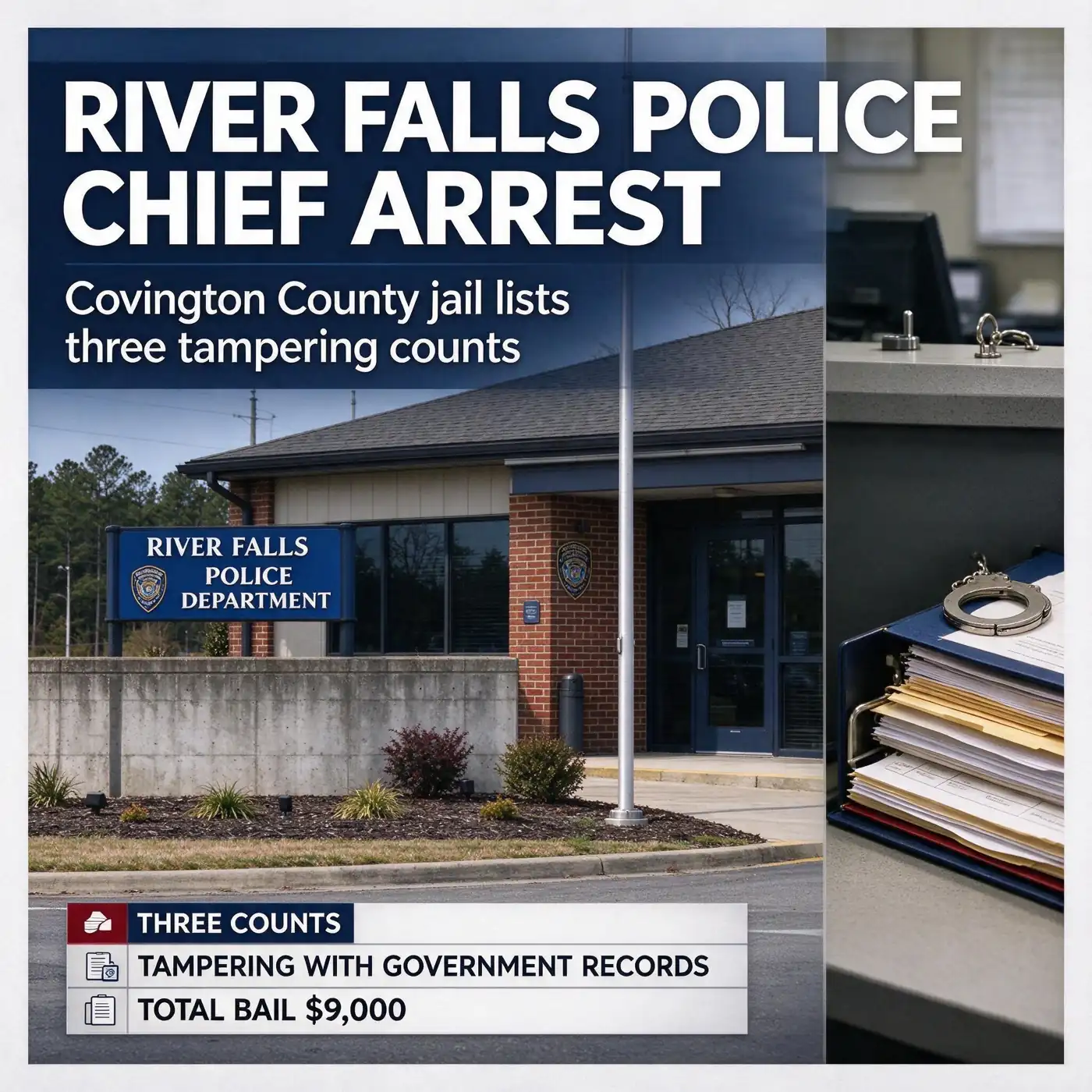
RIVER FALLS, Ala. — The man who leads the small Covington County town’s police force is now facing criminal charges himself. River Falls’ police chief was booked into the Covington County jail Monday morning on three counts of tampering with government records, and the River Falls police chief arrest leaves a sitting law enforcement leader on the other side of the booking desk.
What the chief is accused of doing has not been made public. Court filings in the case were not yet available Monday, and the jail log lists only the charges, the booking time and the bail amounts.
Key facts from the jail log
- Charges: Three counts of tampering with government records.
- Booking time: 9:51 a.m. Monday, Nov. 23, 2026.
- Source of record: The Covington County Sheriff’s Office jail log.
- Bail: $3,000 on each count, for a total of $9,000.
- Court records: Not yet posted, so the specific allegations remain unclear.
Like anyone charged with a crime, the chief is presumed innocent. A charge is an accusation, and the state would have to prove it in court.
Who is River Falls’ police chief?
The chief has led the River Falls Police Department for about a year. He was named to the post in November 2025. The arrest comes roughly one year into his tenure as the town’s top law enforcement officer.
Before taking over the town’s department, he spent time with the Covington County Sheriff’s Office. His roles there included a job at the county jail and service as a reserve deputy.
That background gives the chief long-standing ties to the same sheriff’s office that runs the jail where he was booked Monday. It is not clear whether the Covington County Sheriff’s Office or another agency investigated the allegations, and no agency had publicly described its role as of Monday.
Questions remain after the River Falls police chief arrest
Because charging documents were not yet on file in the state’s online court system, several basic questions remain unanswered. It is not known what records the chief is accused of tampering with, when the alleged conduct occurred, or who brought the case.
It is also unclear what the arrest means for the day-to-day running of the town’s police department. It was not immediately clear whether the chief would be placed on leave or who would oversee the department while the case is pending, and town leaders had not announced any change in the department’s leadership.
Those details may become clearer once court records are posted. In Alabama, criminal case filings are typically accessible through the state court system’s online records service, and charging documents usually describe the basic accusation behind each count. Filings can sometimes lag behind an arrest by a day or more while paperwork is processed and entered into the system, so a gap between a booking and the appearance of court records is not unusual on its own.
What tampering with government records means
Alabama’s criminal code includes an offense for tampering with governmental records. In general terms, the law is aimed at people who knowingly falsify, alter, destroy, hide or improperly remove official public records, or who otherwise interfere with the integrity of documents kept by government agencies.
Government records cover a wide range of material, from incident paperwork and evidence logs to time sheets, financial records and court paperwork. Because public agencies and the courts depend on those documents being accurate, the law treats interference with them as a crime.
The charge is often associated with public employees, since they have the most routine access to official records, but it is not limited to them. Without the charging documents, it is not possible to say which records are at issue in this case or how the alleged conduct is said to have happened.
How bail and the court process work
When someone is booked into an Alabama county jail, bail is commonly set by a schedule or by a judge or magistrate, depending on the charge. In this case, each of the three counts carried a $3,000 bail, bringing the total to $9,000.
Posting bail allows a defendant to be released while the case moves forward, usually with a promise to appear at future court dates. Bail is not a penalty or a finding of guilt; it is meant to ensure that a defendant returns to court. Alabama’s Constitution guarantees a right to bail for most defendants before trial, with narrow exceptions for the most serious offenses.
From here, the case will proceed through the Covington County court system. Depending on how the charges are classified, the case could be handled in district court or move on to a grand jury and circuit court, and the chief will have the opportunity to respond to the allegations with the help of a defense attorney.
Why accurate public records matter
Alabama’s Open Records Act gives residents a general right to inspect and copy public writings kept by state and local government, subject to certain exceptions. That law reflects a broader principle that government documents belong to the public and must be kept honestly.
For a police department, records carry particular weight. Arrest paperwork, evidence logs, incident files and personnel records can affect criminal cases in court, the rights of people who are arrested, insurance claims and the public’s ability to understand how its police force operates.
When questions are raised about whether official records were altered or mishandled, prosecutors and defense attorneys in other cases may also take a closer look at documents tied to the people involved. Whether that happens here will depend on what the allegations turn out to be, which has not yet been disclosed.
What the presumption of innocence means
Under American law, a person charged with a crime is presumed innocent until the government proves guilt beyond a reasonable doubt. That standard applies to everyone, including public officials and police officers.
An arrest means that law enforcement believed there was probable cause to bring charges, which is a much lower threshold than the proof needed for a conviction. Charges can be reduced, dismissed or resolved through a plea agreement, and a case can also go to trial, where a judge or jury decides the outcome.
Alabama classifies crimes as violations, misdemeanors or felonies, and the classification affects which court hears a case and the range of possible penalties. The jail log does not indicate how the three counts in this case are classified, and that information is expected to appear in court filings.
Why accountability for police leaders matters
Police chiefs hold significant public trust. They supervise officers, oversee how arrests and evidence are documented, and are often the public face of public safety in their communities.
In Alabama, law enforcement officers must be certified through the Alabama Peace Officers’ Standards and Training Commission, which sets training requirements and can take action on an officer’s certification in certain circumstances. Any review of that kind would be a separate process from the criminal case, and no such action has been announced.
In a small town, the arrest of a police chief can also raise practical concerns for residents, along with questions about public confidence in the department, such as who is answering calls and how ongoing cases are handled. Residents with an emergency should continue to call 911, and the Covington County Sheriff’s Office provides law enforcement services across the county.
A look at River Falls and Covington County
River Falls is a small town in Covington County in south-central Alabama, located near Andalusia, the county seat. Covington County sits along the Florida state line and is largely rural, with timber, farming and small businesses forming much of the local economy.
Small Alabama towns often rely on police departments with only a handful of officers, and the chief frequently handles both administrative duties and regular patrol work. In such departments, the chief’s role can be especially visible to residents.
How residents can follow the case
Residents who want to keep track of the case can watch for filings in the Alabama Unified Judicial System’s online records once they are posted. Court records can also be requested in person through the circuit clerk’s office in Andalusia.
Public court dockets typically show upcoming hearings, the names of attorneys involved, bond information and any changes to the charges. Those records will likely be the clearest source of information about the case as it moves forward.
What happens next
The next steps will depend largely on what the court records show once they are posted. Those documents should outline what the chief is accused of, which agency handled the investigation and when he is scheduled to appear in court. They may also show whether prosecutors at the district attorney’s office or another office will handle the case.
Town leaders may also need to decide how the department will be led while the case is pending. In many small municipalities, an assistant chief, a senior officer or an interim appointee steps in to manage daily operations when a chief is unavailable, though no such arrangement has been announced in River Falls. Until more information is released, the chief remains presumed innocent of the three tampering charges.