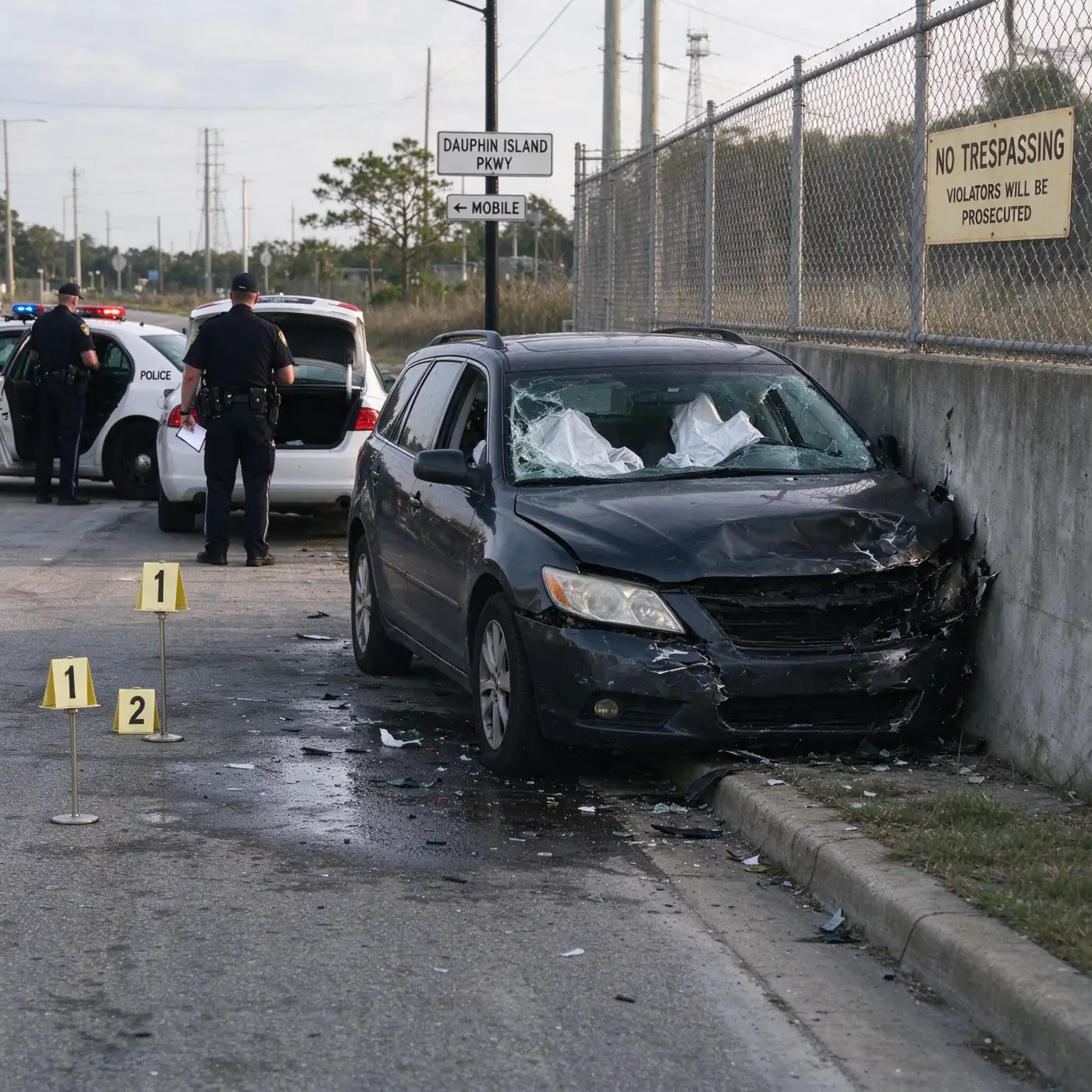
MOBILE, Ala. — A 38-year-old Mobile man is facing an attempt to elude charge after police said he refused to pull over Sunday morning, then ran on foot after his vehicle slammed into a concrete wall close to Dauphin Island Parkway. No one was hurt.
Officers caught up with the man after the brief chase and booked him into Mobile County Metro Jail, police said. The episode began when officers tried to pull a vehicle over and ended a short time later with the wrecked vehicle and a foot search.
As with anyone accused of a crime, the man is presumed innocent unless and until he is proven guilty in court. Police did not say why officers initially tried to stop the vehicle.
Timeline of Sunday’s attempted traffic stop
Police described a quick sequence of events on the morning of Sunday, Nov. 22, 2026. Here is how it unfolded.
- About 8:37 a.m.: Officers try to pull over a vehicle near McRae Avenue and Fairview Drive. The driver keeps going.
- A short time later: The vehicle strikes a concrete wall in the vicinity of Dauphin Island Parkway.
- After the crash: A man climbs out and runs from the wrecked vehicle.
- Arrest: Officers locate him and take him into custody.
- Jail: He is booked into Metro Jail on a charge of attempt to elude.
Police said no injuries resulted from the crash. Officials did not describe the vehicle, say how far it traveled after the stop attempt, or indicate how fast it was going.
What the attempt to elude charge means
In Alabama, attempting to elude is a criminal offense that generally covers a person who intentionally flees from, or tries to get away from, a law enforcement officer after being given a visual or audible signal to stop. The signal might be flashing emergency lights, a siren, a hand signal or a verbal command.
The law applies whether a person tries to get away in a vehicle or on foot. The seriousness of the charge can increase when the flight creates a substantial risk of harm to others or results in someone being hurt or killed.
Police listed a single count of attempt to elude in this case. They did not announce any additional charges or traffic citations related to the crash, and they did not say what classification of the offense applies.
A charge is an accusation, not a finding of guilt. Prosecutors must prove each element of an offense beyond a reasonable doubt, and a defendant has the right to a lawyer, the right to remain silent and the right to contest the evidence.
What happens after an arrest in Mobile County
Metro Jail is the Mobile County Metro Jail, which is operated by the Mobile County Sheriff’s Office and holds people arrested by agencies across the county. After someone arrives there, the booking process typically includes recording personal information, taking fingerprints and a photograph, and inventorying personal property.
Bond is usually the next major step. For many offenses, a bond amount is set by a schedule or by a judge, and a defendant may be released after posting it or after meeting other release conditions.
Alabama court rules call for a person who is arrested to be brought before a judge or magistrate without unnecessary delay for an initial appearance. At that hearing, the defendant is told of the charge and of the right to counsel, and a judge may review release conditions.
Someone who cannot afford a lawyer can ask the court to appoint one. From there, depending on how the charge is classified, a case may be handled in municipal or district court, or it may move toward circuit court if it is treated as a felony.
Many cases are resolved through plea agreements, dismissals or trials, and the timeline varies widely. Court records generally become the best place to follow a case’s progress after the initial arrest.
Why fleeing a traffic stop raises the stakes
Traffic stops are among the most common interactions between police and the public, and the vast majority end with a warning, a ticket or simply a conversation. When a driver decides not to stop, however, the risk to everyone nearby rises quickly.
A vehicle that is trying to get away may run lights, speed through neighborhoods or make sudden turns, putting other motorists, pedestrians and the officers themselves in danger. Sunday’s attempt ended with a vehicle striking a wall, and it is fortunate that no one was hurt.
Crashes that follow a failure to stop are a recognized concern for traffic safety officials nationwide. A driver focused on getting away may not see a pedestrian stepping off a curb, a car pulling out of a driveway or a sharp curve ahead, and even a short flight can end in a serious wreck.
Many police departments across the country have written policies that guide when officers may chase a fleeing vehicle and when they should break off a pursuit. Those policies generally weigh the danger of the chase against the seriousness of the suspected offense and the need to catch the driver right away.
Running on foot after a crash adds another layer of risk. Foot searches can lead officers through yards, streets and businesses, and they can expose both the person running and the officers to injury. In this case, police said officers found the man and arrested him without anyone being hurt.
What to do when you see blue lights
Law enforcement and highway safety agencies offer consistent advice for drivers who are being signaled to pull over. Following it can help keep a routine stop calm and safe for everyone involved.
- Turn on your signal and move to the right shoulder or a safe spot as soon as it is practical.
- Stop in a well-lit area if possible, especially at night, and turn off the engine.
- Stay in the vehicle unless an officer tells you otherwise, and keep your hands where they can be seen.
- Tell the officer before reaching for your license, registration or proof of insurance.
- If you are unsure whether the vehicle behind you is a real police car, slow down, turn on your hazard lights and call 911 to confirm while driving to a populated, well-lit place.
- If you disagree with a ticket or the reason for the stop, raise it later in court rather than at the roadside.
Choosing to flee rarely improves a situation. It can lead to new criminal charges on top of whatever prompted the stop, along with the risk of a crash like Sunday’s.
Where the attempt to elude case unfolded
The attempted stop began near McRae Avenue and Fairview Drive, and the vehicle came to rest after striking a concrete wall by Dauphin Island Parkway. Dauphin Island Parkway is a major route that runs south from the city of Mobile toward the coast and Dauphin Island.
Police did not identify the exact property where the wall was located or say whether it was damaged. They also did not say whether any streets were closed while officers worked the scene and cleared the wreck.
Mobile, the largest city in southwest Alabama, sees officers make traffic stops around the clock on its busy commercial corridors and neighborhood streets. Sunday morning traffic is often lighter than on weekdays, but the roads are still shared by churchgoers, shoppers and families.
Questions still unanswered
Several important details had not been made public by police as of Monday, Nov. 23. Those open questions include the following.
- Why officers first tried to stop the vehicle.
- Whether the man who ran from the wreck was the registered owner of the vehicle.
- How fast the vehicle was traveling and what route it took after the stop attempt.
- Whether the wall or any other property was damaged.
- Whether the man has been released on bond and when his first court date is.
Answers to some of those questions may emerge in court filings as the case progresses. Others may never be made public if the case is resolved early.
When a vehicle damages private or public property during a crash, the property owner generally can seek repair costs through the driver’s insurance or through a civil claim. That process is separate from any criminal case and is handled outside the criminal courts.
Next steps in the case
The 38-year-old man was booked into Metro Jail on the attempt to elude charge. Police have not said whether he had posted bond or when he is scheduled to appear in court.
Additional details, such as the reason for the attempted stop and any further charges, could become public as the case moves through the court system. Any decision about guilt rests with the courts, not with the arrest itself.
With Thanksgiving arriving on Thursday, Nov. 26, police and safety advocates also encourage drivers to slow down, buckle up and stay alert during one of the busiest travel weeks of the year. Cooperating with officers during a traffic stop is part of keeping those trips safe.