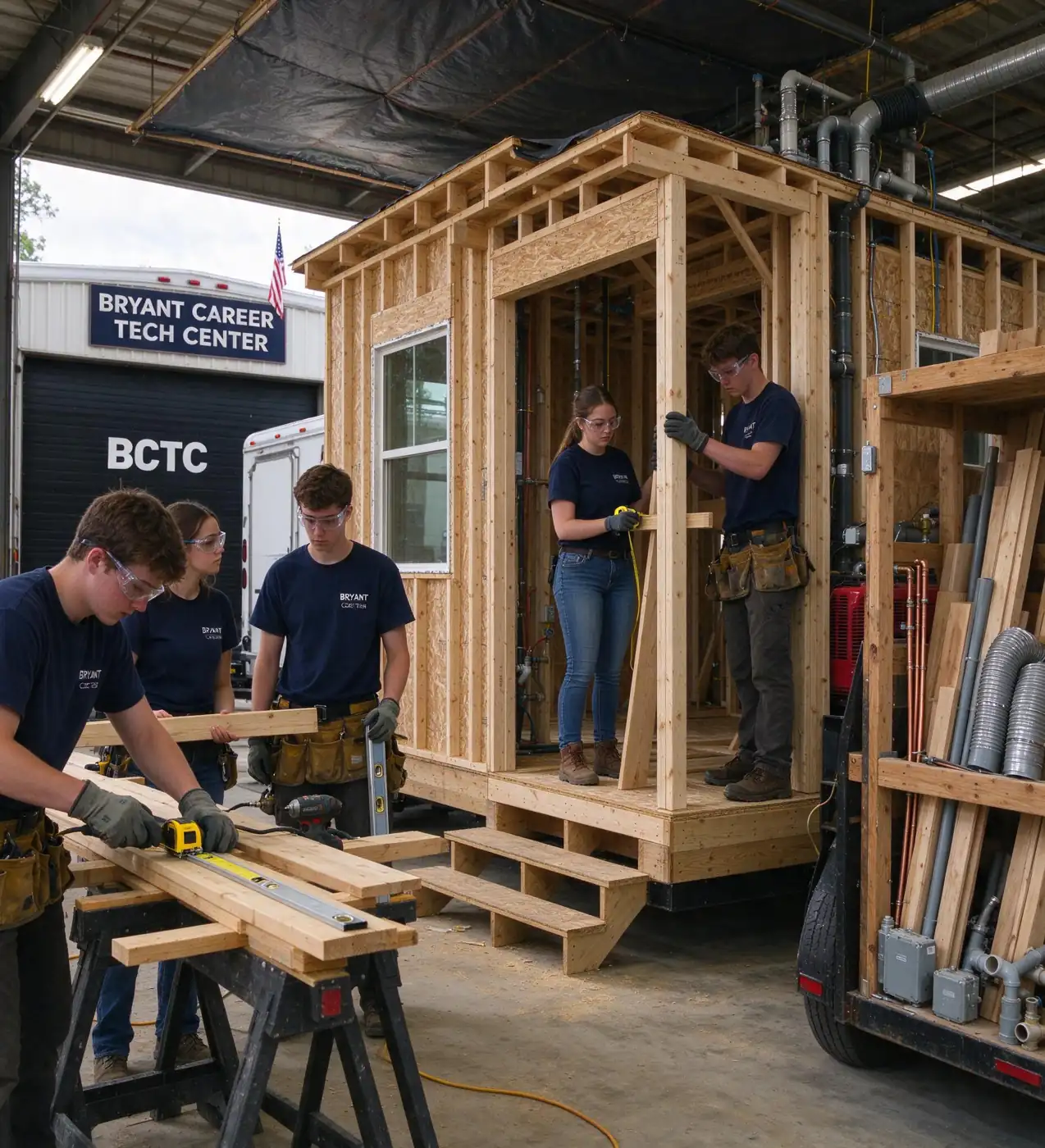
IRVINGTON, Ala. — Inside the shops of Bryant Career Tech Center, this year’s lesson plan comes with a front porch. Students are putting up a fully functional small home from the ground up, a tiny house project that lets them practice their trades on a real structure instead of a classroom mock-up.
The build brings together students from four of the center’s programs: electrical, HVAC, plumbing and construction. School leaders said the effort is meant to give students the kind of real-world experience that is hard to get any other way.
The tiny house project at a glance
- Where: Bryant Career Tech Center in Irvington, a Mobile County Public Schools career-tech campus.
- Who is building it: Students from the HVAC, electrical, plumbing and construction programs, working side by side.
- What it is: A complete, working tiny house built from the foundation up.
- Progress so far: Most of the walls are standing.
- Next steps: Installing beams for the front porch, then setting the roof rafters.
- Targets: Closed in and blacked-in before Christmas; completely finished before the school year closes.
Why a real house beats a practice booth
School leaders said lab exercises can carry students only so far. Practice booths are valuable for learning a single skill, such as wiring an outlet or soldering a joint, but they rarely show how that skill fits into a whole building.
On an actual house, every measurement has consequences. A wall framed slightly out of square affects the roof that sits on top of it, and a drain line placed in the wrong spot can force changes for the electricians and HVAC installers who follow. Students have to plan, check their work and live with the results, much as they would on a paying jobsite.
A full build also teaches pacing and teamwork. Students see that a construction schedule depends on one crew finishing so the next can begin, and that communication between trades can save hours of rework.
Working on a shared project also mirrors the way the industry operates. On most jobsites, carpenters, plumbers, electricians and HVAC technicians are employed by different companies yet must cooperate daily to keep a project on schedule and within budget.
Four trades sharing one jobsite
Each of the four programs brings a different piece of the puzzle. In a typical home build, construction students handle the structure itself: the floor system, wall framing, porch and roof framing, and later the sheathing, siding and interior finishes.
Plumbing students generally install the water supply lines and the drain, waste and vent piping that serve a kitchen and bathroom. Electrical students run the wiring, mount boxes for outlets and switches, and connect circuits to a service panel.
HVAC students focus on heating, cooling and ventilation. In small homes, that work often involves compact systems sized for a limited amount of living space, along with the ventilation needed to manage moisture in kitchens and bathrooms.
The trades also have to work in the right order. In most residential construction, the pipes, wires and ductwork are roughed in after the framing is complete but before insulation and wall coverings go up. Coordinating that sequence on a single small structure gives students a realistic look at how a general contractor juggles subcontractors on a larger project.
Teachers who bring decades of experience
School leaders praised the center’s instructors, describing them as some of the best teachers a school could hope to have. They said each of the teachers has at least 30 years of experience and came into the classroom at the same pay as a first-year teacher.
School leaders said the instructors are there because they want to give something back. They described the group as highly skilled teachers whose goal is to pass their knowledge on to the next generation of students.
Career and technical programs often recruit instructors who spent long careers working in their trades before turning to teaching. That background allows them to share not only textbook methods but also the practical shortcuts, safety habits and problem-solving skills that come from years in the field.
Walls up, rafters next
School leaders said the students have already raised most of the walls. Next comes installing beams that will support the porch at the front of the house, and once those are in, the crew will start setting the roof rafters.
Rafters are the sloped framing members that run from the top of the walls up to the ridge and give a roof its shape. Once they are in place and braced, builders typically cover them with roof decking, which creates the surface for underlayment and the final roofing material.
Porch beams carry the load of the porch roof and transfer it to posts or columns below. Getting them set correctly before the main roof framing goes on helps keep the whole structure aligned.
What blacked-in means and why Christmas matters
The students’ near-term target is to get the house blacked-in before Christmas arrives. In construction, the term generally describes the point when a building’s walls are sheathed and its roof is decked and covered with a protective underlayment, often a dark felt or synthetic membrane, so the interior is shielded from rain.
Builders sometimes call the same milestone being dried-in. It is an important point in any project because work on the inside of the building can continue regardless of the weather, which is especially useful during the winter months.
From there, the remaining goal is to finish the house entirely before the school year closes. That later phase usually includes windows and doors, exterior siding, completing the mechanical, electrical and plumbing systems, insulation, interior walls, flooring and trim.
Why tiny houses make strong teaching tools
Tiny houses have become a popular project for high school and college construction programs, and the reasons are practical. A small footprint keeps material costs and the amount of labor within reach of a single school year, yet the structure still includes nearly every system found in a full-size home.
The International Residential Code, a model building code widely used in the United States, includes an appendix that defines a tiny house as a dwelling of 400 square feet or less in floor area, not counting lofts. Homes of that size still need foundations or support systems, framing, roofing, plumbing, wiring and climate control, which gives students in every trade meaningful work.
Many tiny homes also rely on space-saving features such as sleeping lofts, built-in storage and multipurpose furniture. Designing around those features requires precise measurements, since a few inches can determine whether a staircase, cabinet or appliance fits. Tight spaces also bring their own challenges. Fitting a bathroom, kitchen and mechanical equipment into a compact plan forces careful layout decisions, the kind of real-world problem-solving that classroom exercises seldom provide.
Safety lessons built into the work
A live construction project also gives instructors a natural way to drive home jobsite safety. On a typical residential build, workers wear eye protection, gloves and sturdy footwear, use hard hats when overhead work is underway and follow rules for ladders and power tools.
Roof framing in particular involves working at height, so it is a stage where careful planning, proper bracing and attention to fall hazards matter. Learning those habits in a supervised school setting can make students safer and more valuable employees once they enter the workforce.
Federal workplace safety rules, enforced by the Occupational Safety and Health Administration, set standards for construction sites nationwide. Many career-tech programs introduce students to those standards so they understand the expectations they will face on a professional crew.
About Bryant Career Tech Center
Bryant Career Tech Center is one of three career technical centers operated by the Mobile County Public School System. Career technical centers like it typically give high school students a place to receive hands-on training in technical fields alongside their regular academic studies.
Irvington is an unincorporated community in south Mobile County. The center’s building trades programs, which include HVAC, electrical work, plumbing and construction, are aimed at preparing students for further training or for entry into the workforce after graduation.
Skills that lead to careers
The trades represented on the project are ones that employers across the country continue to seek. Electricians, plumbers and heating and air conditioning technicians are needed in new construction as well as in the repair and maintenance of existing homes and businesses.
In Alabama, contractors in several of these trades are regulated by state licensing boards, and earning a license generally requires a combination of experience, training and passing an exam. Hands-on work in high school can give students a head start toward apprenticeships, technical college programs or entry-level jobs that build toward those credentials.
Beyond the technical know-how, a project like this one helps students build a portfolio of real work. Being able to tell a future employer or instructor that they helped frame, plumb, wire or condition an actual house can set a graduate apart from other applicants.
For now, the focus at Bryant is on getting the roof framed and the house closed in before the holiday break. If the schedule holds, students will spend the spring months turning a framed shell into a finished home.