MOBILE, Ala. — Sophomores at three Mobile County high schools can now train for jobs on the plant floor long before they collect a diploma, as new modern manufacturing academies get underway at LeFlore Magnet High, Mary G. Montgomery High and Murphy High. The programs are built to ready teenagers for starter jobs in one of the region’s anchor industries while giving them a shot at credentials that employers recognize.
The academies grew out of a partnership between the Modern Manufacturing Program (MMP) Center for Excellence, a statewide organization that builds training partnerships with schools across Alabama, and the Career and Technical Education Department of the Mobile County Public School System. Classes currently serve sophomores only, but the district intends to phase in juniors and seniors at all three campuses over time.
What to know at a glance
- Where: LeFlore Magnet High School, Mary G. Montgomery High School and Murphy High School.
- Who can enroll now: Sophomores at those three schools, with juniors and seniors to be added in stages.
- Who runs it: The district’s career-tech department, working hand in hand with the MMP Center for Excellence.
- Industry backers in southwest Alabama: ArcelorMittal, Novelis, Canfor and Arkema.
- The goal: Equip students for starter jobs in manufacturing and help them earn industry credentials.
- How to sign up: Talk with a school counselor or the school’s Career Coach.
Why the district is investing in modern manufacturing academies
A district career-tech administrator said growing the system’s advanced manufacturing offerings will let more Mobile County students gain technical know-how, earn credentials valued by industry and get hands-on practice tied to jobs that are in high demand locally. The administrator said close cooperation with businesses and with postsecondary partners is helping the district build sturdier pathways for students, while also supporting the ongoing expansion of Mobile’s manufacturing workforce.
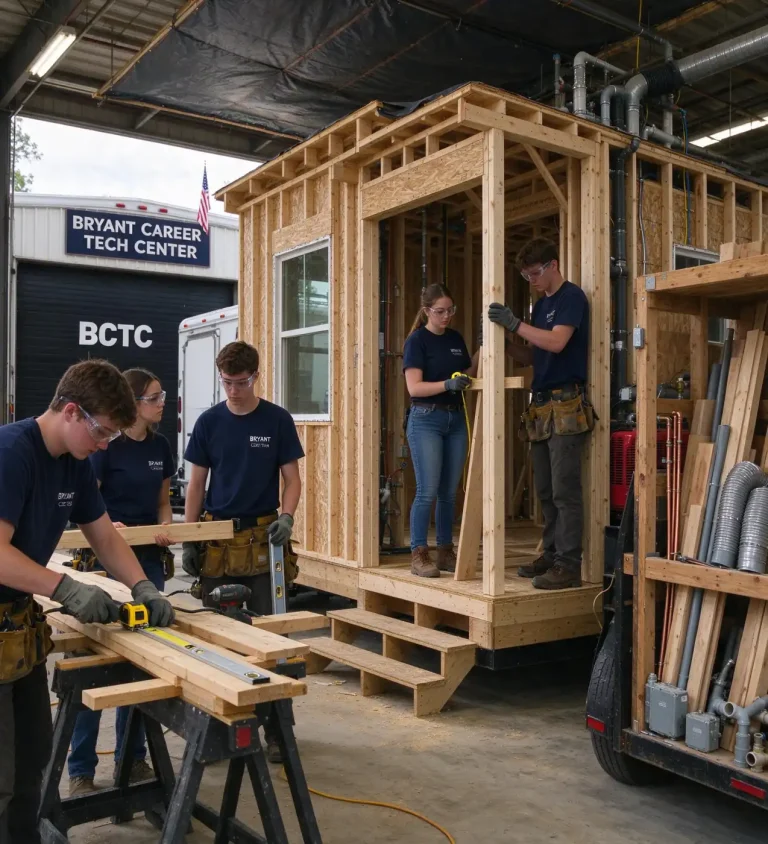
The three academies widen what was already available in the system. MCPSS already offers manufacturing training at both Bryant Career Technical Center and the Citronelle Center for Advanced Technology, so the new academies bring similar instruction to students who attend traditional and magnet high schools.
For many families, that convenience matters. A student who might not have been able to travel to a separate career center can now explore the field inside the school he or she already attends.
Inside the classroom and the lab
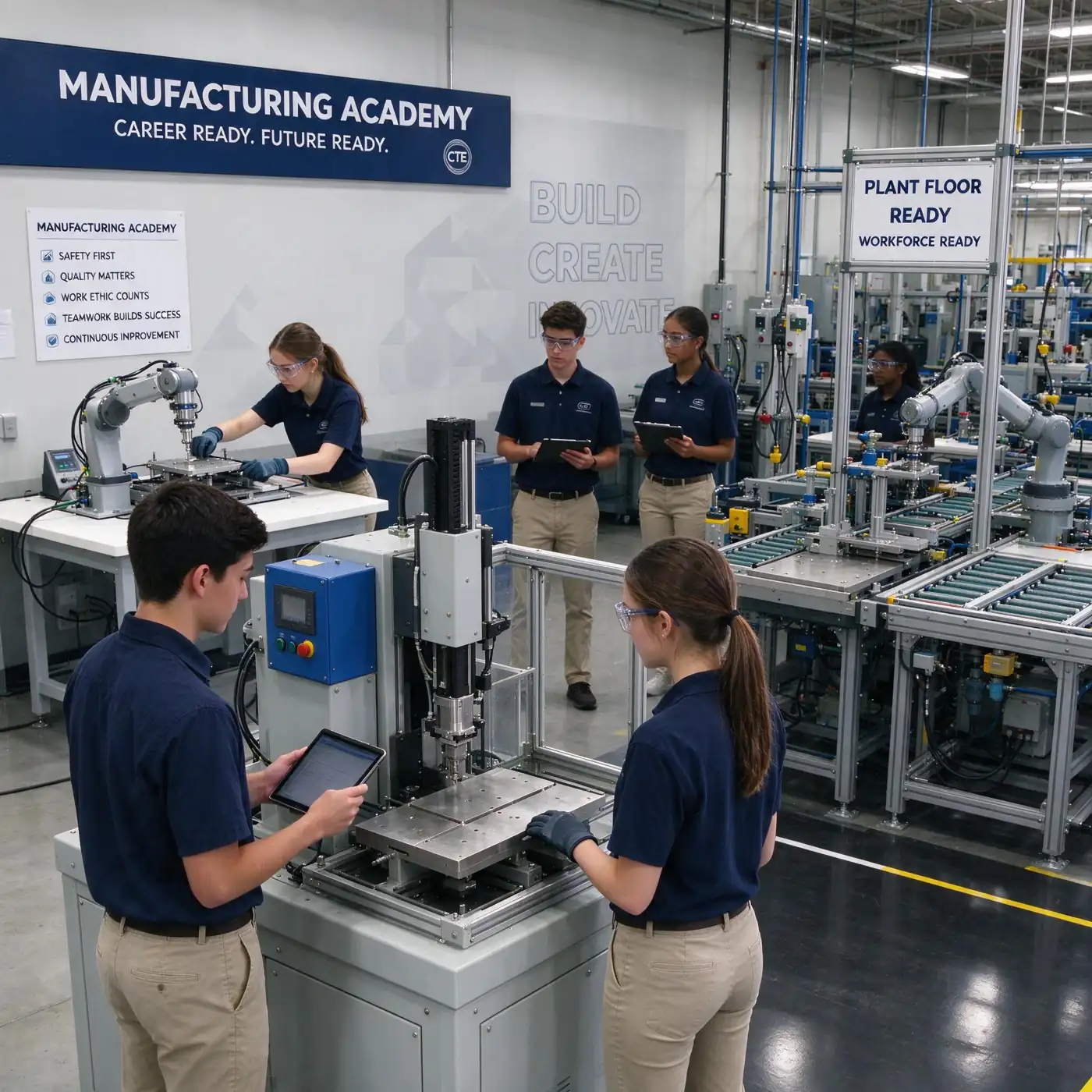
The coursework pairs workplace basics with technical training. Students study employability skills, the habits employers prize such as reliability, communication and teamwork, along with workplace safety and the core principles behind how products are made.
The hands-on portion is broad and mirrors the work done inside a modern plant. Students rotate through a long list of technical topics. Instruction includes:
- Machine operations and production line operations
- Automation and physical controls
- Quality control and instrumentation
- Equipment maintenance
- Manufacturing planning and system analysis
- Safety practices
- Informational infrastructure
In general terms, each of those subjects lines up with real roles in industry. Automation and controls work centers on the sensors, programmable equipment and motors that keep production lines moving with less manual effort. Instrumentation deals with the devices that measure pressure, temperature, flow and other conditions inside an industrial process.
Quality control teaches how finished goods are inspected and measured to confirm they meet specifications. Maintenance training focuses on keeping machines in good working order and spotting problems before they halt production.
Manufacturing planning and system analysis take a wider view, looking at how materials, machines and people are organized so a facility runs efficiently. Informational infrastructure refers to the data and network systems that increasingly tie together equipment, sensors and management software in today’s factories.
Local employers have a seat at the table
The MMP Center for Excellence has set up comparable partnerships with a growing roster of schools around Alabama, using its training model to open routes into well-paying manufacturing careers. In southwest Alabama, its industry partners include ArcelorMittal, Novelis, Canfor and Arkema.
Through those ties, the MMP supplies curriculum, equipment and support, then works side by side with MCPSS teachers to deliver the hands-on program. The companies span several sectors: ArcelorMittal is a global steelmaker, Novelis is known for rolled aluminum and aluminum recycling, Canfor is a forest products company, and Arkema produces specialty chemicals and materials.
A regional project manager for the program said the academies give manufacturers an early chance to connect with students, help them see the careers that exist close to home and start growing a deeper pool of local talent. The project manager said the aim is to forge real links between schoolwork and industry through plant tours, guest speakers, mentoring, donated equipment and materials, and other hands-on experiences that show teenagers what a modern manufacturing setting looks like.
The project manager also thanked the businesses that have already signed on to support the programs at Mary G. Montgomery, Murphy and LeFlore. Those relationships, the project manager said, are expected to keep expanding.
Why industry credentials matter
Industry-recognized credentials are certifications, generally issued or endorsed by trade associations, certifying bodies or employers, that show a person has mastered a defined set of skills. For a high school student with little work history, one of these certificates can serve as evidence of ability that a hiring manager can quickly understand.
Many credentials are also designed to stack. A student can earn an introductory certification in high school and build on it later through a community college program, an apprenticeship or on-the-job training.
That flexibility lets graduates go straight to work, keep studying or combine the two. Career and technical education programs across the country have increasingly leaned on credentials as a bridge between classroom lessons and what employers need, and the new academies follow that approach.
The career academy approach
Career academies, as the model is generally understood in American high schools, blend academic classes with technical training organized around a single industry. They typically rely on employer partners to provide real-world exposure, from workplace visits to mentoring, so students can see how lessons apply on the job.
The structure can help teenagers answer an important question early: whether a field truly fits their interests. A sophomore who discovers a passion for automation or quality work has several years to build skills before graduation, while a student who decides the field is not a match can change course without losing much time.
Because the Mobile County academies start with 10th graders and are set to grow into the upper grades, students who join now may eventually be able to continue their training through their senior year as the program expands. That longer runway could give them more time to master equipment and complete credential requirements before they graduate.
One piece of a larger career-tech network
The academies sit within a wide set of offerings from the district’s Career and Technical Education Department, which offers training in 14 career clusters, spread among a dozen high schools plus three career technical centers. Through those programs, students can pursue career credentials, take part in job shadowing and mentoring, and gain practical training in a broad range of fields.
Career clusters are groupings of related occupations used to organize career and technical education. They allow students to explore a general area, such as manufacturing, health science or construction, before narrowing their focus to a specific program of study.
The three host schools are spread across the county. LeFlore Magnet and Murphy are located in the city of Mobile, while Mary G. Montgomery serves the Semmes area in western Mobile County, giving students in different parts of the system a nearby option.
Manufacturing’s role on the Gulf Coast
Manufacturing has long been a pillar of the economy in the Mobile area and the rest of southwest Alabama. The region is home to shipbuilding, aircraft assembly, steel production, chemical plants and forest products operations, along with the port and logistics businesses that keep goods moving.
Manufacturers nationwide have described a growing need for skilled technicians as experienced workers retire and plants adopt more automated technology. Programs that introduce students to the field early are one way schools and businesses have tried to meet that need, in part by showing young people that factory work today often involves computers, robotics and problem-solving.
Entry-level jobs in the sector can include machine operator, production technician, quality inspector and maintenance helper. With experience and additional training, workers may move into roles such as maintenance technician, controls technician or production supervisor.
How students can get involved
For now, enrollment is limited to 10th graders at Murphy, LeFlore and Mary G. Montgomery. The district plans to widen access gradually so juniors and seniors at the three schools can take part as well.
Students who are curious about the academies can reach out to a counselor or to the Career Coach at their school. Counselors can explain how the program fits into a student’s schedule and graduation plan, and Career Coaches help students think through career options.
Parents may want to ask which credentials students can earn, what industry experiences such as tours or guest speakers are planned, and how participation might connect to college or employment after graduation. Those conversations can help families decide whether the academy is the right fit.