Food, Global Dialogue Mark Columbia Southern’s First International Students’ Day Celebration in Orange Beach
Columbia Southern University marked its first campus celebration of International Students' Day with faculty discussions, a training session on global higher education and an employee cooking contest featuring dishes from around the world.
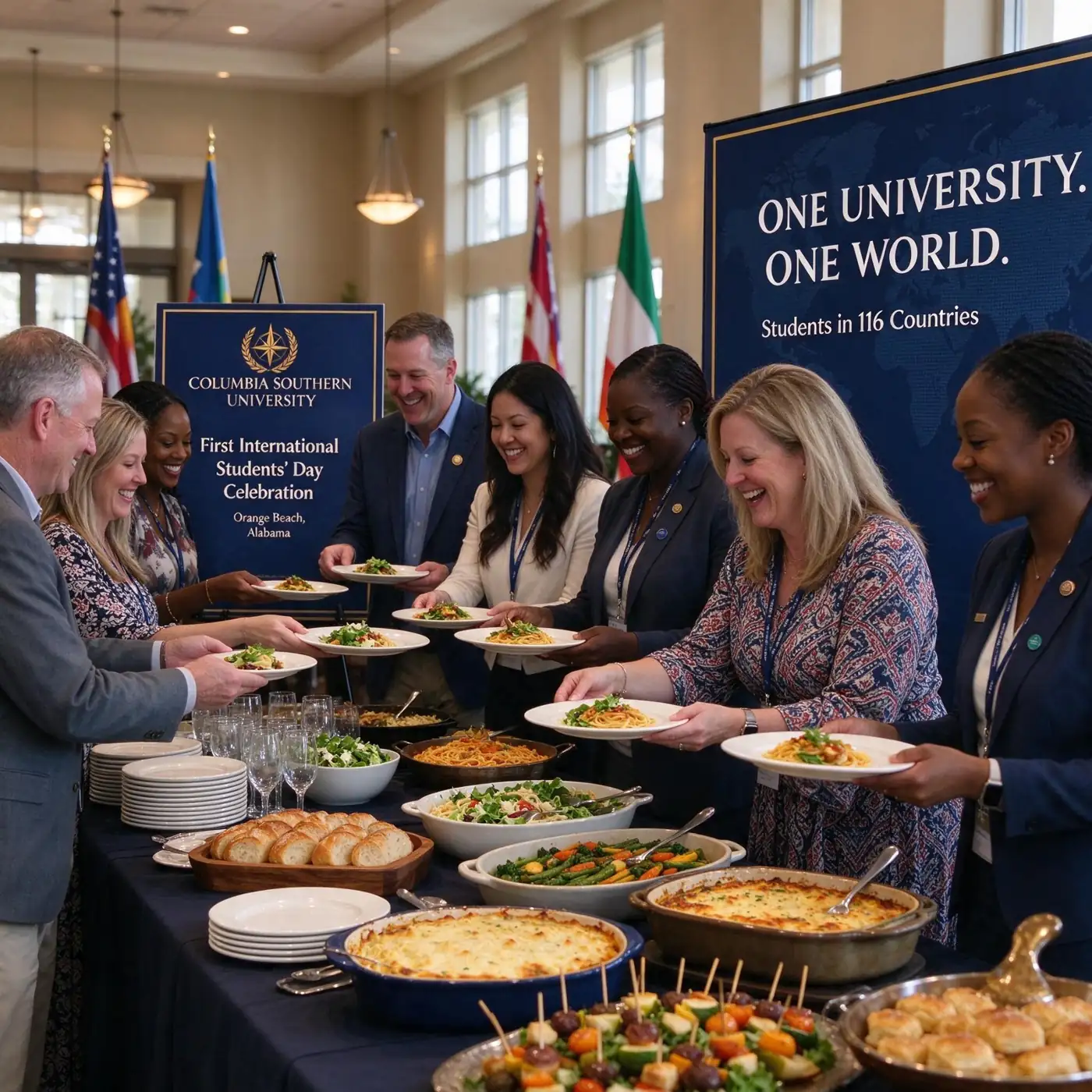
ORANGE BEACH, Ala. — Plates of food from far-flung kitchens and conversations about the future of worldwide learning filled the calendar at Columbia Southern University this week, as the Orange Beach-based school marked International Students’ Day for the first time with an organized celebration of its own.
The university’s Department of International Relations put together the observance, which centered on the Nov. 17 date set aside each year to honor students who study across national lines. Employees took part in live discussions among faculty and staff, and a cooking contest invited workers to prepare and share their best dishes from cuisines around the globe. A visiting expert in international higher education also came to campus to talk about where cross-border learning is headed and to lead a training session for the university’s people.
The event put a spotlight on a part of the Baldwin County university that many local residents may not realize exists: a student body that reaches far beyond the Gulf Coast and far beyond the United States.
A Student Body Spread Across 116 Countries
Columbia Southern currently counts roughly 800 international students on its rolls, and those learners live in 116 different countries. Over the past year, the university awarded degrees to graduates on six continents. Its recent graduates are spread across Africa, Asia, Australia, Europe, North America and South America, leaving Antarctica as the only continent without a Columbia Southern graduate during that stretch.
Those numbers reflect the way the university delivers its programs. Columbia Southern operates primarily as an online institution, which allows students to log in to coursework from a home office in Orange Beach just as easily as from a city on another continent. For many international learners, that format removes some of the biggest hurdles of studying abroad, such as relocating, securing a student visa for full-time residence, or leaving a job and family behind.
Even so, studying with a U.S.-based school from overseas brings its own challenges. Students may be working across time zones, writing in a second or third language, navigating unfamiliar academic conventions, or handling questions about transcripts, credentials and payment from abroad. That is the kind of support an international relations office is designed to provide.
How the University Marked the Day
The celebration was built around people rather than a single ceremony. Key parts of the observance included:
- Live discussions among faculty and staff members about international students and the university’s global reach.
- A culinary competition in which employees cooked and presented international dishes, turning a workday into a sampling of flavors from around the world.
- A guest presentation about what lies ahead for higher education around the world, delivered by the founder and chief executive of an organization that works to connect institutions worldwide.
- A training session for faculty, staff and leadership led by the same visitor.
The guest described the day as the university’s inaugural celebration of its kind and said it offered a chance to trade ideas, share viewpoints from different parts of the world and consider ways that learning across borders can help an institution grow and widen its impact. The visitor stressed that a university becomes globally engaged through its own people, and that when faculty, staff and leadership commit to internationalization together, the benefits reach well past national borders.
The Team Behind the University’s Global Work
Columbia Southern’s international relations initiatives are led by the school’s senior international officer, who also directs the Department of International Relations. University leaders said the institution occupies an unusual and meaningful position in global higher education because it is not bound by geography but instead by the opportunities it can create for students wherever they live.
The department’s stated aim is not merely to grow the number of countries where Columbia Southern has students. Instead, leaders said, the goal is to form lasting relationships and to make sure that opportunity is within reach no matter where a student’s home happens to be.
The office added a global engagement specialist in 2026, a staff member who brings firsthand perspective to the job after studying as an international student herself. She uses that experience to help current students who are going through the same transition. She said working in the department has been deeply rewarding, broadening her outlook, building her confidence and opening doors to new knowledge, exchanges between cultures and growth as a person. The experience, she said, has strengthened her conviction that education is not limited by borders.
Where International Students’ Day Comes From
International Students’ Day was established on Nov. 17, 1941. Its roots are somber. The date commemorates events in Nazi-occupied Czechoslovakia in the autumn of 1939, when German authorities cracked down on student demonstrations in Prague. On Nov. 17 of that year, occupying forces raided university buildings, executed a group of student leaders and sent well over a thousand students to concentration camps. Czech universities were then closed for the rest of the war.
Two years later, the International Students’ Council, meeting in London, chose Nov. 17 as a day of remembrance and solidarity. Over the decades, the observance has broadened. Today universities and student organizations in many countries use the date to celebrate multicultural campuses, to recognize the contributions of students who cross borders to learn, and to call attention to academic freedom and students’ rights.
For a school like Columbia Southern, the date is a prompt to remember that internationalization means more than signing up students in new countries or pushing enrollment figures higher. University leaders said it is about linking people together, welcoming a variety of viewpoints, and creating openings that can change the direction of a person’s life.
Why International Students Matter to American Higher Education
International students have long been a significant presence in U.S. higher education. They bring different perspectives into classrooms and discussion boards, contribute to research, and help domestic students build the kind of cross-cultural skills that employers increasingly seek. Universities also benefit from the professional and alumni networks that form when graduates return home or build careers in other countries.
Online programs add a new dimension to that exchange. In a virtual course, a firefighter in the Southeast might share a discussion thread with a safety manager in Africa or a business student in Asia, each bringing examples from a very different working environment. That mix can make coursework in fields such as occupational safety, emergency management and business administration more practical, since many of the challenges those professions face are global in nature.
At the same time, schools that enroll students from many countries take on added responsibilities. They must help students understand how credits and degrees will be recognized at home, communicate clearly across languages and cultures, and offer advising that works when a student is many hours ahead or behind the university’s own clock. Dedicated international offices, like the one that organized Columbia Southern’s celebration, exist largely to manage those details.
A Baldwin County University With a Worldwide Footprint
Columbia Southern University is headquartered in Orange Beach, the resort city on the eastern end of Pleasure Island along the Alabama coast. While the city is best known for its beaches, marinas and vacation rentals, the university is one of its notable year-round employers and has helped give the community a presence in higher education that stretches well beyond the region.
The school focuses on career-oriented programs delivered online, a model that has drawn working adults, military service members, public safety professionals and others who need flexibility. That same flexibility is what makes it possible for a school based on the Gulf Coast to enroll hundreds of students who have never set foot in Alabama.
Events such as the cooking contest and staff discussions also serve an internal purpose. Many employees who answer student questions, process paperwork or teach courses may rarely meet the international learners they serve. Setting aside time to talk about those students, learn about their cultures and even taste food from their home regions can help staff better understand the people on the other end of an email or video call.
Looking Ahead
With the first celebration complete, Columbia Southern’s international relations team has signaled that it intends to keep strengthening the university’s standing among institutions that educate students worldwide. The emphasis, as leaders described it, will remain on relationships with students and partners rather than on numbers alone.
For a university whose recent graduates live on six continents, the annual Nov. 17 observance offers a fitting moment to look at how far the school’s reach has spread from its base in Orange Beach, and to recognize the hundreds of students around the world who are earning Alabama degrees from home.
About International Students’ Day
- Date: Observed every year on Nov. 17.
- Established: Nov. 17, 1941, by the International Students’ Council in London.
- Origin: Remembers the 1939 suppression of Czech students and universities by Nazi occupation forces.
- Today: Celebrated by universities worldwide as a day honoring multicultural education and student rights.