Saraland High School student tests positive for COVID-19; five quarantined
A Saraland High School student tested positive for COVID-19 Friday, and five people were quarantined for 14 days under district protocol.
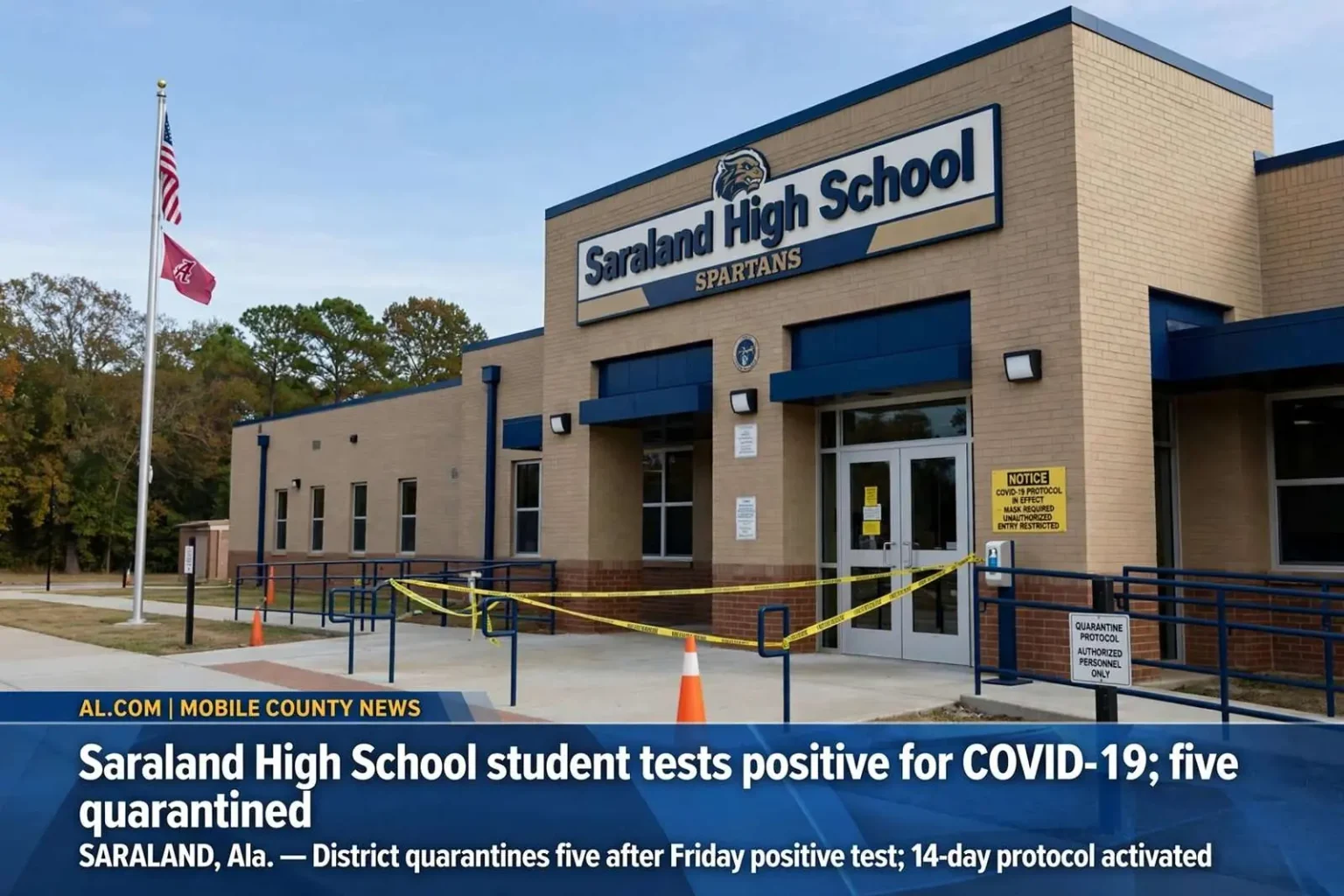
SARALAND, Ala. — A Saraland High School student tested positive for COVID-19 on Friday morning, prompting the school system to quarantine five people. Saraland Schools Superintendent Dr. Aaron Milner said the system was notified that an individual had tested positive and that five people were quarantined as a result. Those who were quarantined will stay home for 14 days under the district’s protocol.
The announcement came during a period when schools across Alabama were reopening under state health guidelines, and it offered one of the first concrete illustrations of how contact tracing would work in practice in Mobile County’s suburban districts. A single confirmed case on a campus triggers a careful review of who the infected person came into close contact with — defined by health authorities as being within six feet for fifteen minutes or longer — and those close contacts are sent home to quarantine even if they feel perfectly healthy.
Dr. Milner’s description of the response emphasized the system’s protocol rather than the individual case, in keeping with privacy laws that prevent school officials from identifying students or staff who test positive. The five people quarantined were notified directly by the school system, and families of other students were informed of the situation without identifying details.
Saraland’s schools and their pandemic role
Saraland City Schools is one of Alabama’s newer city school systems, formed after the city separated from the Mobile County Public School System in the late 2000s, and it has since grown into one of the highest-performing districts in the state. The system includes an elementary school, a middle school, and Saraland High School, serving a fast-growing suburb north of Mobile along the U.S. Highway 43 and Interstate 65 corridors.
The district’s growth made its reopening plans closely watched in the region. Saraland’s enrollment has climbed for years as families move into the city’s expanding residential subdivisions, and classrooms that were designed for a smaller student body faced the added challenge of spacing students apart during the pandemic. District leaders spent the summer preparing layered safety measures — mask expectations, cleaning routines, and plans for handling confirmed cases — knowing that the first positive test on a campus would test those plans immediately.
Under the state’s back-to-school framework, districts were given flexibility to start with remote, in-person, or hybrid instruction, but all were required to report confirmed cases and follow state health department guidance on quarantine. Saraland chose in-person instruction with enhanced precautions, which meant the Friday morning notification was a scenario administrators had prepared for but hoped to avoid.
How school contact tracing works
When a student tests positive, the school’s first task is reconstructing the infected person’s movements on campus — which classrooms they sat in, which buses they rode, which activities they joined. Seating charts, bus rosters, and attendance records become the raw material of the investigation, allowing administrators to identify everyone who meets the close-contact threshold. Only those people are quarantined; classmates who remained six feet away are monitored for symptoms but continue attending school.
The 14-day quarantine period the district applied reflects the standard guidance of the era, based on the virus’s incubation window. People quarantined as close contacts are asked to watch for fever, cough, loss of taste or smell, and other symptoms, and to seek testing if any develop. Health officials acknowledged the burden the policy placed on families — missed school, missed work, childcare scrambling — but defended it as the only reliable way to interrupt silent transmission.
Schools leaned heavily on their nursing staff during this period, and Mobile County health authorities assisted with case investigation and guidance when questions arose. The system functioned only as well as its notification chain: a Friday morning positive test meant calls and emails went out the same day, so that quarantined individuals would be off campus by the following school day.
The burden on students and families
For the five people sent home, quarantine meant two weeks of learning remotely while their classmates continued in person. Districts across Alabama worked to keep quarantined students connected to instruction through virtual assignments and online platforms, though the experience varied widely from school to school. Teachers prepared materials for two audiences at once — the students in the room and the students at home — adding to an already demanding year.
Families faced their own calculations. A quarantined student meant a parent or guardian had to supervise learning at home, and if other family members were identified as close contacts, entire households could be confined together. Health guidance of the time did not require household members of a close contact to quarantine unless the contact developed symptoms, but the disruption still rippled through work schedules and family routines.
What the case meant for the district
A single case with five close contacts was, by the standards of the pandemic, a contained outcome — evidence that masking, spacing, and contact tracing were limiting the spread from an infected individual to a manageable circle. Public health officials repeatedly noted that schools which followed the protocols generally saw transmission on campus remain low, with the virus spreading more readily at gatherings outside school walls.
Dr. Milner and the Saraland administration continued to urge families to keep sick children home, report symptoms honestly, and cooperate with contact tracing efforts. The district’s experience with its first confirmed case became a template for the ones that followed, as schools across the region settled into a pattern of notifications, quarantines, and campus cleanings that would define much of the school year.
The five quarantined individuals were expected to return to campus after their 14 days at home if they remained symptom-free, and the school continued normal operations for everyone else. Saraland officials said the system would continue to notify families of confirmed cases as required, while protecting the privacy of those affected.
The region’s context during reopening
Saraland sits in the northern tier of Mobile County’s suburbs, alongside Satsuma, Creola, and the growing communities along Highway 43. The city’s population has grown steadily since it incorporated its own school system, and its schools are a central part of the city’s identity and its appeal to new residents. Friday night football, school bond campaigns, and academic recognition all feed the community pride that Saraland residents take in their district.
The pandemic pressed on that identity in uncomfortable ways. School activities that bind communities together — pep rallies, packed bleachers, band competitions — were curtailed or modified under health guidelines, and the first confirmed case at the high school was a visible sign that the pandemic had reached into one of the region’s most celebrated school systems. Administrators elsewhere in Mobile County watched how districts like Saraland handled their first cases, knowing their own notifications were likely coming.
Across Alabama, the reopening period saw districts respond to positive cases in broadly similar ways, but the details varied with local conditions. Rural districts with small class sizes sometimes avoided quarantines entirely through spacing; larger suburban schools like Saraland High, with bigger enrollments and more student movement between classes, expected to manage close contacts on a recurring basis throughout the year.
The science behind the 14-day protocol
The 14-day quarantine window that Saraland applied was derived from the estimated incubation period of the virus — the time between exposure and the onset of infectiousness or symptoms. Public health authorities settled on two weeks as the period that would catch the vast majority of infections acquired through a close contact, accepting the burden it placed on individuals in exchange for the outbreaks it prevented.
Close contacts were not generally tested immediately upon quarantine, because a test taken too early could miss an infection that was still incubating. Instead, quarantined individuals were monitored for symptoms and tested if anything developed. The approach frustrated families who wanted a test to prove they were clear, but health officials explained that a negative test in the first days after exposure provided little reassurance.
School districts operated under the direction of the Alabama Department of Public Health, which issued guidance documents on case reporting, quarantine lengths, and the definitions schools should use for close contacts. Local superintendents like Dr. Milner carried out that guidance in their buildings, adapting it to bus routes, cafeteria seating, and athletic practices as best they could.
Communication with the community
The Saraland case highlighted how school districts had become, almost overnight, public health communicators. Superintendents who had spent their careers on curriculum and budgets found themselves explaining incubation periods, quarantine math, and testing logistics to anxious parents. Districts that communicated quickly and transparently generally kept community trust; those that delayed notifications or hid behind privacy rules without explanation drew criticism.
Saraland’s statement — confirming the positive test, the five quarantines, and the 14-day protocol — followed the model that state health officials encouraged: confirm facts, explain the response, protect privacy, and remind families of the precautions that keep schools open. The alternative to following the protocols, officials warned, was uncontrolled spread on campus and a return to remote learning for everyone.
For the Saraland community, the Friday morning notification was the first of what would become a familiar rhythm of the school year. The five students or staff members sent home completed their quarantine and returned, the campus continued its schedule, and the district’s pandemic playbook — tested for the first time that week — became routine. The episode closed with the school community intact and the district’s protocol validated by its first real-world test.