Serial Killer Samuel Little Confesses to Two Pascagoula Murders
Convicted serial killer Samuel Little has confessed to two murders in Pascagoula, Mississippi, including the 1982 killing of Malinda Lapree.
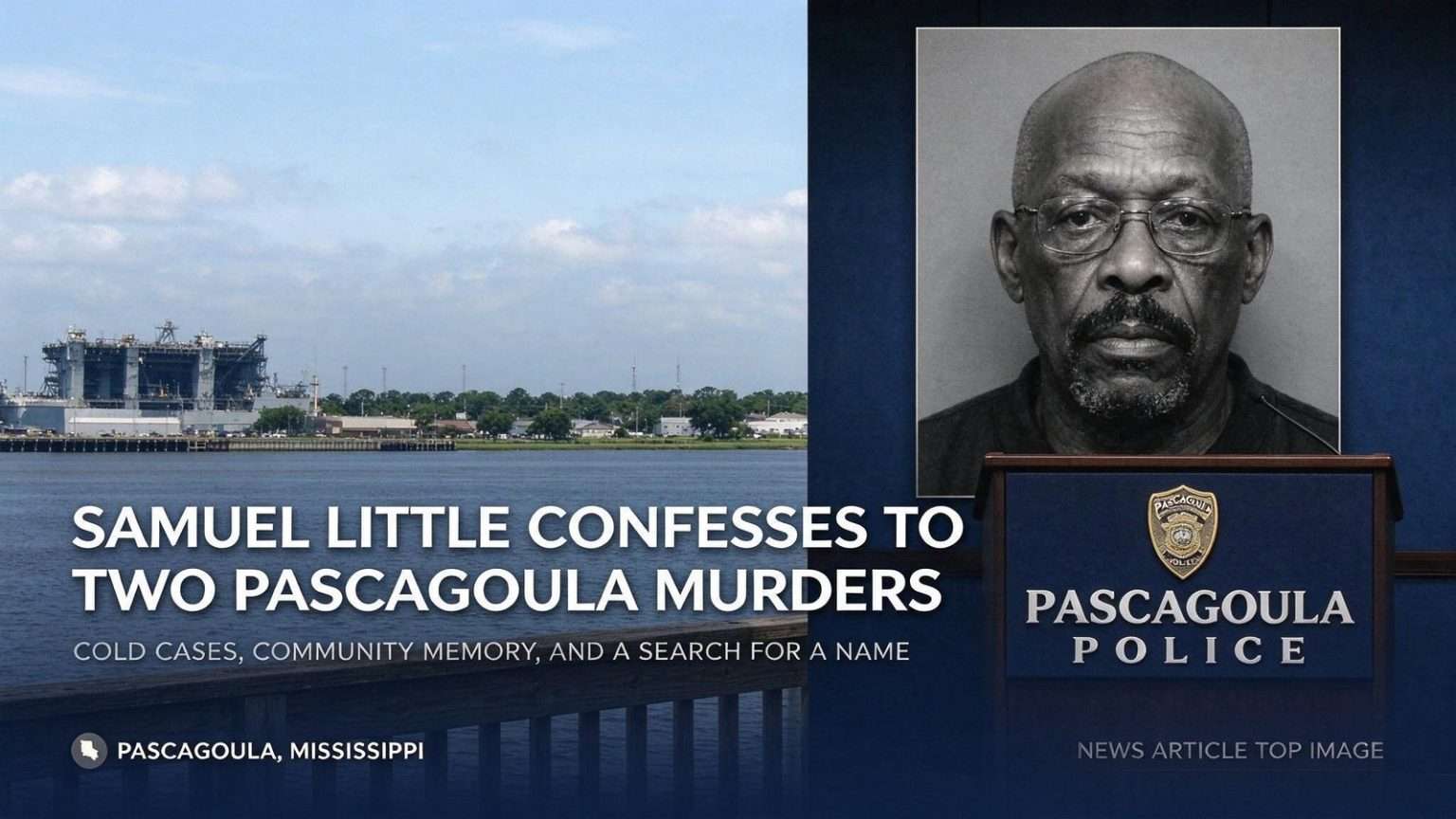
A convicted serial killer serving a life sentence in California has confessed to two murders in Pascagoula, Mississippi, according to local investigators. Samuel Little, also known as Sam McDowell, has confessed to 90 murders across the country. Two of those confessions involve women killed in Pascagoula, according to Lieutenant Darren Versiga of the Pascagoula Police Department. For a coastal city of Pascagoula’s size, the revelation tied its cold cases to one of the most sprawling murder investigations in American history — and gave two families the closest thing to an answer they had received in decades.
Little, 78, is serving a life prison sentence in California for three murders. Authorities recently brought him to Texas for an investigation, where he was indicted for a 1994 murder of a Texas woman. The Texas case became the hinge on which the national investigation turned: once investigators there demonstrated that Little’s confessions could be corroborated against physical evidence, agencies across the country began matching his detailed recollections to their own unsolved cases from the 1970s, 1980s and 1990s.
One Victim Identified
One of the two Pascagoula victims has been identified as Malinda Lapree, who was killed in 1982. Investigators say Lapree left her Pascagoula housing project in September of that year and never returned home. “She was taken from there and ultimately strangled to death and dumped in Gautier, Mississippi,” Versiga said. Little was never charged in Lapree’s murder due to a lack of evidence. The discovery that a body found in neighboring Gautier — just west of Pascagoula along the Pascagoula River — fit Little’s pattern gave investigators a named victim where a cold case file had held only questions.
Lapree’s disappearance followed a pattern that would become achingly familiar as Little’s confessions mounted nationwide: women, many of them vulnerable and marginalized, who vanished from city streets in the span of a single evening and whose cases went unsolved for decades. Across the country, Little’s confessions have allowed investigators to close files that had sat open since the Carter and Reagan administrations.
Second Victim Remains Unidentified
The second victim remains unidentified. Versiga says Little described her as a light-skinned Black female believed to be from the Jackson, Mississippi area, weighing about 120 pounds and in her 30s. She worked at Ingalls Shipbuilding in Pascagoula. The description is a targeted appeal to the region’s memory: Ingalls has been Pascagoula’s dominant employer for generations, and anyone who worked at the shipyard in that era or knew a co-worker matching the description may hold the detail that finally gives the woman her name.
Identifying that victim is now the central task for Pascagoula investigators, because Little’s confessions — however detailed — cannot themselves close a case. Prosecutors and medical examiners need a name, a missing-person report and, where possible, records that place the woman in the area during the years Little described. Public appeals like this one have resolved similar cases elsewhere in the country, where family members seeing a suspect’s description recognized a relative who had vanished decades earlier and whose disappearance had never been connected to a crime.
Versiga traveled to California to testify against Little. He was accompanied by Lelia Johnson, a former Pascagoula resident who is now deceased. Johnson testified about how Little attempted to strangle her in his car after beating her. She fought back and escaped. Survivor testimony of that kind is rare in serial-murder investigations — most of Little’s victims did not survive — and it provided authorities with a living witness to his methods at a moment when his confessions alone could not carry the legal weight.
History in Pascagoula
Little was first arrested in Pascagoula in 1977 for selling stolen clothes out of the trunk of his car. Investigators say he admitted to killing several women inside that same vehicle. The detail is among the most chilling in the case — a routine property-crime arrest in a Jackson County city, documented and forgotten, that in retrospect put a confessed serial killer on the local record years before anyone understood what he was.
That 1977 arrest also illustrates how Little operated across the country for so long. He was arrested repeatedly over the decades for thefts, assaults and other offenses, serving time in multiple states, yet the full scope of his violence went unrecognized because the murders were committed in one place and the killer lived in another. Victims went missing in cities he passed through; by the time investigators in any one of them had a suspect, he was long gone. Only when DNA science matured and a single jurisdiction connected its case to a pattern did the national picture come into focus.
If convicted of all 90 murders, Little would be one of the most prolific serial killers in American history. Prosecutors in Texas say they have already corroborated about a third of those confessions. The corroboration effort relies on a grim kind of archaeology — matching Little’s recollections of cities, streets, neighborhoods and victims against old case files, newspaper archives and modern DNA testing of decades-old evidence.
How the Confessions Work
What set Little apart from other confessed killers was the specificity of his memory. Investigators who interviewed him found he could describe the cities and neighborhoods where he killed, the physical details of his victims and the circumstances of their deaths with a consistency that checked out against unsolved case files around the country. Working with federal authorities and state investigators, he produced drawings of many of his victims from memory — sketches that have been circulated nationally in the effort to identify the women he described but whose names he never knew.
Those sketches are the reason the unidentified Pascagoula victim’s description circulates publicly now. Federal and state investigators released Little’s drawings to media outlets across the country precisely so that relatives of the long-missing might recognize a face. For families, the sketches have been both a blessing and a torment: a possible answer to decades of uncertainty, delivered in the hand of the man who confessed to the killing.
For Pascagoula, the case has connected the city’s cold cases to a national story. Versiga’s testimony in California made Jackson County part of the prosecution record against Little, and the investigation continues as long as one victim remains nameless. Investigators have urged anyone with information about the woman described — a light-skinned Black woman in her 30s, about 120 pounds, believed to be from the Jackson area and working at Ingalls Shipbuilding — to come forward, however fragmentary the memory.
The Lapree case, meanwhile, stands as an example of what these confessions can mean for a community. Her family waited through four decades without charges, without answers and without a name to attach to the loss beyond the one they already carried. The confession did not bring a prosecution — evidence limitations saw to that — but it restored something close to an ending, and it placed her death on the record where it belongs, among the crimes of one of the most prolific killers the country has ever identified.
Pascagoula’s geography also figures in the story. The city sits at the mouth of the Pascagoula River on Mississippi’s Gulf Coast, wedged between Gautier to the west and the Alabama line to the east, and in the era of Little’s crimes its streets, bars and transient lodging connected a shipyard city to a constant flow of people moving along the coastal corridors. Gautier, where Lapree’s body was found, lies just a few miles down the river — the kind of short, forgettable drive that Little later described to investigators in city after city across the country.
The shipyard’s role deserves emphasis as well. Ingalls Shipbuilding has anchored Pascagoula’s economy since 1938, employing thousands across the generations and drawing workers — men and women alike — from across Mississippi and the Gulf South. A workplace of that scale in that era meant hundreds of women on the payroll at any given time, many of them new to the area, and the passage of decades has thinned the circle of former co-workers who might remember the described victim. Anyone who worked at Ingalls in the relevant years, or whose relative did, remains the best lead investigators have.
What Comes Next for the Cases
Even without additional prosecutions in Mississippi, the practical outcomes of Little’s confessions are meaningful for the affected communities. Confessed murders on the record allow departments to close cases officially, update missing-person files, correct long-held assumptions about what happened to the vanished, and — most importantly — give families a documented account of their relatives’ fates. In Pascagoula’s case, the work now centers on turning Little’s description into a name, which would complete the record for both victims.
Nationally, the Little investigation became a model of a new kind: a single confessed killer whose recollections were cross-checked against cold cases in dozens of jurisdictions, coordinated through federal databases and state investigators. The effort demonstrated how much forensic progress a determined multi-agency push could make on decades-old files, and it prompted departments across the country to re-examine their own unsolved cases from the years Little was active.
For local investigators like Versiga, the case is personal as well as professional. Testifying against Little in California meant representing Pascagoula’s dead in a courtroom far from home, standing alongside a survivor whose escape decades ago preserved the only firsthand account of what Little did to the women in his car. The testimony is now part of the permanent record of the case against him.
Residents with information about either Pascagoula victim — or about the era surrounding the 1977 arrest and the 1982 killing — can still contribute to that record. Cold cases are solved in exactly that way: a ledger entry, a photograph, a memory of a co-worker who stopped showing up at the shipyard. In a case where the killer has already confessed, the missing piece is the victims themselves, and the community that remembers them is the only place that piece can come from.