Seventeen Years of Poker Runs, Camp Flags and Delta Rats: The Man Who Throws a Party Deep in the Mobile-Tensaw Swamp
Kendall Dexter built the High Flying Chickasaw Poker Run into a Delta institution. Inside the camp culture of the Mobile-Tensaw Delta and the party that.
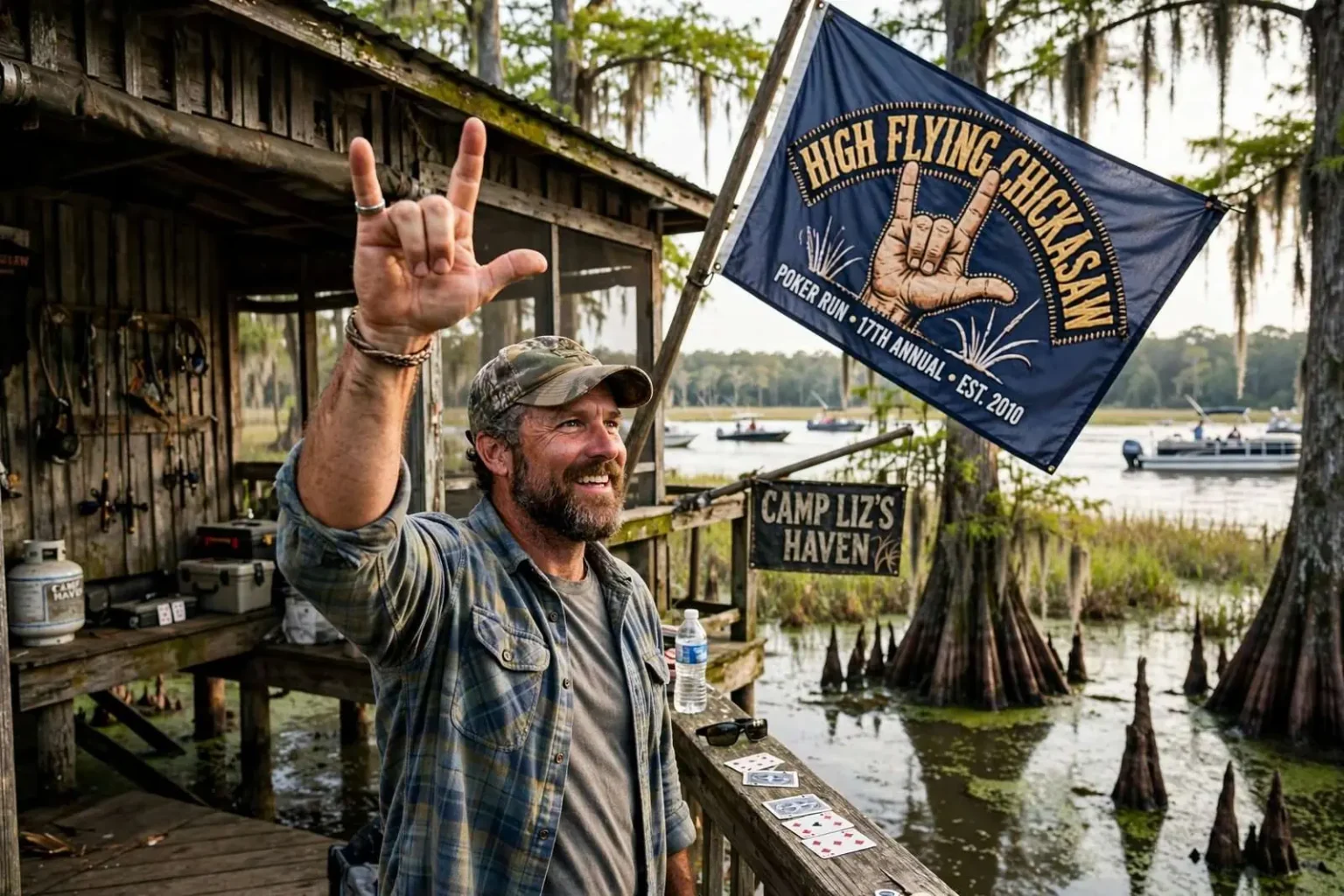
Kendall Dexter grew up in Mobile, but he will tell you without hesitation that he was raised in the Delta. The Mobile-Tensaw River Delta — the vast floodplain where the Mobile, Tensaw, Apalachee and Spanish rivers converge above Mobile Bay — has shaped his summers, his friendships, his idea of hospitality and, eventually, one of the more unusual annual traditions in south Alabama: the Mobile-Tensaw Delta High Flying Chickasaw Poker Run, now in its 17th year.
To understand the Poker Run, you first have to understand the Delta itself. Covering roughly 260,000 acres across the northern reaches of Mobile and Baldwin counties, it is the largest river delta and wetland in Alabama and the second-largest delta in the contiguous United States. About 20,000 of those acres are open water, 10,000 are marsh and more than 85,000 are bottomland forest, all draining a watershed that pulls water from some 44,000 square miles — including roughly two-thirds of Alabama. The federal government designated 190,000 acres of the bottomlands a National Natural Landmark in 1974, and naturalists, including the Mobile-born biologist E.O. Wilson, have long called the region “America’s Amazon.” By one count, the Delta hosts 126 species of fish, 46 mammals, 69 reptiles, 30 amphibians and at least 300 species of birds.
A sportsman’s paradise, built by boat
That bounty made the Delta a magnet for hunters and fishermen generations ago. Around the 1940s, sportsmen began building hunting and fishing camps deep in the swamp — structures that could be reached only by water, assembled from tools and materials that had to be hauled in by boat. Most were, and still are, one- or two-room shacks raised on pilings above the marsh grass.
Living out there is not easy, and the environment is relentlessly hostile to anything man-made. Materials rot and deteriorate at an accelerated pace in the wet heat. Untended camps literally sink into the mud, and a single hurricane can erase decades of work. Dexter said that the people who really love it build one and a storm gets it; the second one, the third one — now you’re in your fifties, it’s tough. He added that after that, people give up on it.
But for generations, the camps were the center of a thriving culture. When Dexter was 15, a 16-year-old friend with a boat became his ticket into the swamp. Every summer morning, the two would launch from the Causeway — the stretch of U.S. 90 that crosses the Delta between Mobile and the Eastern Shore.
He recalled that they would stop at Pollman’s, get two sandwiches and some Coca-Colas, and explore that Delta day in and day out until they knew every bit of it. When duck season opened, their parents let them skip school. He also recalled that they would leave the causeway Wednesday afternoon at 3:00 and come back Sunday afternoon; 15 years old, no cell phone, nothing, but they came back every time.
Liz’s Haven and the flag code
After college, Dexter became a regular at Liz’s Haven on the Causeway, a bar with a boat launch — or maybe a boat launch with a bar — that served as the unofficial cultural center for the lower Delta’s camp community. In duck season, the ritual was dependable: camps filled up on Friday afternoons, members scouted for birds, and after dark everyone converged on Liz’s.
Dexter said that you would bust up into Liz’s and the place would be packed with 65 guys all dressed in camouflage, jukebox cranked up, energy level way up, plenty of beer. The crowd would head back to camp, hunt the next morning, and regroup at Liz’s around lunch to do it all again.
The bar, he said, was where he learned the Delta’s social code. He said that it didn’t matter what you did, where you lived, or anything like that; you were judged based on your character in the Delta.
That code extended to camp etiquette, and it revolved around flags. Every camp flew one. A flag up meant the owners were in and open to visitors — and a visit meant something. Dexter said that you didn’t just get up there and say you were just passing through; you sat down, drank a few beers, ate their food, saw their camps, and talked to them. The hospitality ran both ways, and it built a community that cut across every other line. Liz’s Haven never reopened after Hurricane Katrina, and the Delta community has been thinner ever since.
An aging institution
Keeping a camp alive takes labor, and keeping a camp membership alive takes something more. Even the eight members who shared Dexter’s camp when he was young rarely participate anymore. He does not see the next generation filling the gap. He said that the young guys love it, but that what’s going to happen is that in two or three years from now, they start getting married, they start having kids, and it slows down.
The ground under the culture has shifted, too. Much of the Delta’s land has moved from private industrial ownership to protected public property, making it harder and more expensive to buy or lease a spot for a camp. Conservation groups have been part of that change — The Nature Conservancy acquired nearly 8,000 acres in the heart of the Delta in February 2024 as part of a long-term effort to protect the watershed. The ducks that once drew hundreds of hunters are largely gone, and many camps have disappeared.
Still, Dexter refuses to be a pessimist. He believes the Delta might even be an antidote to modern life — the busyness, the screens, the overcommitted calendars. He said that a certain level of peace and joy is the return on your investment in the Delta.
Bringing the Delta to people
Dexter has made it a personal mission to get as many people as possible into the swamp. When he and his wife lived near Braided River Brewing Company in Mobile, they got to know the staff, and now the brewery’s whole crew makes an annual trip to his camp for team-building. He organized an annual father-son frog gigging trip and invited a crowd of kids, many of whom fell for the Delta — some of them, now out of college, still come.
His biggest vehicle for that mission is the Poker Run. Poker runs themselves are nothing new — participants travel point to point collecting playing cards, then compare hands at the end — but Dexter, who launched the Delta version in 2010, saw how well the format fit the swamp. The participating camps act as dealers. On run day, they fly flags bearing the High Flying Chickasaw logo, welcome visitors, show off their places, put out food and drink, and deal one card to each participant. Late in the afternoon, everyone gathers for more food, live music and the draw-down; the best five-card hand takes the pot.
The name comes from a Delta salutation Dexter learned about one night at Liz’s — a wave with the thumb and forefinger extended and the other fingers curled into a fist. A “high flying Chickasaw” is the same gesture delivered with maximum enthusiasm, preferably one hand on the tiller of a jon boat.
The event is not a fundraiser, and Dexter does not make money from it; he covers his costs and everything else goes into the pot, with real care taken to keep the game honest. Over the years it has grown into the busiest day of the year in the most remote corners of the Delta, drawing 50 or more boats. There have been bands playing on pontoon boats in the river, and Dexter has packed so many people onto his camp’s deck that he worried about the structure.
His goal has evolved, though. The early aim was volume — seeing how many people he could get into the Delta. Now he cares most about camp participation: getting camps to know one another, to visit comfortably, and to take pride in hosting. He said that for him, it’s just a matter of nurturing this community with fun activities involved with it. He is ready to hand the event to someone younger; he would like to spend his Delta time slowing down, taking his grandson to the camp to fish and swim, and enjoying the quiet.
Earning the name
There is a title in the Delta that outsiders sometimes misread as an insult: Delta Rat. Dexter said that everybody wants to be a Delta Rat, but you have to earn it. The people who earn it know what it is to put down the mud paddle and pick up the push pole — the slow, stubborn business of levering a boat out of the muck, one pull at a time, until the water is finally deep enough that the hull glides free.
It is still work, but it is not backbreaking work. And that, Dexter said, is the point. The Delta gives back exactly what you put into it, in the currency of peace, friendship and long afternoons. He is ready to collect on the investment. But anyone who knows him would bet his camp’s flag will still be flying.
Related coverage from South AL News
- Exploring the Mobile-Tensaw Delta with Ben Raines: Indian Mounds, Giant Cypress and America's Amazon
- A New Keeper for the Gateway: The Alabama Wildlife Federation Reopens the 5 Rivers Delta Center
- Six Decades on the Causeway: The Bluegill Keeps Mobile Bay's Seafood Tradition Rolling
- Mystics of Pleasure Poker Run Sunday Offers $1,000 Prize on Six-Stop Boat and Car Route