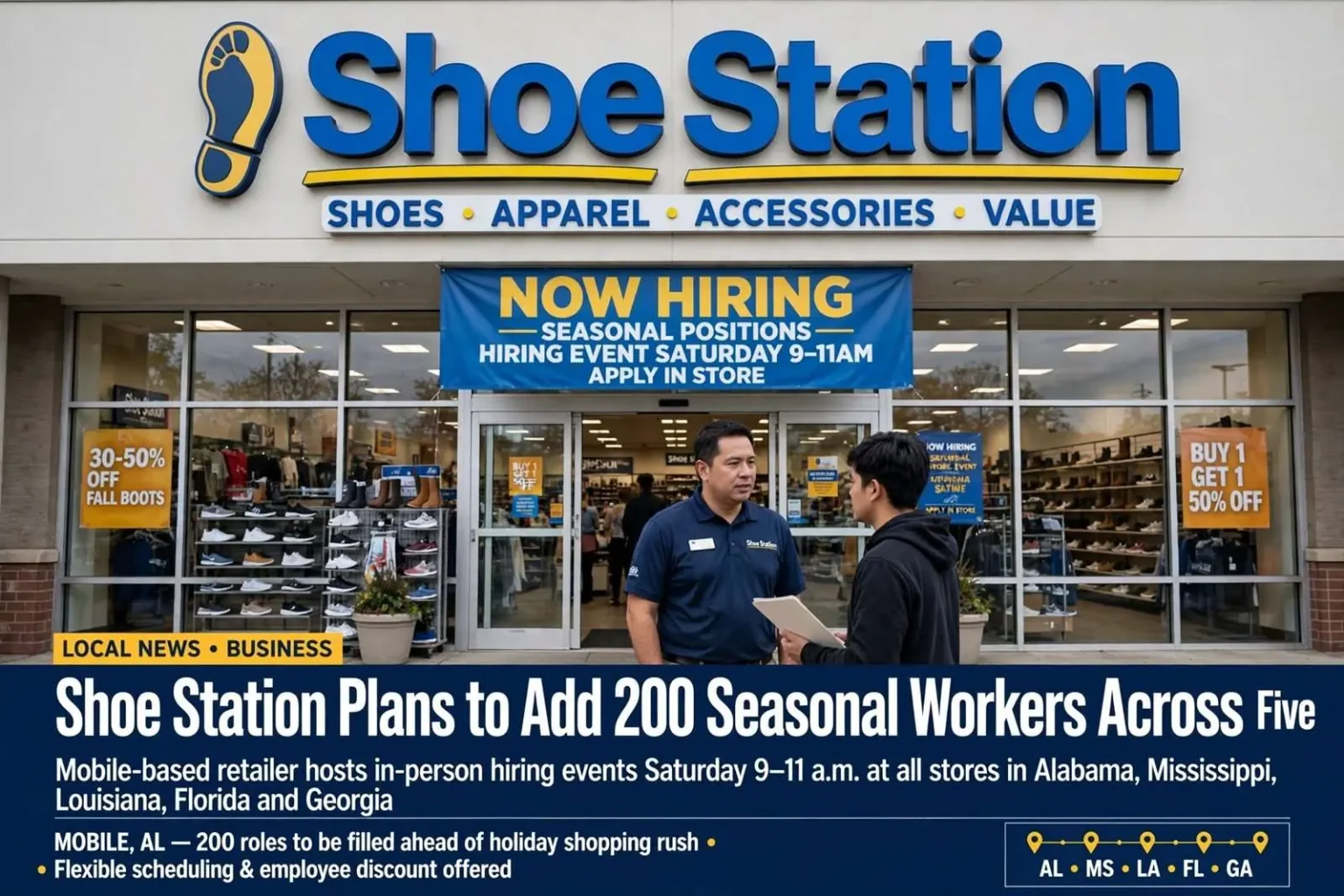
MOBILE — Mobile-based retailer Shoe Station is looking to fill roughly 200 seasonal positions ahead of the holiday shopping rush, and the chain is holding hiring events at each of its stores this weekend to do it. The job fairs run Saturday from 9 to 11 a.m. at every Shoe Station location, giving applicants a two-hour window to apply in person at the store where they hope to work. Managers will be on hand to collect applications, answer questions about schedules and duties, and in many cases conduct brief on-the-spot interviews.
The company operates stores across five southeastern states — Alabama, Mississippi, Louisiana, Florida and Georgia — and the hiring push covers all of them. That footprint means the 200 positions will be spread from the Gulf Coast through the broader Southeast, with the heaviest concentration at the chain’s home market stores in and around Mobile and Baldwin County. For a region where retail is a major employer, a hiring wave of that size is a meaningful dose of short-term opportunity, particularly for students home for the holidays, parents seeking income around school schedules, and workers looking to add hours during the busiest stretch of the retail calendar.
What the seasonal jobs involve
Seasonal employees at a shoe store do a bit of everything. The core of the job is customer service: helping shoppers find men’s, women’s and children’s footwear and accessories, checking sizes in the stockroom, and keeping the sales floor orderly during heavy traffic. Behind the scenes, seasonal staff handle unloading trucks, restocking shelves, processing online-order pickups, and keeping the back room organized so that the right boxes reach the floor quickly. Holiday weeks bring extended store hours, and that is precisely why the extra workers are needed.
In announcing the hiring, the company said it anticipates strong sales both online and inside its brick-and-mortar stores through the holiday season. The expectation reflects a broader pattern in which footwear has remained one of retail’s steadiest categories, and in which the line between e-commerce and physical stores has blurred. A customer may order online and pick up in the store, return an online purchase at the counter, or browse in person after seeing a product on the website — all of which takes staff. Shoe Station said benefits for the seasonal hires include flexible scheduling and an employee discount, perks that matter to the students and second-job workers who make up much of the seasonal workforce.
A familiar Gulf Coast rhythm
Seasonal retail hiring is a familiar late-fall pattern along the Gulf Coast, where stores staff up through November and December and sometimes keep on workers who perform well once the holiday rush winds down. For many young workers in Mobile, Baldwin County, and the surrounding parishes and counties, a seasonal retail job is a first work experience — a crash course in handling a register, managing a demanding customer, and staying on task through a long shift. For others, it is a bridge between jobs or a way to earn extra money for the holidays without committing to a permanent schedule.
The post-holiday conversion is the part seasonal workers watch most closely. Retailers typically staff up knowing that January will bring a slowdown, but strong performers — those who show reliability, learn the stockroom, and treat customers well — frequently receive offers to stay on. In a store where the permanent staff knows who worked hard through December, a seasonal job can become a foot in the door. Applicants who want that outcome should treat the Saturday hiring event as a job interview rather than a formality: dress for a customer-facing role, bring availability information for the full holiday period, and be ready to describe any prior work experience.
The homegrown chain behind the hiring
Shoe Station occupies a particular place in Mobile’s retail landscape. The company began as a single store in the Port City and grew store by store into a regional chain whose distinctive warehouses of footwear became familiar to shoppers across the Southeast. Its growth followed the region’s own: as Mobile, Baldwin County, and the Gulf Coast’s other population centers expanded, the chain added locations along the corridors where shoppers actually go, from suburban Mobile to Pensacola and beyond. The company’s buying model — deep assortments of shoes and accessories at value prices — depends on volume, which is one reason a strong holiday season matters so much to the operation.
Mobile has reason to take note when one of its homegrown retailers expands its payroll. Local-headquartered companies keep their decision-making, their distribution operations, and a large share of their spending in the region, and each seasonal hire in a distant state still ties back to a payroll system headquartered here. The hiring event also lands during a stretch when the Port City’s retail calendar is at its fullest, with holiday shopping overlapping the start of Mardi Gras season planning and the winter tourism traffic that passes through the region.
Tips for applicants
The company said applicants are directed to attend the Saturday session at the store where they would like to work. That detail matters. Because the events run simultaneously at every location, applicants should pick their preferred store, note the 9-to-11 a.m. window, and arrive early — managers at popular locations can work through a crowd quickly. No appointment is needed, but candidates should come prepared with basic information: prior employment history, references if they have them, and a clear statement of which days and hours they can work between now and early January.
Flexibility is the single strongest card a seasonal applicant can play. Stores need the most help on evenings, weekends, and the stretch around the major shopping days, and an applicant who can commit to those windows has a real advantage over one who can only work weekday mornings. The advertised benefits — flexible scheduling and an employee discount — cut both ways: the company builds schedules around its staffing needs, and workers who can flex with them are the ones managers remember when permanent positions open up.
What it says about the season ahead
A 200-worker hiring push is, at bottom, a forecast: the company expects a busy holiday stretch. Retailers do not add payroll on a hunch, and a chain with stores in five states ordering simultaneous hiring events is betting that foot traffic and online orders will both justify the headcount. For shoppers, that translates into shorter lines and better service during the weeks when stores are at their most crowded. For the local labor market, it means a few hundred paychecks spread across the Southeast, many of them in the Mobile area where the chain was born.
Applicants who miss Saturday’s window are not necessarily out of luck — stores frequently continue accepting applications until positions are filled — but the company’s message is that the Saturday session is the direct route. Show up at the store where you want to work, between 9 and 11 a.m., and ask for the manager running the hiring event.
For a Mobile-based business, a holiday hiring drive is also a homecoming of sorts: the chain that grew from one Port City store is once again counting on the region’s workers to carry it through its busiest season of the year.
Why in-person hiring events still work
In an era when most large retailers funnel seasonal applicants through online portals, Shoe Station’s decision to hold in-person job fairs at every store is a deliberate choice. A Saturday morning event lets managers see applicants face to face — how they carry themselves, how they speak, whether they seem comfortable approaching a stranger — which is difficult to judge from a web form. It also compresses the hiring timeline. Instead of collecting applications for weeks and then scheduling interviews, a store can meet dozens of candidates in two hours and move promising ones directly toward offers, which matters when the season is only days or weeks away.
The format also fits the product. Selling shoes is an active, hands-on job: kneeling to fit a child’s shoe, walking back to the stockroom for a size, standing for a full shift. Applicants who attend an event in person implicitly demonstrate the energy the work requires, and managers get a far better read on that than any resume provides. For applicants, the event removes the uncertainty of the online black hole — they walk out knowing they met a manager, and often knowing roughly where they stand.
Workers considering the opportunity should also think about what comes after December. Retail experience is portable: cash handling, customer service, inventory management, and point-of-sale systems are skills that transfer to nearly any employer in the region, from big-box stores to restaurants to distribution centers. A seasonal stint that ends in January still leaves a worker with a reference, a work history entry, and a sense of whether retail suits them. A seasonal stint that goes well can leave a great deal more — managers across the retail industry consistently say their best permanent employees started as holiday hires who simply never stopped showing up as expected.