Snipping & Sipping Fundraiser Aug. 29 to Support Low-Cost Pet Neutering Program
A Snipping & Sipping fundraiser Aug. 29 in Pensacola will benefit the Save Our Shelters low-cost spay and neuter program for Escambia County, Florida families.
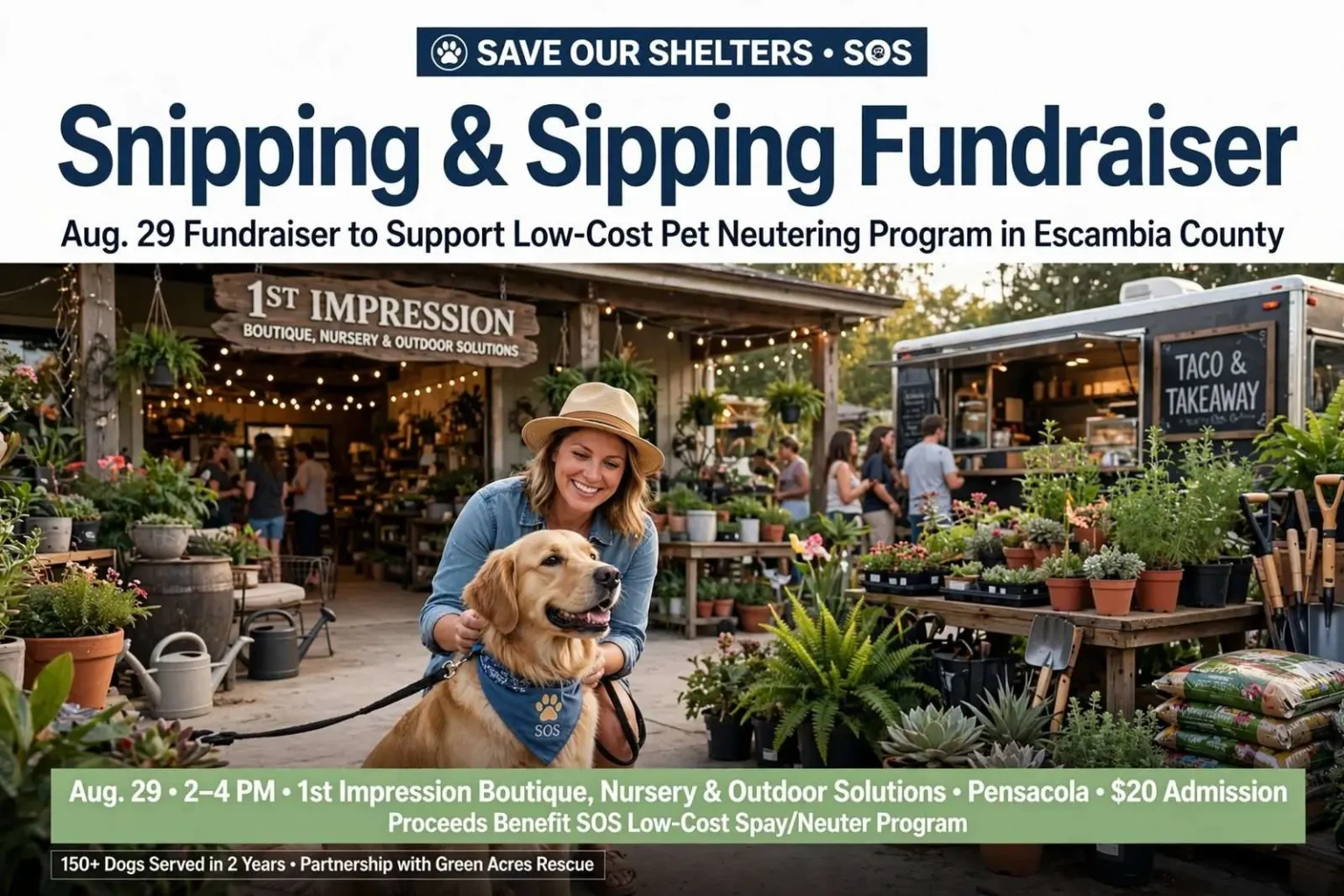
A “Snipping & Sipping” fundraiser benefiting the Save Our Shelters (SOS) low-cost spay and neuter program will be held Aug. 29 from 2 to 4 p.m. at 1st Impression Boutique, Nursery and Outdoor Solutions in Pensacola. The event combines an afternoon of shopping and socializing with a direct appeal for one of the most persistent problems facing animal welfare advocates along the Gulf Coast: too many unwanted animals and too few affordable options for the families who love them.
Admission to the event is a $20 donation, with all proceeds going toward helping low-income families across Escambia County, Florida, access spay and neuter services for their dogs that might otherwise be out of financial reach. Organizers stress that the donation model keeps the barrier to entry low — the cost of a single routine veterinary visit in many cases — while the money collected goes straight into a fund that pays for surgeries for qualifying households.
The Save Our Shelters program is partnered with Green Acres Rescue to connect eligible families with the service. The partnership matters because access is the central problem: a family that wants to do the right thing for its pet may still be unable to afford a procedure that can run well into the hundreds of dollars at a private clinic. By pairing the SOS fund with a rescue organization that already works with the community, the program shortens the path between a family’s request and an actual appointment.
Why Low-Cost Spay and Neuter Matters
Veterinarians and shelter professionals have long identified spaying and neutering as the single most effective tool for reducing the number of animals that end up in shelters. Dogs and cats that are not sterilized can produce multiple litters a year, and those litters — whether they are surrendered deliberately or abandoned — eventually land on the capacity of municipal and nonprofit shelters. A single unaltered female dog and her offspring can, over successive generations, produce thousands of descendants, which is why targeted surgical programs are treated as population control rather than simple pet care.
The financial side of the equation is just as important in a community like Escambia County. Household income in parts of the Pensacola area remains well below national averages, and veterinary costs have risen sharply across the country in recent years. When a spay or neuter surgery competes with rent, utilities and groceries, the surgery loses — and the result is another litter of puppies that the family cannot keep and that no shelter particularly has room for. Low-cost programs exist to remove exactly that trade-off.
There are also direct health benefits for the animals themselves. Sterilization reduces or eliminates the risk of several reproductive cancers and serious infections, and it is associated with reduced roaming behavior, which in turn lowers the odds that a dog will be hit by a car, injured in a fight or picked up as a stray. For families on tight budgets, a subsidized surgery is often the only realistic way to capture those benefits.
Two Years of Impact
Organizers say the program has already made a measurable difference in the community. Over the past two years, the Save Our Shelters program has helped 150 dogs belonging to Escambia County residents get spayed or neutered, an effort that has helped reduce overcrowding at local animal shelters. Each of those 150 surgeries represents one fewer chance of an unwanted litter, and the cumulative effect compounds: the dogs served by the program will never add to the stray population, and their owners avoided a bill that could have strained household finances for months.
Spay and neuter programs are widely credited with curbing unwanted litters, which in turn eases the burden on shelters that often operate at or beyond capacity. Shelter overcrowding is not an abstract concern in Northwest Florida. When kennels fill up, shelters face difficult choices — extended stays for animals already in residence, reduced intake of new strays, and greater reliance on fosters and transfer partners in other counties and states. Every litter prevented before it is born is capacity the shelter does not have to find later.
The SOS program’s work also supports the broader rescue ecosystem in the Pensacola area. Organizations like Green Acres Rescue depend on community adoptions and transfers to move animals through their systems, and the pace of that movement improves when the supply of new homeless animals slows. Rescuers frequently describe spay and neuter funding as the upstream fix: spend a few hundred dollars on surgery today, and avoid the far greater cost of sheltering, feeding and rehoming a litter next season.
The two-year track record also demonstrates something that pure advocacy often cannot — that local families want to be responsible pet owners when the financial obstacle is removed. The program’s 150 served dogs came from households that took the step of seeking out the service, applying through the partnership with Green Acres Rescue, and following through with appointments. Fundraisers like the Aug. 29 event are what keep that pipeline open for the next group of families.
An Afternoon Out for a Cause
A food truck will be on-site during the event, giving attendees a chance to enjoy food while supporting the cause. The format is designed to feel less like a charity function and more like a community afternoon — guests can browse the boutique, nursery and outdoor offerings, grab a plate from the truck, and talk with organizers about the program and how to apply for its services.
The host venue is itself part of the story. 1st Impression Boutique, Nursery and Outdoor Solutions is a Pensacola business that has opened its grounds to the fundraiser, and community-hosted events like this one have become a staple of grassroots animal welfare fundraising across the Gulf Coast. Rather than renting event space, organizers put the fundraiser where the shoppers already are, which lowers overhead and means more of every dollar goes toward surgeries.
Organizers emphasized that every dollar raised at the Aug. 29 event will go directly toward continuing that work, allowing SOS to keep helping low-income families across the county access a service that might otherwise be unaffordable. That direct-to-service model is a significant part of the program’s pitch to donors: there is no long administrative chain between the donation at the door and the surgery it funds. With roughly 150 dogs served in the program’s first two years, sustained funding is what determines whether the next two years look the same.
How Residents Can Get Involved
For residents who want to support the program but cannot attend, the underlying need does not expire after the event ends. Donations to the spay and neuter fund, fostering for rescue partners, and simply spreading word of the program to eligible families all extend its reach. Pet owners in Escambia County who believe they may qualify for assistance are encouraged to ask about the SOS program through its partnership with Green Acres Rescue, where staff can walk families through eligibility and scheduling.
Those interested in supporting the program are encouraged to attend the fundraiser at 1st Impression Boutique, Nursery and Outdoor Solutions on Aug. 29, from 2 to 4 p.m. A $20 donation at the door buys admission, food-truck fare and — more importantly — a share in keeping one of the county’s most practical animal welfare programs running for the families and dogs who depend on it next.
The event’s timing also fits the rhythm of animal welfare work on the Gulf Coast. Late summer is a hard season for local shelters, coming on the heels of spring and summer breeding months when litters arrive in force and kennel populations peak. Fundraising in late August positions the program to spend through the fall, when spay and neuter demand is high and every prevented litter eases the strain heading into the following spring. It is the same logic shelter medicine specialists apply nationally: funding sterilization capacity just ahead of breeding season delivers the largest return per dollar.
The broader picture in Florida reinforces the stakes. Animal welfare organizations across the state have reported sustained pressure on shelter capacity in recent years, driven by rising costs of pet ownership, housing instability and the simple arithmetic of unsterilized animals. Northwest Florida is not exempt, and Escambia County families feel it directly when a stray dog shows up in the neighborhood or a shelter posts an emergency intake plea. Programs like SOS operate at the opposite end of that cycle — quietly, one surgery at a time, before the emergency exists.
For attendees, the Aug. 29 event is a low-lift way to participate in that cycle’s better half. Two hours, one food truck, and a twenty-dollar bill translate into sterilization services for families who have already demonstrated that they want them. In a county where the program has served 150 dogs in two years, that math is easy to like.