

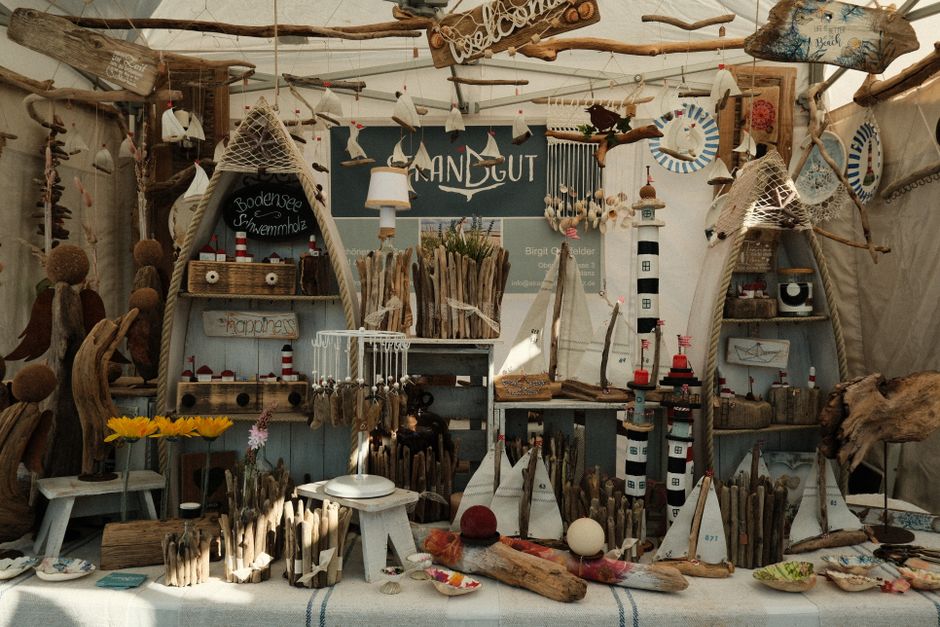
A small shop along a shady lane off Twin Beech Road in Fairhope is where Evans Davis is happiest — when he isn’t on a stage, that is. Other than playing music, there is not much he would rather do than find new uses for old wood, and after nearly 35 years on the Eastern Shore, he has built a life that runs on both: a carpentry and art practice called Oakwood Art, and a parallel career as a songwriter and guitarist in one of the coast’s favorite acts, the Leavin’ Brothers.
The two crafts share more than a workbench and a band schedule. Both start with raw material — a weathered plank or a melody — and both reward the patience to reveal what was there all along. Customers who buy his frames, shutters, tables, benches, headboards, and bookcases tend to sense that: each piece is one of a kind, practical, and seasoned by the same engaging personality that animates his shows.
Old wood with a family address
Davis works mostly with wood salvaged from old farmhouses and barns, much of it from Lowndes County — a direct link to his own family’s past. He loves sanding down old layers of paint to reveal the faded hues underneath, and he has the trained eye to look at a weathered plank, window, or door and know what kind of tree it came from and roughly when it was milled. “I like its history,” he says. “They did all this before electricity, so they had these steam-powered or mule-driven sawmills out in the middle of the woods in these communities, using the wood they had, which was mostly pine and cedar and a little oak.”
The history he values is increasingly scarce. Much of the South’s old-growth longleaf pine and cedar went into farm structures in the nineteenth and early twentieth centuries — wood that is denser and tighter-grained than most of what is harvested today, and which survives only in the buildings it once held up. When a barn comes down now, the boards are often the last physical record of the family and community that raised it. That is part of what Davis is preserving in his shop: not just lumber, but a region’s building memory, one sanded layer at a time. It also explains the demand for his work. Tastes have moved toward exactly this look — the aged, charactered wood that mass retailers now imitate with wire brushes and stains — but buyers who want the real thing need someone who can find it, and Davis’s decades of salvage work put him among the few who can.
His grandfather set the pivotal project in motion, asking Evans to help tear down an old barn on the family property. The barn yielded a trailer full of used building materials — and, more importantly, a direction. “This was several years ago, before this reclaimed, stressed wood got real hot,” he says. “Nowadays you even see it duplicated in the stuff you get from Home Depot and Walmart and places like that — but this is the real deal.” He had been building and remodeling homes and businesses for years, with guidance from cousins who were third-generation carpenters. His father had urged him to learn a conventional trade alongside music; the barn taught him the trade and the calling could be the same thing. “I just took to it, and I’ve been doing it ever since,” he says.
Driftwood and decoys
If the furniture side of Oakwood Art is sturdy and functional — “It’s solid, it’s tough and it’s durable,” Davis says, adding with characteristic humor, “I can throw it in the truck or throw it on the trailer, stack it up and go to an art show, and the more dents and scratches it gets, the more it’s worth” — his artistic side comes from the water. On strolls along the Eastern Shore’s beaches, he collects driftwood of different sizes and shapes and arranges the pieces into visual representations of familiar coastal wildlife: a shrimp, a seahorse, various fish, and more recently a full-sized duck that suggests an abstract decoy. The duck began, he says, with a single piece of wood that looked like a head — so he scavenged the shoreline for pieces that looked like feathers. The sculptures are somewhat delicate compared with his furniture, which is exactly the point: one end of the shop for the porch, the other for the mantel.
Among his larger builds is what he calls a “Rolling Home” — a tiny house on wheels that started life as a boat trailer. Davis laid a floor, erected four walls, and finished it with a full bath, a kitchenette, a window air conditioner, and a small space heater, all within 8 by 14 feet. He imagines it as a guest house, temporary quarters, an art studio, a man cave — “or maybe even a hair salon,” he offers, with the shrug of a man who has learned not to predict what people will want until they walk in the shop.
Brothers, Nashville, and the Leavin’ Brothers
The music half of the story runs through his brother Charles. The Davis brothers formed the Leavin’ Brothers while pursuing songwriting careers in Nashville, then toured the South for five years before slipping off the boots for more comfortable footwear on the Eastern Shore. Songs like “Here Comes the Farm,” “Caroline,” “Amnesia,” and “Love Budget” carry the band’s easy, storytelling sound, and the duo has remained a mainstay of the L.A. Songwriters Festival held each year at American Legion Post 199 in Fairhope — as familiar on local stages as their furniture is in local houses.
Davis knew from a young age that he wanted to play music; the carpentry, at his father’s urging, became the trade that made the music sustainable. These days the balance has tipped the other way, with the band more of a side venture to the shop — but both feed the same appetite for making things by hand. The rhythm of the two careers suits him: songwriting in the early morning, sawdust by mid-morning, a show when the calendar calls. Fellow musicians know the shop as a place where instruments get repaired as often as picture frames get built, and fellow craftsmen know the band as the reason orders sometimes wait until after a weekend gig. Neither complains; that is how a working artist’s calendar is supposed to look.
A Fairhope family story
Davis’s own history on the Eastern Shore is a family story. His parents moved to Fairhope in 1990, when his father — a beloved physician — decided he wanted to live near the water and took a job at Bay Medical Family Practice. His mother, Dr. Margaret Haigler Davis, who held a doctorate in English, joined the faculty of Spring Hill College as an English professor. Evans followed his parents to Fairhope, and his four younger brothers eventually did the same. Dr. Davis passed away in 2020, but the Davis family remains an active, visible part of the community.
The choice of town was fitting, too. Fairhope has drawn makers and artists since its founding days as a single-tax colony on the bluff above Mobile Bay, and the town’s reputation as a haven for artists, writers, and craftsmen has only grown with its art walks, galleries, and juried shows. A craftsman-musician fits the local character exactly — and the demand Davis sees at art shows and through word of mouth suggests his neighbors agree. His “Rolling Home” could itself double as a festival booth on wheels; its owner has the imagination to see a trailer as a guest house, and the skill to make the vision stand up.
Nearly 35 years after arriving, Evans Davis has carved out a niche that suits him precisely: a shop off Twin Beech Road full of second lives for first-growth lumber, a shoreline habit that turns driftwood into ducks and seahorses, and a band book that still gets opened for the festivals and listening rooms of the coast. It is a legacy built the way his favorite barns were — a little at a time, out of materials that were too good to waste.