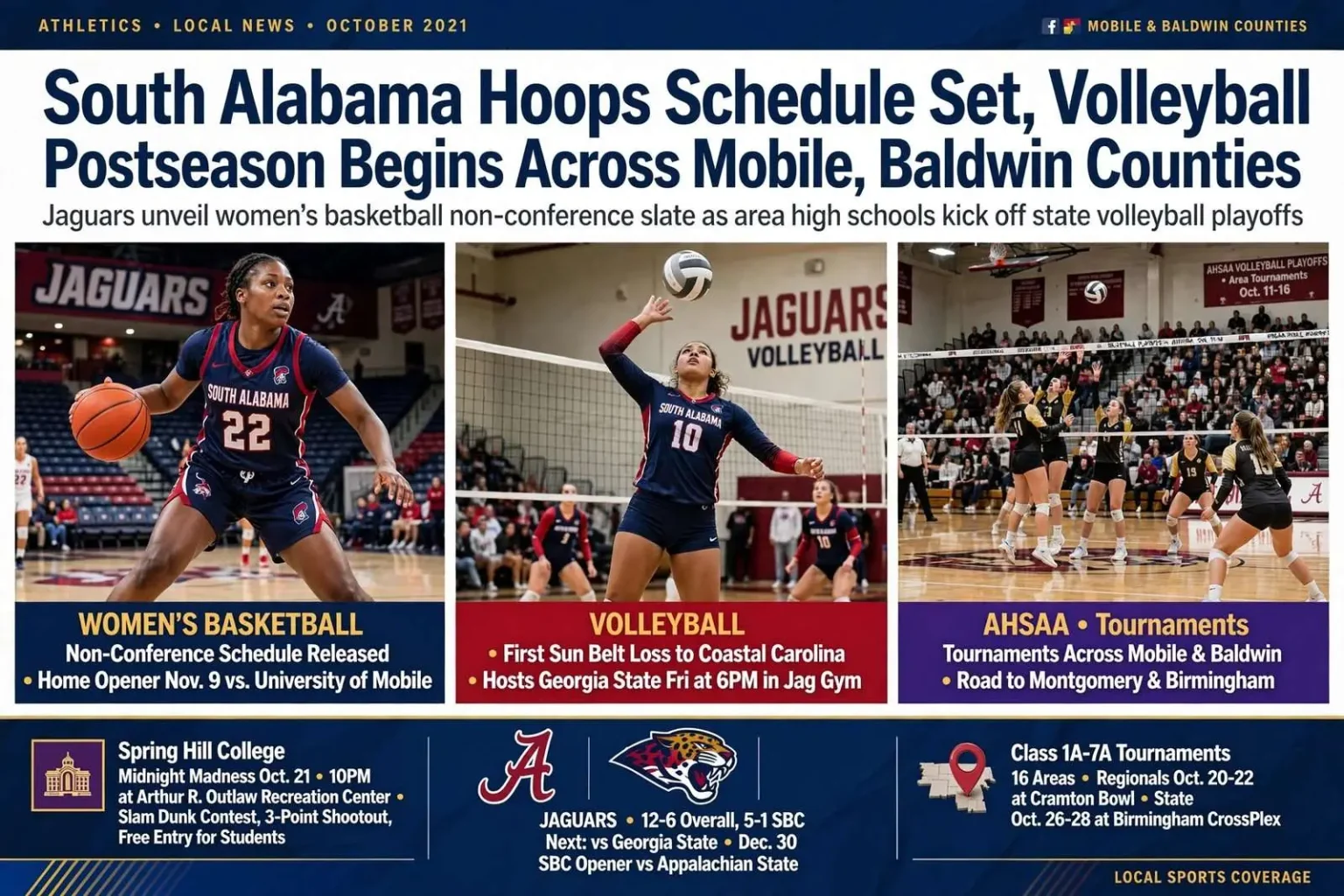
South Alabama athletics and area high schools have a busy stretch of games and tournaments on tap this month, with the Jaguars women’s basketball program unveiling its non-conference schedule, the volleyball team absorbing its first Sun Belt Conference loss of the season, Spring Hill College gearing up for a preseason celebration, and dozens of Mobile and Baldwin county high schools kicking off the state volleyball playoffs.
The University of South Alabama women’s basketball team released its full non-conference schedule this week, and it features six games at the Mitchell Center along with a marquee road trip to the Southeastern Conference. The Jaguars open the season with an exhibition against Spring Hill College on Nov. 1 before their regular-season opener at home against the University of Mobile on Nov. 9. South Alabama then hits the road for the first time on Nov. 12 for a matchup at Rutgers, returning to Mobile on Nov. 15 to host Auburn-Montgomery.
The schedule continues with a trip to Tulane on Nov. 20, followed by consecutive home games against New Orleans on Nov. 23 and Mercer on Nov. 26. The Jaguars close out November on the road at Alabama State on Nov. 28 before returning to the Mitchell Center on Dec. 5 to face Southern Miss. A trip to Nicholls State on Dec. 11 precedes the team’s final non-conference home game on Dec. 14 against Faulkner. South Alabama will then head to Georgia for a three-game stretch, taking on Charleston Southern and Tulsa on Dec. 18-19 as part of the Georgia State Classic before a matchup at Georgia on Dec. 21. The Jaguars are slated to open Sun Belt Conference play at home against Appalachian State on Dec. 30.
On the volleyball court, the South Alabama Jaguars suffered their first Sun Belt Conference loss of the season last weekend, falling to Coastal Carolina in four sets by scores of 25-23, 18-25, 16-25 and 15-25 in an East Division match played at the HTC Center. The result snapped a five-match winning streak for the Jaguars, who improved to 12-6 overall and 5-1 in conference play before the setback. South Alabama took the opening set to grab an early 1-0 lead, but Coastal Carolina, now 12-4 overall and 6-0 in Sun Belt play, rallied to take the next three sets and extend its winning streak over the Jaguars to 12 matches. South Alabama returns to action this Friday, hosting Georgia State at 6 p.m. at Jag Gym.
Spring Hill College is preparing to welcome back fans and players alike with Midnight Madness festivities set for Thursday, Oct. 21, beginning at 10 p.m. at the Arthur R. Outlaw Recreation Center. The event marks the return of the college basketball season as well as the return of spectators to arenas, and will introduce fans to the players and coaches of the 2021-22 Spring Hill Badgers men’s and women’s basketball teams. The evening will include a slam dunk contest judged by local celebrities, a three-point shooting contest, games with prizes for fans, and performances by the Spring Hill cheer and dance squads. A DJ will provide music throughout the event, and free food will be available for Spring Hill students with a valid ID.
Meanwhile, the Alabama High School Athletic Association’s volleyball postseason is underway, with area tournaments taking place across Mobile and Baldwin counties this week. Area tournaments are being played from Oct. 11 through Oct. 16, with the top two teams from each area advancing to their respective regional tournament, scheduled for Oct. 20-22 at the Multiplex at Cramton Bowl in Montgomery. The top two finishers from each classification at regionals will then advance to the state tournament, set for Oct. 26-28 at the CrossPlex and Harris Arena in Birmingham.
In Class 1A Area 1 action at Bayshore Christian, McIntosh and Fruitdale meet at 5 p.m. on Oct. 14, with the winner facing host Bayshore Christian at 6:30 p.m. for the area title. Class 2A Area 1 will be decided at Orange Beach, where Washington County takes on J.U. Blacksher at 4:30 p.m. on Oct. 14, followed by a 6 p.m. title match against Orange Beach.
Class 3A Area 1 will be held at St. Luke’s on Oct. 12, with Mobile Christian facing Cottage Hill Christian at 3:30 p.m. and St. Luke’s taking on Chickasaw at 4:30 p.m., setting up a 5:30 p.m. title match between the two winners. Class 4A Area 1 is scheduled for Oct. 16 at St. Michael, where the host Cardinals face Vigor at 9 a.m. and W.S. Neal meets Escambia County at 10 a.m., with the area championship following at 11 a.m.
Class 5A Area 1 play will take place at Bayside Academy on Oct. 13, with Elberta facing B.C. Rain at 5 p.m. before the winner meets Bayside Academy at 6 p.m. for the title. In Class 5A Area 2 at UMS-Wright, Satsuma and LeFlore square off at 4:30 p.m., with the winner advancing to a 6 p.m. title match against the host Bulldogs.
Class 6A Area 1 will be contested at Saraland on Oct. 13, beginning with Blount and Citronelle at 2 p.m., followed by Saraland taking on that winner at 3:30 p.m. In the other half of the bracket, St. Paul’s Episcopal faces Faith Academy at 5 p.m., with the area championship set for 6:30 p.m. Class 6A Area 2 will be decided at Spanish Fort, where the host Toros face Robertsdale at 1 p.m. and Gulf Shores meets Baldwin County at 2:30 p.m., setting up a 4 p.m. title match.
Class 7A Area 1 tournament play is set for Oct. 14 at Mary G. Montgomery, with Theodore facing Davidson at 1 p.m. and the host Vikings taking on that winner at 3 p.m. Baker and Alma Bryant meet at 5 p.m., with the area title match following at 7 p.m. Rounding out the local brackets, Class 7A Area 2 will be held at McGill-Toolen, where Murphy and Foley meet at 2:30 p.m., with McGill-Toolen facing the winner at 4 p.m. Fairhope and Daphne square off at 5:30 p.m., setting up a 7 p.m. championship match.
This story unfolds across the distinctive landscape of South Alabama, a region defined by its pine forests, winding rivers, and Gulf Coastal Plain geography. The area’s communities—from the port city of Mobile to the agricultural heartlands of the Black Belt—share interconnected economies and histories shaped by timber, agriculture, shipping, and more recently, aerospace and advanced manufacturing. Local governance across county lines often coordinates on regional planning, workforce development, and infrastructure projects that affect residents throughout the southern tier of the state. The geography itself shapes daily life: low-lying coastal plains face hurricane exposure, while inland counties contend with river flooding and rural transportation challenges. Understanding the setting helps explain why local decisions carry weight far beyond municipal boundaries.
The environmental context of South Alabama is inseparable from its waterways and Gulf coastline. The Mobile-Tensaw Delta, one of the nation’s most biodiverse river systems, filters freshwater into Mobile Bay while supporting fisheries, recreation, and flood mitigation. Coastal communities face recurring hurricane exposure and long-term sea-level considerations, shaping building codes, insurance markets, and emergency planning. Conservation efforts by organizations like the Alabama Coastal Foundation, The Nature Conservancy, and state agencies work to preserve critical habitat while balancing development pressures. Water quality monitoring, oyster reef restoration, and living shoreline projects represent collaborative approaches to sustaining the natural resources underpinning both ecology and economy. Inland, working forests and farmland form the backbone of a rural landscape where land use decisions carry generational significance.
Education across South Alabama spans a network of public school districts, community colleges, and universities serving diverse student populations. The University of South Alabama in Mobile anchors higher education with medical, engineering, and marine science programs, while Troy University, Faulkner University, and Spring Hill College provide additional four-year options. The Alabama Community College System—including Coastal Alabama, Bishop State, Reid State, and Lurleen B. Wallace Community Colleges—delivers workforce training, dual enrollment, and transfer pathways. K-12 districts navigate state accountability measures, teacher recruitment challenges, and facility needs across urban, suburban, and rural settings, with local tax referendums often determining supplemental funding for programs and capital improvements. Partnerships between schools, employers, and nonprofits aim to keep opportunity tied to place, so that graduates can build careers without leaving the region.
The cultural fabric of South Alabama weaves together Indigenous heritage, colonial-era settlements, Civil War history, civil rights milestones, and enduring folk traditions. The region’s Mardi Gras traditions—centered in Mobile as the birthplace of North American Mardi Gras—coexist with community festivals celebrating shrimp, peanuts, watermelons, cattle, and maritime heritage. Historic districts in Mobile, Fairhope, Monroeville, and elsewhere preserve architectural character while supporting heritage tourism. The Alabama Historical Commission, local preservation societies, and the Alabama Trust for Historic Preservation work to protect significant sites. Oral history projects and university archives document the stories of communities shaped by agriculture, timber, shipbuilding, and the ongoing negotiation of identity in a rapidly changing South. These traditions not only enrich daily life but also anchor a sense of place that newcomers and longtime residents share.
Public safety across South Alabama depends on layered coordination among municipal police, county sheriffs, state troopers, and federal partners. Sheriffs’ offices in rural counties often serve as the primary law enforcement presence, while city departments handle municipal policing and community outreach. Emergency management agencies at the county and state level plan for hurricanes, flooding, and other hazards, coordinating shelters, evacuations, and recovery aid. Fire districts, volunteer rescue squads, and emergency medical services bridge gaps in coverage where paid staffing is thin. The Alabama Law Enforcement Agency and programs like AMBER Alert and the state fusion center extend resources regionally. How these agencies communicate and cooperate—through joint task forces, mutual aid compacts, and shared dispatch systems—directly affects response times and community trust in the places where people live and work.
Sport occupies a central place in South Alabama’s community life, from Friday-night high school football that draws whole towns to the sidelines, to college athletics at the University of South Alabama and across the state. Mobile’s longstanding role as a cradle of football talent—producing legends who went on to the professional ranks—is a point of regional pride, reinforced by events like the Senior Bowl, which has showcased NFL hopefuls in the city for decades. Youth leagues, recreation departments, and booster clubs sustain participation at the grassroots level, while the area’s coastal setting supports fishing tournaments, regattas, and beach athletics that reflect the local environment. The economic and social lift from sporting events—hotel stays, restaurant traffic, and civic visibility—makes athletics a quiet but steady contributor to the regional identity and to the small-business economy that surrounds game days.
Animal welfare organizations across South Alabama operate with limited resources and a steady stream of need. Municipal animal shelters in Mobile, Baldwin, and neighboring counties manage intake, adoption, and reunification efforts, often partnering with nonprofit rescues that provide foster networks, spay-neuter assistance, and transport to out-of-region adopters. Volunteer-driven groups fill gaps that public funding cannot, relying on donations, fundraisers, and grant support to keep operations running. The Gulf Coast’s position as both a tourist destination and a growing residential region has increased demand for pet services, while rural areas contend with stray and feral populations that strain capacity. Community education on responsible ownership, microchipping, and low-cost veterinary care has emerged as a practical lever for reducing shelter overcrowding. Efforts like local giving campaigns demonstrate how resident participation can translate directly into care for animals that might otherwise go without.
As this situation continues to develop, stakeholders across the affected communities will monitor outcomes and adjust responses accordingly. The interconnected nature of South Alabama’s counties means that decisions in one jurisdiction often ripple outward, affecting neighbors in ways that underscore the value of regional communication and coordinated planning. Residents seeking to stay informed can engage with local government meetings, school board sessions, and community forums where these matters are discussed in public. The ongoing dialogue between officials, experts, and citizens reflects the democratic processes through which the region navigates change while preserving the character and resilience that define its communities. Continued attention from local news outlets helps ensure that decisions remain transparent and that the people most affected have the information they need to participate in shaping what happens next.