South Alabama-Led Science Team Tapped to Count Greater Amberjack Across Gulf and South Atlantic
A Mississippi-Alabama Sea Grant team led by USA's Sean Powers will estimate greater amberjack numbers in Gulf and South Atlantic waters.
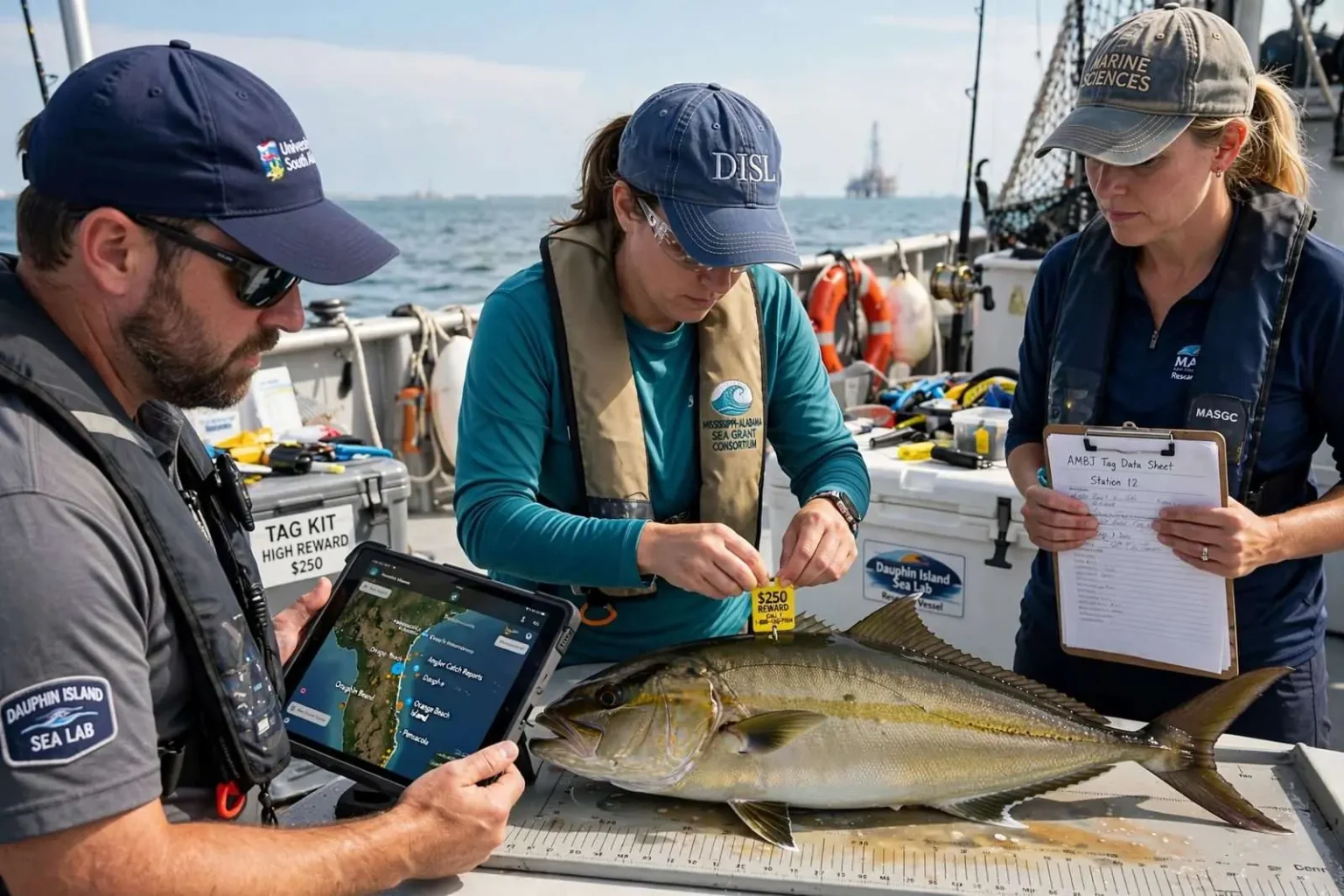
A team of scientists organized through the Mississippi-Alabama Sea Grant Consortium will lead an independent effort to estimate how many greater amberjack swim in U.S. waters of the Gulf of Mexico and South Atlantic — a study with major implications for the prized game fish that anchors much of the Gulf Coast’s offshore charter industry. The team, selected through a peer-review process, will also study the species’ movement patterns and how the fish distribute themselves across artificial reefs, natural habitat and uncharacterized bottom.
The scale of the undertaking reflects how much rides on getting the numbers right. Greater amberjack support one of the most popular offshore fisheries on the northern Gulf Coast, drawing charter boats and private anglers to the rigs and reefs off Alabama, Mississippi and the Florida Panhandle. When federal managers set seasons and bag limits based on stock assessments, those assessments are only as good as the data beneath them — and for years, both fishermen and some independent scientists have questioned whether the official picture of the amberjack population matches what anglers see on the water.
Why an independent count matters
Stock assessments for greater amberjack have long been a point of friction between the recreational fishing industry and the federal agencies that manage it. Amberjack seasons have been shortened or closed in the Gulf in recent years, and charter operators from Orange Beach to Destin have argued that fish are more abundant than the assessments suggest — an argument that carries weight in coastal towns where a day of offshore fishing supports boat crews, marinas, tackle shops and bait houses. An independent estimate, developed alongside the standard federal process, gives managers a second line of evidence to weigh and gives the fishing public a stake in the science that shapes its seasons.
The Mississippi-Alabama Sea Grant Consortium, which connects university researchers across the two states with coastal communities and industries, was chosen to coordinate the effort because of its position between the scientific and fishing worlds. The peer-review selection process meant competing research teams submitted proposals that outside experts evaluated for scientific rigor before a winner was chosen — a structure designed to ensure the resulting estimate can withstand scrutiny from federal scientists and skeptical anglers alike.
Fishermen asked to map their catches
Project leader Sean Powers, chair of marine sciences at the University of South Alabama and a senior marine scientist at the Dauphin Island Sea Lab, said a major component is what researchers call Traditional Ecological Knowledge. Anglers will be able to use interactive web tools to mark on a map exactly where they typically catch amberjack, helping scientists design smarter surveys and concentrate sampling where fish are actually abundant.
The premise behind the mapping effort is straightforward: commercial and recreational fishermen have spent years, in many cases decades, learning where amberjack hold on the northern Gulf. Charter captains know which wrecks and reefs produce fish in spring and which deep spots hold them in the heat of summer; recreational anglers know the rigs and artificial reefs where the species gathers to spawn. That accumulated knowledge is invisible to trawl surveys and fishery observers, but it can steer scientists toward the habitats where sampling will actually count.
The study will develop new data sources and assessment approaches to improve both agency and independent estimates of the stock’s abundance across its range. Researchers are also offering high-reward tags worth $250 to anglers who return them with catch locations, adding another stream of on-the-water data from the recreational fleet.
High-reward tagging has a long track record in Gulf fisheries science. When a modest fraction of tagged fish carries a substantial prize, anglers have a real incentive to report recaptures — and every reported recapture tells scientists something about how far a fish moved, how fast it grew and how heavily a particular area is fished. For a species like amberjack, which shows strong site fidelity to reefs and wrecks, the pattern of tag returns can be as revealing as the count itself.
The habitat question: reefs, natural bottom and the unknown
One of the study’s central tasks is understanding how amberjack distribute themselves across artificial reefs, natural habitat and uncharacterized bottom — areas of the seafloor that have never been mapped in detail. That last category is larger than most anglers realize. Vast stretches of the Gulf floor off Alabama and the Florida Panhandle have never been surveyed with modern instruments, and scientists cannot say with confidence how much fish habitat exists in the unmapped expanse.
Alabama’s artificial reef program, among the most extensive in the nation, has deposited thousands of structures — from decommissioned ships and bridge spans to concrete pyramids — across a permitted zone off the coast. Those reefs concentrate amberjack, snapper, grouper and other species, making them magnets for anglers and, in turn, focal points for the fishery. But a stock assessment built only on data from heavily fished reefs can miss fish holding on natural bottom or in undocumented areas, which is precisely the blind spot the movement and distribution work is designed to address.
The institutions behind the study
The University of South Alabama and the Dauphin Island Sea Lab sit at the center of Alabama’s marine research establishment. The Sea Lab, located on the eastern end of Dauphin Island, hosts the state’s marine science consortium and runs research vessels, laboratories and educational programs that reach from elementary classrooms to graduate research. Powers, who holds appointments at both institutions, has spent years studying reef fish populations in the northern Gulf, including work with underwater cameras and acoustic surveys on Alabama’s reef system. Putting a locally based scientist in charge of an estimate this consequential is itself notable: the charter fleet that will supply much of the data will be working with researchers they know by name.
The Mississippi-Alabama Sea Grant Consortium ties that local capacity into a national network. Sea Grant programs, modeled on the agricultural extension system, fund coastal research and translate it for the public; the consortium’s member universities span the two states’ coastal campuses. Studies of this kind — where the research question comes as much from industry as from academia — have become a Sea Grant specialty, and the amberjack effort follows the model of earlier independent assessments that paired scientists with fishermen on shared sampling trips.
What the fishing fleet can expect
For anglers, participation is designed to be simple. The interactive mapping tools allow fishermen to mark catch locations without disclosing more than they choose to — a map point, a general description of effort, nothing that exposes a captain’s private spots beyond what he or she volunteers. Charter operators, who see amberjack more regularly than any other group, are expected to be among the heaviest users, and their collective input will shape where researchers point their survey gear.
The $250 high-reward tags add a second, complementary channel. A conventional tag return — reported with date, location and fish size — is valuable data on its own; a high-reward return, reported promptly and precisely, is even better, because the prize motivates complete reporting. For the charter and recreational fleet, the tags amount to a rare arrangement in which cooperation with science pays directly.
From data to seasons
The study’s ultimate destination is the management process. Greater amberjack in the Gulf are managed under a federal plan that sets catch limits from stock assessments conducted at intervals; when assessments suggest the stock is below target, seasons shrink. If the independent estimate produced by this team shows a population larger than the official numbers — or a different distribution across the Gulf and South Atlantic — it will give the regional fishery management councils new evidence to consider at their next assessment cycle.
For the Gulf Coast’s charter industry, the stakes are concrete: more days on the water, more customers, more paychecks in towns like Orange Beach, Dauphin Island and Biloxi. For scientists, the stakes are methodological — a demonstration that fishermen’s knowledge, modern tagging and independent surveys can produce estimates that stand beside the federal numbers. The amberjack study will take years to complete, but its first requirement is the simplest: fishermen willing to open their maps and mark where the fish are.
Amberjack and the Gulf’s offshore economy
Greater amberjack hold a particular place in the culture of Gulf offshore fishing. The species is powerful, aggressive and abundant around structure, which makes it a favorite target for anglers heading out past the pass — a fish that tests tackle and stamina and gives up nothing easily. Charter boats across the northern Gulf build trips around them, and the fish’s willingness to strike jigs, live bait and topwater offerings in deep water makes it a reliable draw even when other species are closed or slow.
That reliability is why the question of abundance matters so much to coastal economies. A shortened amberjack season does not merely remove one species from a charter’s menu; it removes a dependable selling point for summer trips, and customers who cannot count on the fish they came for may book elsewhere — or not at all. Marinas, ice houses, hotels and seafood restaurants all sit downstream of the fishing seasons set in federal offices far from the water, which is why fishermen here watch stock assessments the way farmers watch long-range forecasts.
Teaching old data new tricks
Beyond the headline estimate, the study’s quieter contribution may be methodological. Traditional stock assessments lean heavily on catch reports, dockside sampling and scientific surveys, each of which has known weaknesses: catch reports depend on anglers’ compliance and accuracy, dockside samples reflect what is landed rather than what is thrown back, and surveys cover only the stations scientists choose to visit. The approaches under development for this study aim to weave together streams the standard process has underused — fishermen’s maps, tag returns, movement data and habitat surveys — into estimates that are transparent enough for independent verification.
If the approach works for amberjack, the model could extend to other contested Gulf fisheries, from red snapper to gray triggerfish, where the gap between fishermen’s observations and federal estimates has generated years of conflict. The vision driving projects like this one is a fishery management system in which the people who catch the fish help generate the data, the science is open to outside scrutiny, and seasons rest on numbers that both sides accept. Getting there will take more than one study — but for the amberjack fleet of the Gulf and South Atlantic, the first real step is now underway, led from Alabama’s coast by scientists who plan to spend as much time listening to fishermen as counting fish.