South Baldwin Cities Team Up to Push Baldwin County Toward New Regional Animal Shelter
Gulf Shores, Foley and Orange Beach are working with Baldwin County on plans for a new regional animal shelter in South Baldwin County, as the existing county facility in Summerdale struggles with overcrowding.
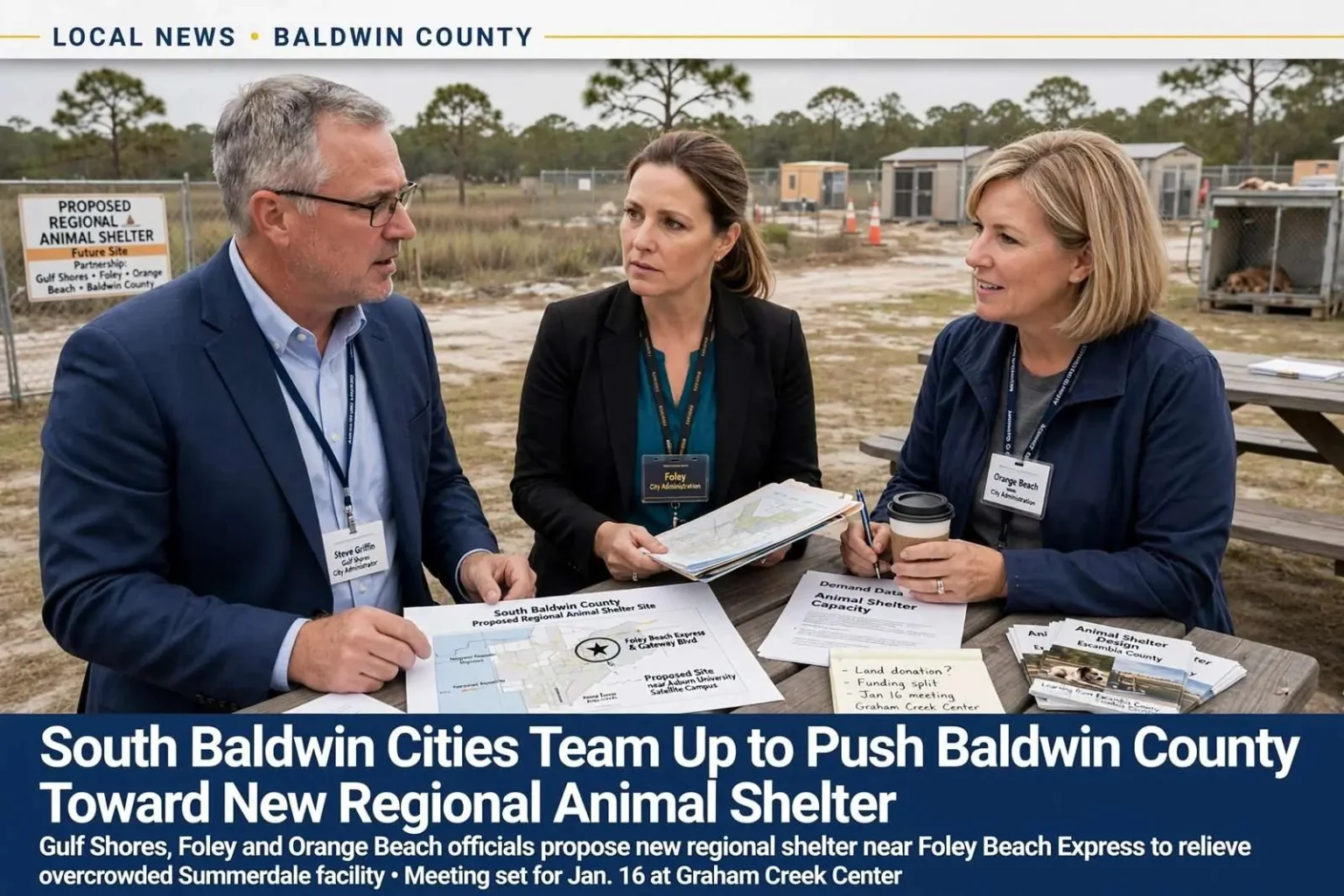
Gulf Shores, Foley and Orange Beach officials are working together to convince Baldwin County to build a new regional animal shelter in South Baldwin County, hoping to avoid the fate of an earlier push for a shared satellite jail that fell apart before it could get off the ground.
Gulf Shores City Administrator Steve Griffin said the three South Baldwin cities have been meeting to figure out how they can help the county get a new shelter built, whether that means donating land, providing financial support or some combination of both.
“The same issues are coming up with animal shelters down here,” Griffin said. “We’re looking to work together to see if we can get Baldwin County to locate a regional shelter and find out what participation, help, etc., we need from our three cities.”
The reference to the satellite jail is a cautionary one for everyone at the table. South Baldwin cities had previously explored a shared detention facility, only to watch the plan collapse under questions of cost, jurisdiction and political will — a history that has made every subsequent intergovernmental project in the area slower to promise and quicker to hedge. The animal shelter push is deliberately structured to avoid the same trap: rather than asking the county for a facility, the cities are offering to bring land, money and demand data to convince the county commission that a regional shelter in South Baldwin serves the whole county’s interest.
The county-run shelter in Summerdale, which took over county animal control operations, is regularly full and struggling to keep up with demand, according to Griffin. He said South Baldwin County’s continued population growth has only added to the strain on the facility.
“The animal shelter the county operates now is often at capacity and needs more room for animals,” Griffin said. “As we’re growing down here we’re seeing more local regional needs in South Baldwin County. That’s what’s been talked about.”
Summerdale sits well inland of the beach communities, a placement that made sense for a countywide operation but adds miles — and hours of staff time — to every response along the coast. Baldwin County’s growth over the past two decades has been fastest in its southern reaches, from the beach corridors to the Foley bedroom communities, and animal control demand has followed the rooftops: more strays, more owner surrenders, more calls, and more animals making the long haul to a facility that was never sized for this volume.
Learning from other communities
City and county representatives have already begun researching how other communities handle similar challenges. Griffin said officials recently toured a shelter operated in Escambia County to see how that facility is designed and run.
Representatives from Gulf Shores, Foley and Orange Beach are scheduled to meet Jan. 16 at the Graham Creek Center to continue discussions on how the cities can support the county in locating a new shelter in the region.
“We’re all wanting to find out what we can do to assist Baldwin County to locate one here,” Griffin said. “Whether that’s land or financial help. It’s a work in progress and something may happen Jan. 16.”
The site visits and benchmarking are more than ceremony. Shelter design has changed substantially in a generation — from warehouses of cages to campus-style facilities built around adoption traffic, medical suites, isolation wards and behavior space — and the difference between a shelter built on outdated assumptions and one built on current practice is measured in both live-release rates and long-term operating costs. By studying an operating regional facility before committing, the cities and the county are trying to buy experience cheaply instead of paying for design mistakes for decades.
The vision: an animal campus near Auburn
Tobi Waters, president of the Gulf Shores Animal Care and Control Program, said the cities would ideally like to see a new shelter built near the Auburn University satellite campus planned on Gulf Shores-owned land at the northwest corner of the Foley Beach Express and Gateway Boulevard, formerly known as County Road 8.
“It is our shared goal to have a state-of-the-art animal campus centrally located in close proximity to the new Auburn Veterinary Referral Center,” Waters said.
The location sits at the crossroads of South Baldwin’s growth — the Foley Beach Express corridor that connects the beach towns to the inland suburbs — and its proximity to the planned Auburn facility is central to the concept. Auburn University’s College of Veterinary Medicine has been extending its clinical reach into Baldwin County, and animal welfare advocates saw immediately what co-location could mean: access to veterinary expertise, surgical capacity and educational partnerships that a small municipal shelter could never generate on its own.
Waters described a vision that would include an open-admit and managed-admit animal shelter, a centralized stray-hold facility serving all three municipalities, overflow stray-hold and sheltering space for the broader South Baldwin County area, a preconstructed pet evacuation center for use during hurricanes and other emergencies, and an animal clinic and surgery suite.
The evacuation center component carries particular weight on the Alabama Gulf Coast. Every hurricane season, evacuating households confront the same wrenching problem of where to take pets, and the region’s shelters and emergency plans have repeatedly been strained by animals left behind, rescued afterward, or turned away from human shelters that could not accept them. A purpose-built, preconstructed evacuation facility — standing ready before the season starts — would address a gap that coastal emergency managers have identified for years.
Waters said such a campus would also support ongoing trap-neuter-return efforts for community cats in the area, along with other companion-animal support services.
The TNR programs that started it all
Gulf Shores and Orange Beach both began trap-neuter-return programs in September 2017, after their city councils provided seed money to get the volunteer-run efforts started. The programs rely primarily on donations to continue operating.
In Orange Beach, more than 120 cats have gone through the trap-neuter-return program since it began. The Gulf Shores program, formed in August 2018, started trapping cats in October and has so far had 32 cats and two dogs neutered, with 13 cats placed in adoptive homes, according to Waters.
Trap-neuter-return — the practice of trapping free-roaming cats, sterilizing and vaccinating them, and returning them to their territory — has become the standard approach to community cat populations across the country, replacing older catch-and-euthanize cycles that tended to leave a vacuum filled by new, unsterilized cats. The coastal programs’ early numbers are modest, but the volunteer logistics behind them are not: each animal requires trapping, transport, surgery, recovery monitoring and, for the adoptable ones, foster placement before adoption.
Waters credited Orange Beach Animal Control Officer Tom Conerly and Orange Beach Animal Care and Control Program volunteer Stephanie Christie with helping the newer Gulf Shores program get up and running.
That cross-city cooperation is, in miniature, the same logic driving the shelter push. The two beach cities’ programs have shared training, equipment and experience across their municipal line, demonstrating to officials in both communities — and to Foley and the county — that animal welfare in South Baldwin already operates as a regional system in practice, even if the physical facilities have not caught up.
City and county officials say the Jan. 16 meeting at the Graham Creek Center will be a key step in determining what a regional shelter partnership could look like and how quickly it might move forward.
What a partnership would require
Turning the vision into a facility will require the three cities and the county commission to answer the questions that sank the earlier satellite jail: who owns the land, who staffs the operation, how each government’s share is calculated, and who is accountable when costs run over. The current approach has tried to sequence those answers rather than leap past them — first the demand data and site tours, then the offer of land and funding, and only then the formal partnership agreement that would commit each government’s share.
The geography gives the idea a natural logic. Gulf Shores, Orange Beach and Foley sit within a short drive of the Beach Express-Gateway site, far closer than Summerdale is for coastal animal control calls, and a central location would shorten stray-hold runs for all three municipalities while still serving the rest of South Baldwin. The Graham Creek Center itself — the Foley venue hosting the Jan. 16 meeting — sits near the corridor the cities hope to serve, a reminder that the region’s civic infrastructure has grown faster than its animal welfare capacity.
Advocates also point to the economics of doing it right the first time. An at-capacity shelter generates hidden costs for every city in the region — longer response times, animals boarded in temporary quarters, disease risks in crowded kennels — while a well-designed campus near veterinary partners generates adoption traffic, volunteer networks and, potentially, revenue from clinical services. The question before Baldwin County’s commission is whether the county’s growth southward justifies shifting the map of its animal services now, or whether the Summerdale facility will be asked to stretch through several more years of the population boom that created the problem.
For the volunteers and city staff who have pushed the project this far, the Jan. 16 meeting is the moment the conversation moves from aspiration to arithmetic — from what a state-of-the-art animal campus could look like, to what each of the four governments around the table is prepared to put on the land, in the budget, or both.