Spanish Fort Tests Tornado Sirens at 12:30 p.m. on September 7
Spanish Fort tests its tornado sirens at 12:30 p.m. Wednesday, Sept. 7, part of a monthly first-Wednesday routine. What residents should know.
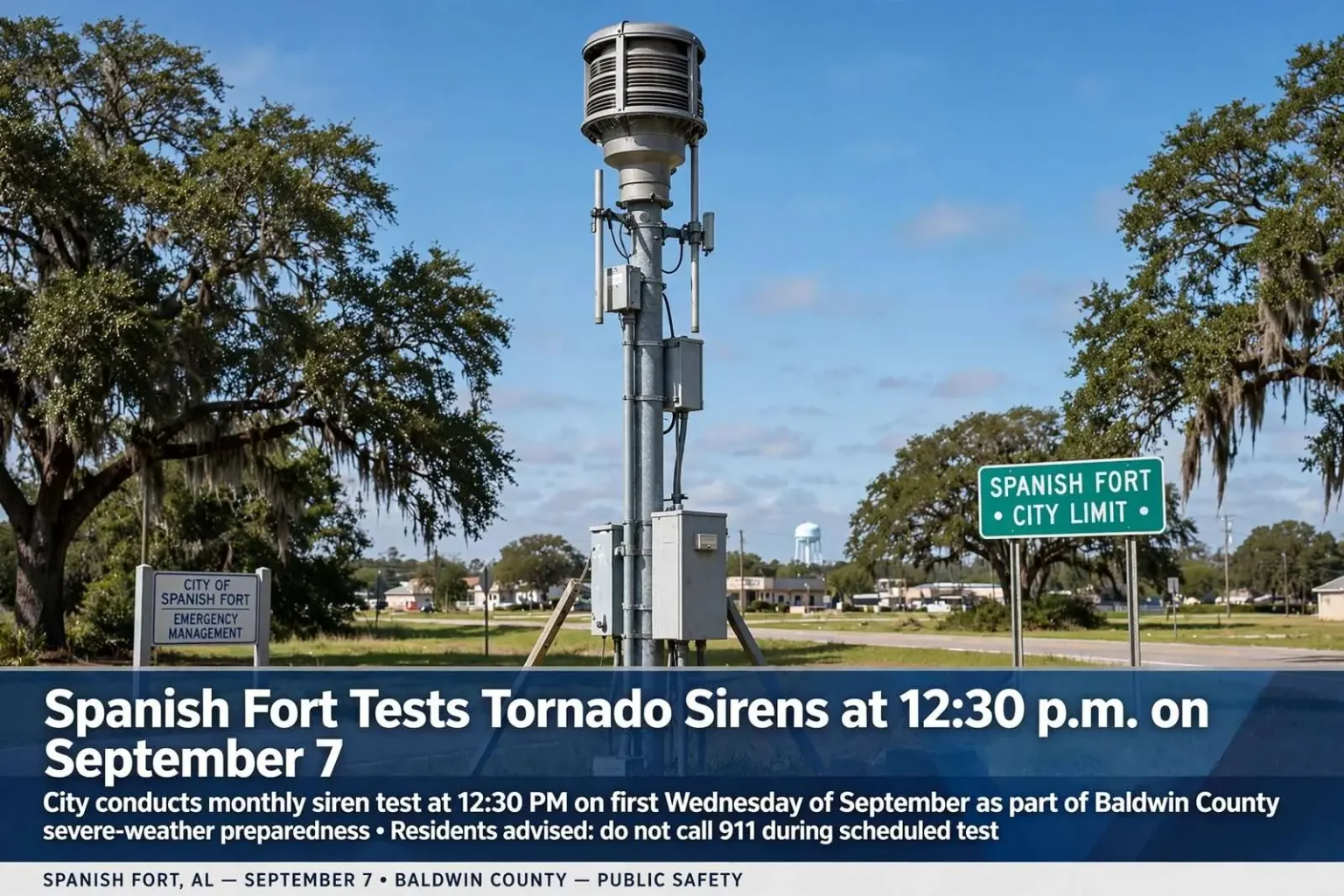
Spanish Fort will conduct its regularly scheduled tornado siren test on Wednesday, September 7, sounding the city’s outdoor warning sirens at 12:30 p.m. The brief test runs about five minutes, weather permitting, and is part of a standing monthly routine: sirens across the city are tested at 12:30 p.m. on the first Wednesday of every month.
The schedule is no accident. A fixed test date and time, kept consistent month after month, trains residents to recognize the sirens’ sound and gives the city a predictable window to verify that every siren head, radio receiver and activation link in the system is working. When a real warning comes, there is no time to wonder whether the network functions — which is why municipalities across Baldwin County and the rest of the Gulf Coast run these checks like clockwork.
Spanish Fort sits in one of the most tornado-active corridors in the United States. The Gulf Coast’s spring and fall severe weather seasons regularly send squall lines and supercells across south Alabama, and the region has seen deadly outbreaks historically. That exposure is why Baldwin County communities invest in outdoor warning systems at all, and why the city treats the monthly test as essential maintenance rather than a formality.
During the test, residents can expect the sirens to activate for roughly five minutes — longer and louder than a real alert, deliberately so, to make the test unmistakable. The city asks that people not call 911 or police dispatch to report the sirens during the scheduled window, since dispatchers know the test is underway and emergency lines need to stay open for genuine calls.
Outdoor warning sirens are owned and activated at the municipal level in most Alabama cities, with each jurisdiction deciding on its own test schedule and activation policy. Neighboring cities in the Eastern Shore area run similar monthly tests, so residents near municipal boundaries may hear sirens from more than one community during midday test windows.
City officials use the monthly test as an opportunity to remind the public what the sirens are — and what they are not. The system exists to reach people who are outdoors: at ballfields, in yards, on job sites, walking downtown. It was never designed to wake sleeping families or to penetrate the walls and ambient noise of an indoor environment, and treating it as an all-hazards indoor alert is a mistake safety officials have worked for years to correct.
Don’t Rely on Outdoor Sirens Alone Indoors
City officials stress that the outdoor sirens are meant to alert people who are outside, and that anyone already inside a building should not count on hearing them. Modern construction, central air conditioning, television volume and ordinary background noise can all mask a siren that is audible on an open ballfield. A resident who sleeps through a night warning will never know the siren sounded at all.
Residents are encouraged to maintain multiple layers of warning, including local news broadcasts, a NOAA weather radio, and severe weather alerts on their phones. The layering approach is the backbone of modern severe weather preparedness: no single channel is reliable in every situation, but a household with two or three independent warning sources will almost always receive a life-saving alert in time.
A NOAA weather radio deserves particular mention because it works when everything else fails. The radios receive direct broadcasts from the National Weather Service, sound a tone alarm for warnings affecting the listener’s specific county, and run on battery power and backup batteries when electricity and cell networks are down. For families in inland Baldwin County, where nighttime tornadoes are a real threat, safety experts consider a weather radio as fundamental as a smoke detector.
Smartphone alerts add another layer. Wireless Emergency Alerts push tornado warnings to phones in the warned area automatically, and weather apps can be configured to sound loud alarms for warnings tied to the phone’s location. Officials caution that phones should not be the only warning layer, since cell networks can become congested or lose power during severe weather, but they have become one of the fastest ways a warning reaches a sleeping household.
Local news broadcasts remain a mainstay during tornado events, with Mobile and Pensacola television stations providing continuous coverage during warnings, tracking storms street by street with radar. During significant outbreaks, those broadcasts are often the best source of storm-specific detail — where the rotation is, which neighborhoods it is approaching and when it has passed.
When all of those layers sound at once, the message is the same: take shelter immediately in the lowest floor of a sturdy building, in an interior room away from windows, and protect your head. In south Alabama, where tornadoes can arrive embedded in fast-moving squall lines with only a few minutes of lead time, the households that survive are the ones that already knew the plan before the warning was issued.
What the Sirens Are Designed to Do
The National Weather Service’s Mobile office maintains a detailed set of frequently asked questions about how outdoor warning sirens work and what they are designed to do, covering everything from why sirens sound for other threats to how far their audible range extends. The office, which issues warnings for south Alabama and northwest Florida, works with local governments on warning communication as part of its broader mission, and its guidance has shaped how Gulf Coast cities run their systems.
Among the points the agency emphasizes: siren audible range varies with weather, wind direction and background noise, and no manufacturer’s rated range should be counted on in real conditions. Sirens may also be activated for hazards other than tornadoes in some jurisdictions, so residents should never assume the reason for an activation without checking a trusted information source. And a siren that stops sounding does not mean the threat has passed — activations may be repeated or re-sounded as a warning is extended.
The NWS guidance also addresses a common misconception: sirens are not a signal to go outside and look at the sky. Officials urge the opposite — anyone who hears a siren should get indoors and seek information immediately from a weather radio, broadcast media or phone alerts, then take shelter if a warning is confirmed for their area.
If the Weather Is Bad on Test Day
If skies are stormy on testing day, the test is pushed back rather than run in threatening weather, so a silent siren on a stormy first Wednesday does not mean the system is down. The delay policy exists to avoid a genuinely dangerous confusion: sounding a siren for a test while severe weather threatens would train residents to ignore activations, and it could send people scrambling for shelter for no reason.
The policy cuts both ways. On a clear first Wednesday, the sirens will sound right at 12:30 p.m. and the test proceeds as scheduled. On a stormy first Wednesday, silence is expected, and the city makes up the test when conditions allow. Residents who are unsure can always check the city’s official channels for confirmation rather than assuming a malfunction.
Spanish Fort’s system is part of a broader Baldwin County warning network, with municipal sirens in Spanish Fort, Daphne, Fairhope, Gulf Shores, Orange Beach and other communities, coordinated with county emergency management. During widespread severe weather, multiple jurisdictions may activate nearly simultaneously, and the county’s emergency alert channels provide information that cuts across city lines.
The monthly test also serves as a standing invitation for residents to test their own preparedness. Safety officials suggest using the first Wednesday of each month as a personal checklist day: confirm the weather radio has fresh batteries, verify that phone alerts are enabled, review the household shelter location and make sure every family member knows what to do when a real warning sounds.
Why the Routine Matters on the Gulf Coast
Alabama sits at the heart of Dixie Alley, the Southeast’s own tornado belt, where the character of tornado risk differs from the better-known Plains states. Gulf Coast tornadoes often strike at night, form in the fall and winter as well as spring, and move fast within squall lines, giving residents less visual warning and less time to react. Those traits make automated warning systems and rehearsed household plans disproportionately valuable here.
Baldwin County’s experience with major tornadoes and damaging outbreaks over the decades has made warning infrastructure a budget priority for its municipalities. The Eastern Shore cities grew rapidly in recent decades, adding neighborhoods and schools across a landscape that was once largely rural, and each new subdivision adds people who need to hear, see and understand a warning in time to act.
Spanish Fort’s own growth — from a small community along the bluff above Mobile Bay to one of the fastest-growing cities in the county — means many residents are relatively new to Gulf Coast severe weather. The monthly siren test doubles as an education tool for exactly that population, a recurring reminder that tornado season in south Alabama never really ends.
City officials encourage newcomers and longtime residents alike to sign up for any local emergency notification systems the city and county offer, which deliver warnings by text, email or phone call in addition to the sirens, radio and television. Combined with the National Weather Service’s own alert channels, those systems give every household multiple independent paths to receive a warning.
The September 7 test will sound the same activation that a real tornado warning would, on the same equipment, through the same channels. That is the point: when the real one comes — on a spring afternoon or a winter night — the sound will be familiar, the response will be rehearsed, and the minutes saved by knowing exactly what to do will be the minutes that matter most.
For questions about the siren system or the city’s severe weather preparations, residents can contact Spanish Fort City Hall, and for detailed guidance on warning systems and tornado safety, the National Weather Service Mobile office’s online resources remain the reference standard for the Gulf Coast.