State Health Officer Reopens Portions of Mobile Bay to Oyster Harvesting
State Health Officer Dr. Scott Harris has reopened portions of Mobile Bay, including Cedar Point, Portersville Bay, Heron Bay and Dauphin Island Bay, to oyster harvesting after a temporary closure.
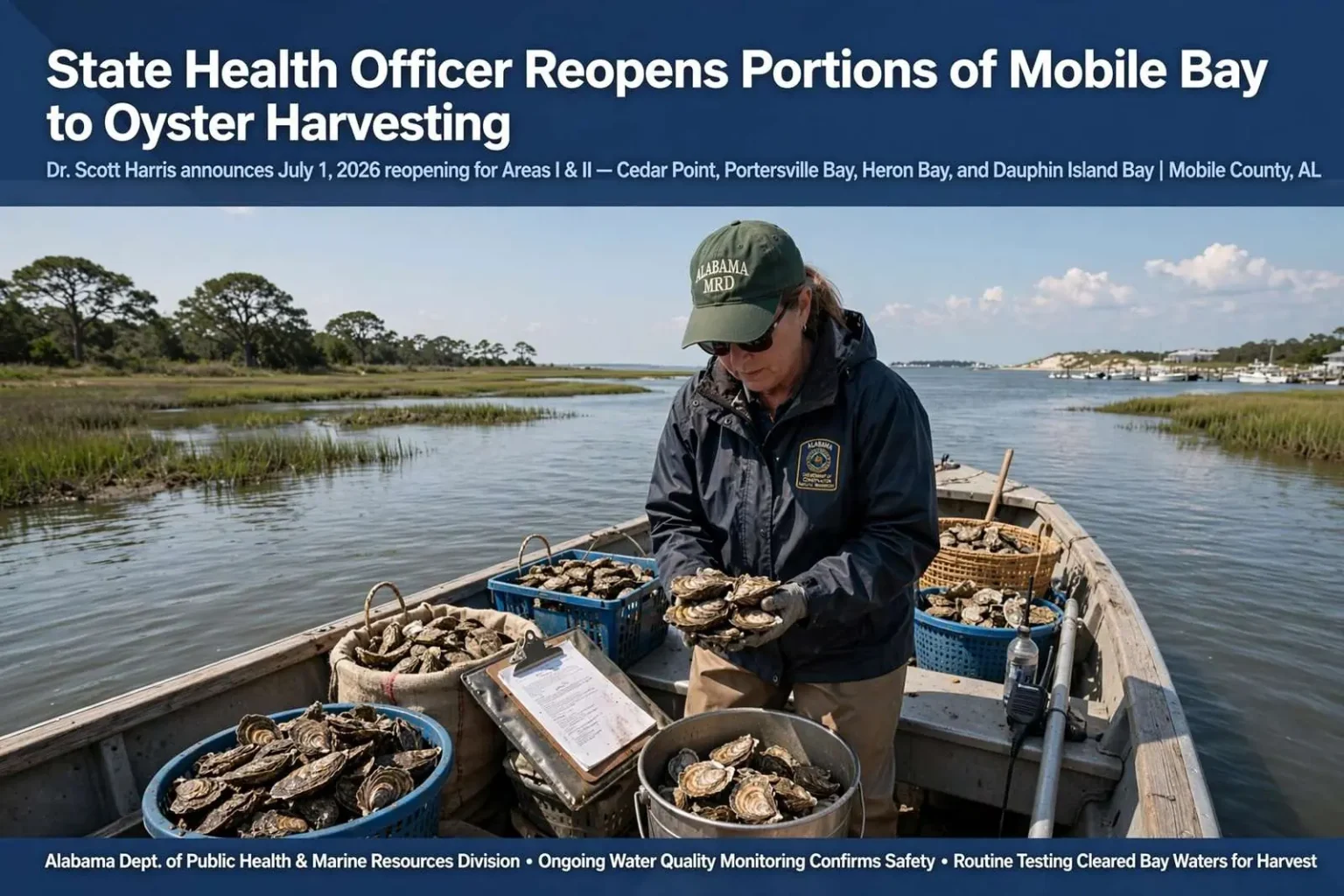
State Health Officer Dr. Scott Harris has announced the reopening of portions of Mobile Bay that had been temporarily closed to oyster harvesting since June 24, 2026. The reopening covers designated Areas I and II, which include Cedar Point, Portersville Bay, Heron Bay and Dauphin Island Bay, all located in Mobile County along Alabama’s Gulf Coast.
The reopening order took effect at 1 p.m. on July 1, 2026, allowing catchers to resume harvesting oysters from the affected waters after the roughly weeklong closure.
How Alabama Manages Its Public Oyster Reefs
All public oyster reefs in Alabama are managed for harvest by the Alabama Department of Conservation and Natural Resources’ Marine Resources Division, commonly known as MRD. The division oversees which areas are open to harvest at any given time, and officials are reminding catchers to check directly with MRD for up-to-date information on which specific areas are available before heading out on the water.
Temporary closures of shellfish growing waters are a routine part of how Alabama protects public health. State and local health officials periodically test bay waters and shellfish tissue for bacteriological safety, and can order areas closed to harvest when conditions warrant caution, then reopen them once testing confirms the water meets safety standards again.
Ongoing Monitoring
The Alabama Department of Public Health, or ADPH, said it will continue to monitor bay waters and shellfish in the region to ensure bacteriological safety for consumers. That ongoing monitoring is what allows the agency to reopen waters like Cedar Point, Portersville Bay, Heron Bay and Dauphin Island Bay once conditions are again considered safe for harvest.
Oyster harvesting is an important part of the economy and food culture along coastal Mobile County, supporting both commercial catchers and the broader Gulf Coast seafood industry. Catchers and consumers alike depend on ADPH and MRD to keep them informed about which waters are open and safe at any given time.
Why these specific waters were closed
Temporary oyster-bed closures of this kind are most often driven by water-quality concerns. Heavy rainfall, runoff from upstream rivers, or localized spills can raise the bacterial counts in shallow bay waters, and shellfish – because they filter large volumes of water as they feed – can accumulate the bacteria that come with it. Alabama’s two agencies, the Marine Resources Division within the Department of Conservation and Natural Resources and the Alabama Department of Public Health, divide the work along clear lines: MRD manages the reefs, decides which are open and enforces the rules of harvest, while ADPH runs the testing that determines whether the waters are safe. When a closure is ordered, the same testing, in consultation with the two agencies, is what allows a reopening once the bacteria counts have fallen back within the standards set for shellfish-growing waters.
The roughly weeklong duration of this particular closure fits the pattern of a routine, weather-driven event. Tropical systems and the heavy summer thunderstorms that move through the Gulf Coast often push runoff into the bay, and ADPH and MRD regularly respond with short, well-defined closures to protect public health. Reopenings are announced once sampling shows the affected areas have returned to acceptable levels.
The waters that were reopened
Area I and Area II, the two oyster harvest areas included in the order, cover a substantial stretch of Mobile County coastline. Cedar Point sits at the eastern edge of the Mississippi Sound, north of Dauphin Island and west of the Mobile Bay ship channel. Portersville Bay and Heron Bay, both on the eastern shore of the Mississippi Sound, are productive shellfish grounds that commercial oystermen have worked for generations. Dauphin Island Bay, just to the south and west, lies between Dauphin Island and the mainland, in a section of water long associated with the Alabama oyster industry. Together, these reopened waters account for a meaningful share of the state’s commercial harvest, which is why even a short closure draws attention from catchers and processors.
Alabama’s oyster industry in context
Alabama sits on the eastern edge of the Gulf of Mexico, where Mobile Bay, the Mississippi Sound and the barrier islands create a shallow, nutrient-rich estuarine system. The state’s oyster industry has historically depended on this geography: wild reefs in the public-trust waters of the bay and the sound are managed as a renewable public resource, with seasons, size limits and gear restrictions designed to keep the fishery productive across years. Oysters harvested from these waters are sold fresh, shucked and on the half shell, and shipped to restaurants and seafood markets across the Southeast, supporting jobs on the water, in processing plants and along the supply chain. Health-based closures are a regular feature of this fishery precisely because the same shallow, productive waters that grow oysters are also the most vulnerable to runoff events.
What catchers should do now
State officials have used the announcement to remind oystermen that the reopening of these specific areas does not necessarily mean that every other reef is open. Catchers heading out on the water are urged to confirm the status of their intended area directly with MRD before harvesting, since conditions can change between sampling rounds and additional closures are always possible during periods of warm weather and runoff. The same caution applies to consumers and retailers, who depend on the state’s tagging and traceability rules to ensure that only legally harvested, properly handled oysters reach the market. ADPH and MRD’s continued monitoring of bay waters and shellfish tissue is what makes the cycle of closure and reopening work, and what allows the industry to resume when conditions allow.
Why routine closures are not a sign of failure
For an outside observer, repeated oyster-bed closures can look like a problem with the fishery, but within the agencies that manage it they are a sign that the surveillance system is working. The point of testing is precisely to find conditions that would make shellfish unsafe and to remove them from the market until they are safe again. The July 1 reopening of Cedar Point, Portersville Bay, Heron Bay and Dauphin Island Bay reflects that cycle operating as designed: a problem identified, a closure imposed, a period of testing, and a reopening once the waters cleared. For catchers, processors and consumers alike, that rhythm is the everyday reality of working a public resource that depends on weather, water quality and the state agencies charged with keeping watch over both.
The Mobile Bay system and its shellfish grounds
Mobile Bay is one of the largest estuarine systems in the United States, fed by the Mobile, Tensaw, Alabama and Tombigbee rivers and exchanging water with the Gulf of Mexico through a relatively narrow opening between Dauphin Island and Mobile Point. That geography – a large shallow basin with significant freshwater inflow – is what makes the bay both productive for shellfish and sensitive to changes in runoff. The salinity gradient from the upper bay to the Gulf side of Dauphin Island supports different communities of fish, crabs and oysters, and the reefs that the Marine Resources Division manages are spread across that gradient. When salinity drops sharply after a major rain event, oysters can be stressed; when runoff carries additional bacteria, the public-health risk rises. Both effects can prompt closures of the kind that have just been lifted.
The Mississippi Sound, which lies west of Dauphin Island and forms the other half of the state’s shellfish footprint, is a quieter body of water that supports much of Alabama’s wild oyster harvest. The Cedar Point, Portersville Bay, Heron Bay and Dauphin Island Bay reefs sit along the eastern side of that sound, where bottom conditions and salinity have historically produced reliable sets of new oysters each year. Commercial oystermen typically work these grounds from small boats using tongs or, on the larger reefs, hydraulic dredges under carefully regulated seasons. The continued productivity of these reefs is what makes the difference between a short closure and a long-term problem for the fishery.
The agencies behind the order
Two state agencies share responsibility for keeping Alabama’s oyster beds safe and productive. The Marine Resources Division, part of the Department of Conservation and Natural Resources, manages the reefs themselves, including seasons, catch limits, gear rules and the daily opening and closing of specific areas. The Alabama Department of Public Health, by contrast, focuses on the safety of the product: it samples water and shellfish tissue for bacterial contamination and sets the standards that must be met before oysters can be harvested for human consumption. Reopening orders like the one Dr. Scott Harris announced are a joint product, issued once MRD and ADPH agree that an area is once again safe and ready for harvest. The cooperation between the two agencies is the routine machinery behind a routine decision.
Looking ahead through the summer
Summer is the busiest time of year on Alabama’s oyster reefs and the period when closures are most likely. Warm water, frequent storms and the long days of the Gulf Coast calendar all combine to keep the agencies on watch. For oystermen, the practical effect is to plan around the possibility of an interruption, whether by checking the latest status before leaving the dock or by working multiple reefs in different areas. For consumers, the reassurance lies in the fact that the oysters reaching the market have been harvested under a system designed to catch the conditions that would make them unsafe. The July 1 reopening of Areas I and II is a small but useful reminder of how that system is meant to function, and how often it does.