

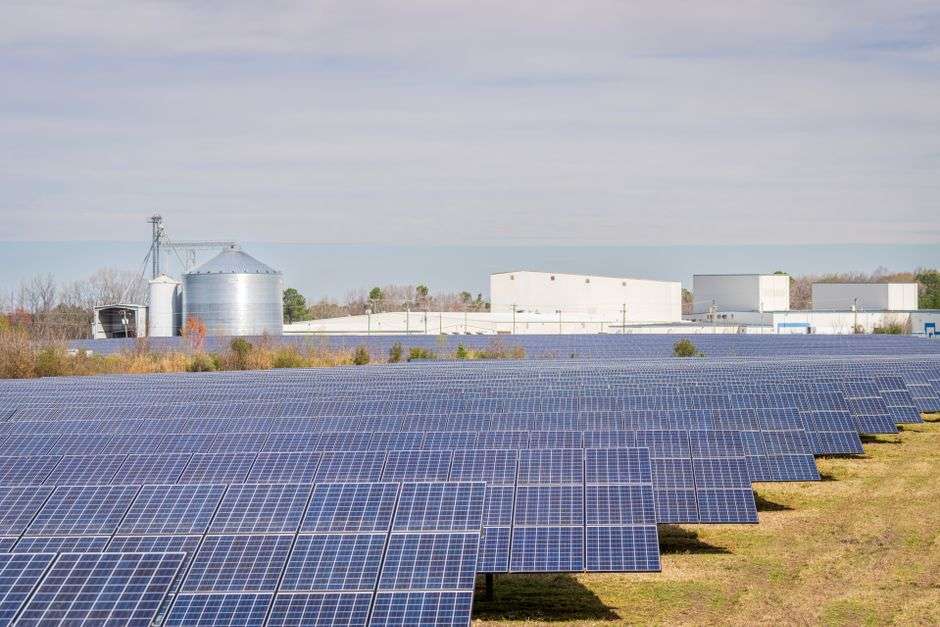
Residents of the Stockton community voted Tuesday to bring their corner of north Baldwin County under county zoning for the first time — a historic local vote driven by opposition to a massive solar farm — but county officials say the project at the center of the fight will likely be exempt from whatever rules come next.
According to referendum results provided by the Baldwin County Probate Office and posted on the door of the Stockton Civic Club Tuesday night, 215 voters supported adopting zoning in what is now Baldwin County Planning Zone 3, while 161 voted against — a 57 percent approval on 376 ballots cast. The new planning district runs between Interstate 65 and Old Gainey Road from south to north, and between the Tensaw River and roughly State Highway 95 from west to east.
“We are thrilled to learn that Stockton showed up as a community today,” said Meagan Fowler, president of the nonprofit Friends of the Tensaw River, which led the referendum push. “Residents are ready to have a voice in the conversation about their own town’s future. No longer will they be left out of the conversation completely.”
What happens now
The passage of the referendum automatically triggers a 180-day moratorium on new development in Planning Zone 3. The county will appoint a five-member advisory board of local residents, which must hold at least two community meetings and draft zoning proposals for the district. Final approval rests with the Baldwin County Commission.
Those meetings will give residents the chance to shape guardrails for future development — the kind of control the unincorporated community has never had. But whether the new rules will touch the project that started it all is another question.
The Silicon Ranch question
At the heart of the referendum was Silicon Ranch, the Nashville-based solar developer that purchased a 4,500-acre property off Interstate 65 in Stockton earlier this year. The company plans a $350 million utility-scale solar farm covering roughly 2,000 acres of the tract, built in two phases near the northeast corner of U.S. Highway 59 and I-65. Under an “energy plus agriculture” model, the company says the panel footprint would double as grazing pasture for a working sheep ranch, with the remaining 2,500 acres placed into long-term conservation.
The power, though, would not stay in Stockton. Alabama Power has signed a 25-year agreement to buy the site’s full 260-megawatt output — an arrangement the Alabama Public Service Commission approved in December 2025 — and every watt is earmarked for Dotier LLC, a Meta subsidiary building a data center south of Montgomery, roughly 150 miles away.
County officials have already said the project is likely grandfathered in. A county spokesperson confirmed before the vote that two permit applications related to the project were formally accepted before the referendum: a subdivision exemption allowing Silicon Ranch’s parcels to be combined, and a land disturbance permit that has completed technical review with conditional approval. Under the county’s position, any complete development permit application accepted before the vote carries vested, grandfathered status and would not be subject to zoning adopted afterward.
The land disturbance permit remains contingent on approvals from the U.S. Army Corps of Engineers and the Alabama Department of Environmental Management, which have not been finalized.
Fowler said her group’s legal counsel disputes that reading, arguing that an application must be complete to be grandfathered in — a disagreement that could end up in court.
“I don’t know how this doesn’t end up in court,” she said, adding that Friends of the Tensaw River is considering filing a lawsuit to pause the development.
A community that organized quickly
The referendum push began earlier this spring, when residents learned of the solar farm’s plans and gathered 176 signatures in 24 hours to call the vote. Stockton has only about 400 registered voters, and the campaign that followed split the small community. Opponents of the referendum blanketed mailboxes with mailers urging residents to vote no to protect property rights, and backed the effort with mass text message blasts. One of the groups behind the mailers, RAE PAC — established in May — had reported no referendum spending as of this week, according to Alabama Secretary of State filings. Friends of the Tensaw River paid for its own mailers and materials.
The Alabama Legislature even weighed in during its spring session, considering a one-year moratorium on solar farm projects in Mobile and Baldwin counties; the bill passed the Alabama Senate but stalled in the House.
Residents’ concerns have centered on stormwater runoff from clearing timber for panels, potential damage to the wetland ecosystem that feeds the Mobile-Tensaw Delta, and what happens to the site when the panels wear out. Fowler pointed to a Georgia case in which Silicon Ranch was found liable for unregulated erosion and pollution of wetlands, though the company said it learned lessons from that incident and placed part of the blame on the property owner. Silicon Ranch has said it will follow all applicable regulations and take precautions against environmental harm, and projects $50 million in new local tax revenue and more than 700 temporary construction jobs.
CEO Reagan Farr told a town hall in Bay Minette in April that the company planned to move ahead regardless of opposition. In a written statement after the vote, he said the referendum “does not impact our project” and that Silicon Ranch looks forward to participating in the public process as a landowner and investor in the community.
Baldwin County Commission Chairman Jeb Ball, whose district includes Stockton, did not respond to a request for comment. For now, the community has its zoning, the moratorium clock is running — and the question of whether any of it matters for the solar farm is likely headed for a judge.