

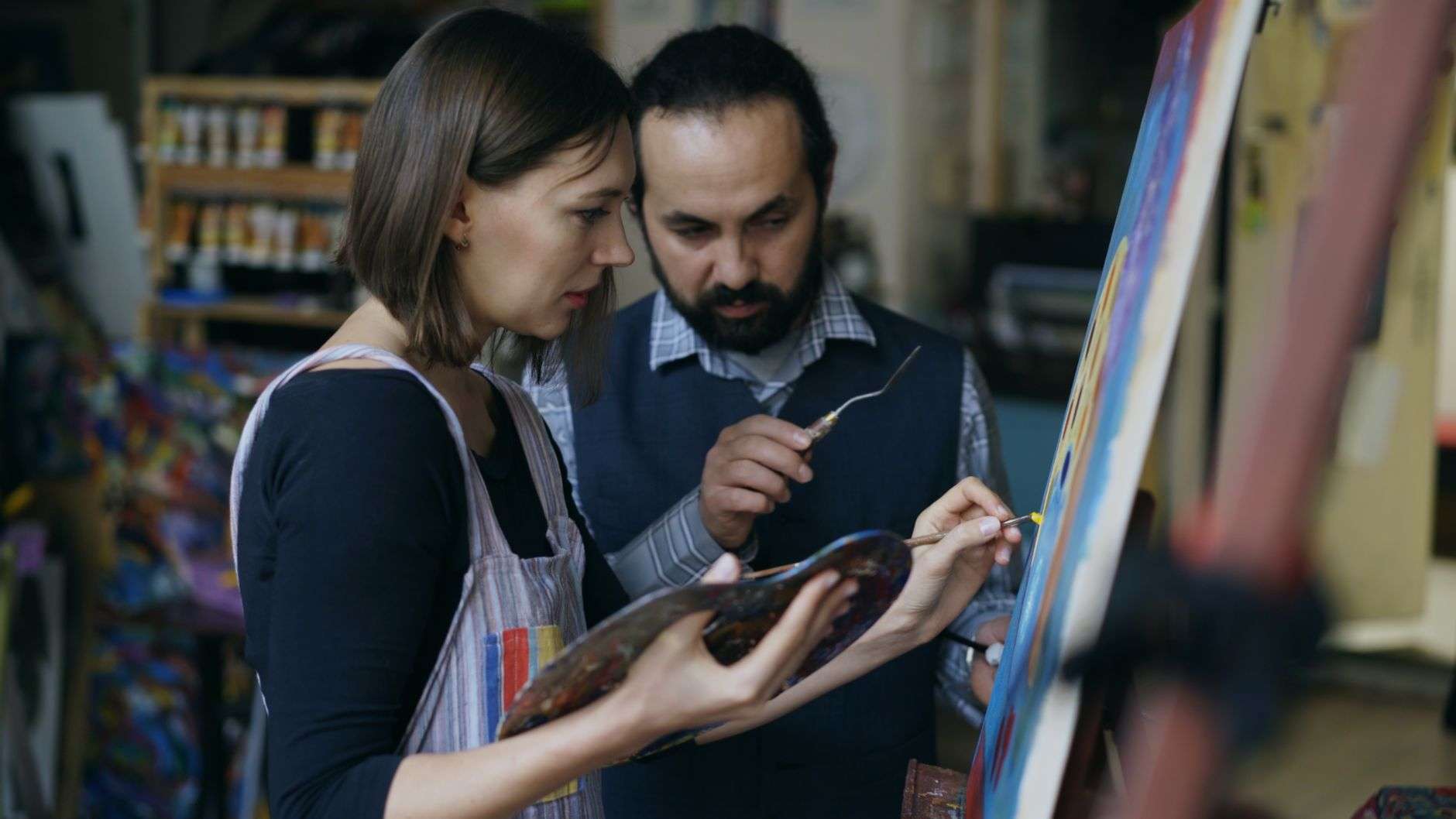
What began as a simple painting class became something much more for stroke survivors and their caregivers who gathered recently for Strokes for Strokes, a community event hosted by Hope Survives and supported by the USA Health Comprehensive Stroke Center.
The event was designed to show that life after stroke can continue to include creativity, meaningful activities and social connection with the right support and adaptations. Around the tables, brushes moved at different speeds and in different grips — some participants painted with their unaffected hands, others with adapted tools — but the goal was the same for everyone in the room: finish something beautiful and enjoy the doing of it.
A Helping Hand at the Easel
One of the day’s most touching moments came when occupational therapy students worked alongside a stroke survivor who regularly attends the group’s support meetings, helping her overcome physical limitations so she could complete her painting.
“One of our survivors who we know a little more was getting help from the OT students with her deficits and helping her to paint, and I know it meant the world to her,” said Ashleigh Mackey, MSHQS, BSN, RN, stroke certification coordinator at USA Health and a Hope Survives ambassador.
The pairing of students and survivors is one of the quiet strengths of events like this. Occupational therapy students spend their training learning how the loss of fine motor control, strength and coordination changes everyday tasks — and there is no better teacher than a survivor who wants to paint but cannot hold a brush the way she used to. For the survivor, the students’ assistance turned a frustrating limitation into a finished canvas; for the students, the afternoon offered hands-on insight no textbook provides.
The event welcomed both longtime members of the stroke survivor community and participants attending for the first time. That mix matters: newcomers arriving after a stroke often feel isolated from every part of their former life, and seeing survivors years down the road laughing, socializing and creating sends a message no clinical brochure can match.
Care That Outlasts Discharge
For Emily Dahlmann, DNP, director of the USA Health Stroke Program, programs like Strokes for Strokes fill an important gap in recovery by supporting survivors and caregivers long after formal rehabilitation ends.
“Many people don’t realize that care for the stroke survivor and caregiver continues after discharge, whether that be one day or 20 years,” Dahlmann said.
That reality shapes everything the stroke community does. Formal rehabilitation — inpatient therapy, outpatient sessions, home health visits — covers a defined window of recovery, but a stroke’s effects last a lifetime, and so do the demands on the family members who become caregivers. Support groups, social events and adaptive activities give both groups somewhere to go once the therapy schedule ends: a place where the challenges they live with are understood without explanation.
The slow-paced painting class encouraged participants to work at their own comfort level while expressing themselves creatively in a judgment-free environment. No one was graded, timed or compared. A survivor with limited use of one arm painted differently from one with full mobility; a caregiver who had never painted at all tried something new. The instruction met each person where they were, which is precisely the philosophy that adaptive recreation brings to post-stroke life.
What Comes Next for the Group
More activities are already in the works. “We plan on continuing our series of stroke survivor and caregiver activities,” Dahlmann said. “Maybe another art class, crafts, music, or chair yoga. The possibilities are endless, and we can’t wait to bring them to our community.”
The variety is deliberate. Different survivors carry different deficits and different interests: an art class exercises fine motor control and self-expression; chair yoga builds balance, flexibility and breathing control for those with limited mobility; music reaches memory and mood in ways that speech alone cannot. Rotating through activities gives every member of the community a program that fits, while keeping the social calendar — often the most valuable part — active year-round.
Hope Survives, the group behind the event, exists to carry exactly that load. Built around the relationships formed between survivors, caregivers and the clinical team at USA Health, the organization turns the shared experience of stroke into ongoing community — support meetings where members compare progress and setbacks, and activities like the painting class that remind everyone life after stroke is still lived in color.
The USA Health Comprehensive Stroke Center’s involvement reflects its role in the region’s care system. Comprehensive certification designates hospitals equipped to handle the most complex stroke cases around the clock, from emergency intervention through rehabilitation, and centers with that designation increasingly treat community reintegration as part of their mission rather than an afterthought. Events like Strokes for Strokes sit at the far end of the care continuum the center provides — after the cath lab, after the hospital stay, after the therapy appointments, in the years when survivors and caregivers need a community more than they need a clinic.
The Bigger Picture on Stroke Recovery
Stroke is among the leading causes of long-term disability, and the survivors it leaves behind face challenges that vary as widely as the people themselves — some relearn to walk, others relearn to speak, others carry deficits that are invisible to strangers but reshaped every part of daily life. Recovery research consistently points to the same conclusions: rehabilitation continues to produce gains well beyond the first months, and social engagement, purposeful activity and caregiver support all correlate with better long-term outcomes.
A painting class will not appear on any treatment chart, but it exercises everything the research points toward. Grip strength, coordination, focus, patience and pride all get a workout at the easel, and the social setting combats the isolation that so often follows a serious stroke. Caregivers, who commonly sacrifice their own social lives and health, get an afternoon of connection with people living the same reality.
For the occupational therapy students who volunteered their afternoon, the event also planted a seed for their profession. Therapists who see survivors as whole people — artists, joke-tellers, regulars at a support meeting — carry that perspective into clinical practice, and the survivors who worked with them got the rare experience of being helped by someone learning rather than treating.
When the canvases went home at the end of the day, the finished paintings were almost beside the point. The real product of Strokes for Strokes was the proof it offered everyone in the room: that creativity survives a stroke, that help is available for as long as it takes, and that a community built around recovery can keep growing — one art class, one chair yoga session, one gathering at a time.
The painting class also demonstrated something about adaptation that medical settings rarely show as vividly. Small changes — a brush with a built-up handle, a table at the right height, a partner to steady a jar of water — made the entire activity accessible to survivors with significant physical limitations. That is the core insight of adaptive recreation: most of the world remains open after a stroke when the environment is adjusted to meet the person, rather than the person expected to clear the bar unaided.
Mackey’s dual role as a clinical coordinator and a Hope Survives ambassador captures how the event came together. The hospital side brings the clinical expertise, the certification standards and the patient relationships built during treatment; the community group brings the calendar, the volunteers and the trust of families who have been living with stroke for years. When the two work together, activities like this one stop being one-off gestures and become part of an ongoing support structure.
Organizers expect the series to keep growing as word spreads. Survivors and caregivers who attend their first event often bring others from the support network, and each new activity — whether another art class, a crafts session, music or chair yoga — offers a different doorway into the community for someone who has not yet stepped through. For a population whose greatest risks are isolation and inactivity, the series represents something closer to ongoing care than recreation, delivered with paint brushes and laughter instead of appointments.
Behind the scenes, the event required the kind of coordination that only a true partnership can manage: the venue and supplies from Hope Survives, the volunteers and clinical guidance from USA Health, and the outreach that brought both longtime support-group members and first-timers through the door. Each partner contributed what it does best, and the participants got an afternoon that felt effortless — even though, like most things worth doing after a stroke, it took a team to make it look that way.
As the community looks ahead to the next gathering, the painting class has already set the template: pick an activity that exercises body and spirit, adapt it to whoever shows up, staff it with people who care, and let the survivors and caregivers do what they have always done — support each other. The possibilities, as Dahlmann said, are endless. The community that filled the room is already waiting to see what comes next.