A Wanted-Style Poster of a Sitting Judge Greeted Visitors at the Mobile County Courthouse
Security officers at the Mobile County Courthouse were told to alert supervisors and search suspended Circuit Judge Stuart DuBose for weapons if he appeared, as a 60-count ethics complaint against him remained unresolved.
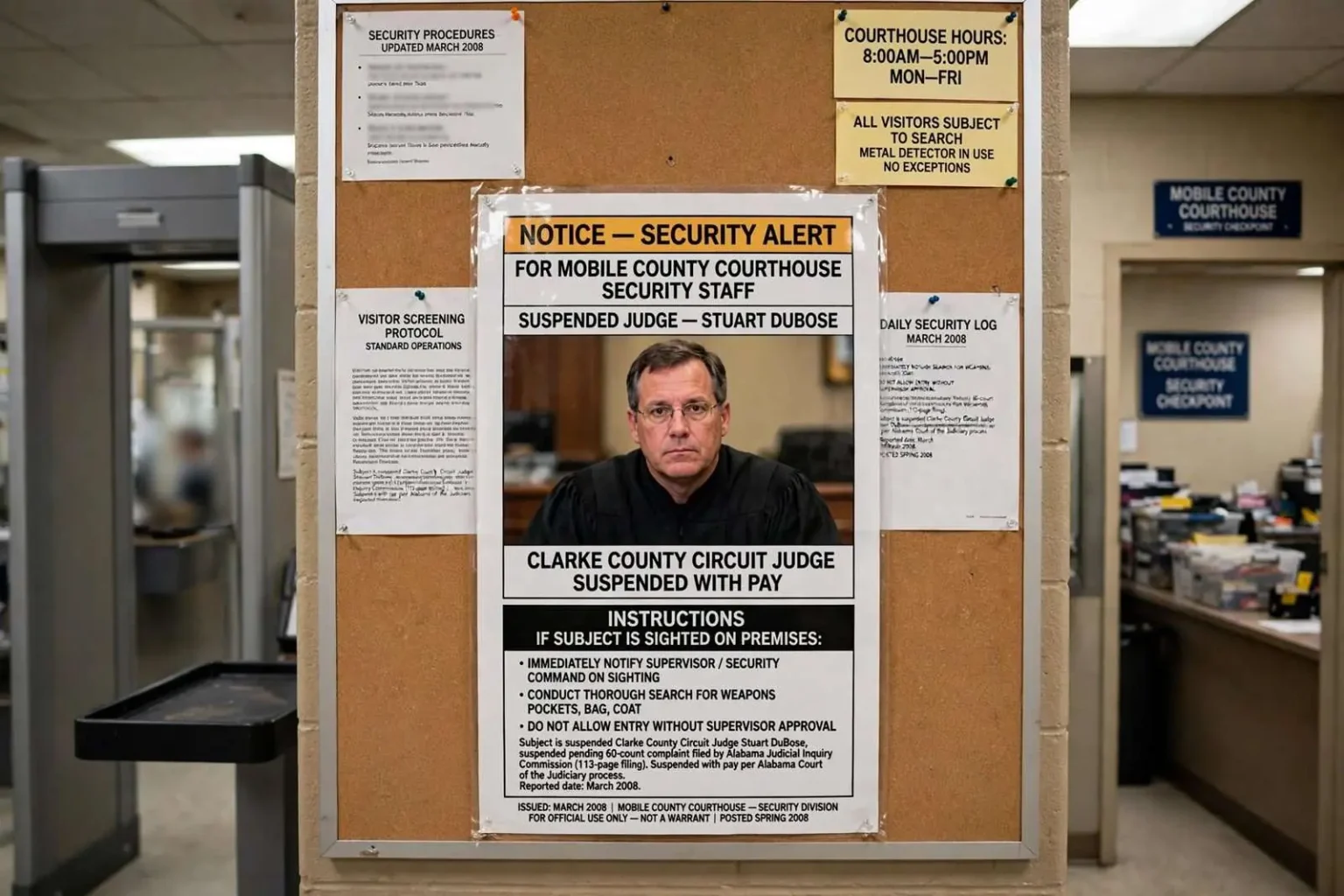
Visitors passing through the security checkpoint at the Mobile County Courthouse in the spring of 2008 encountered an unusual sight on the bulletin board between the metal detectors: the photograph of a sitting circuit judge, posted for the benefit of the officers manning the machines. The subject was Stuart DuBose, the suspended Clarke County circuit judge. The notice instructed courthouse security officers to alert a supervisor immediately if DuBose was seen on the premises, and directed them to be especially thorough in searching him for weapons.
It was not a wanted poster. But it was, by any measure, an extraordinary posture for a courthouse to take toward a member of the judiciary — and it captured how completely relations had broken down between DuBose and the Mobile legal community during his short and turbulent tenure on the bench. Alabama’s courthouses are shared workplaces: judges, lawyers, clerks, deputies and the public all move through the same doors, and the routines at the front entrance assume a baseline of mutual trust among the officials inside. A laminated photo of a sitting judge, posted beside the daily instructions to the security staff, announced to everyone in the building that the baseline had failed.
Sixty charges, 113 pages
DuBose remained suspended with pay while the Alabama judiciary worked through a 113-page complaint filed against him by the Judicial Inquiry Commission, the state body that investigates allegations of judicial misconduct. The complaint contained 60 separate charges. A filing of that length and breadth was itself unusual; most disciplinary matters before the commission resolve with far shorter complaints, and the sheer volume of allegations signaled that investigators had spent months collecting accounts from across the circuit.
Under Alabama’s system, a judge charged by the Judicial Inquiry Commission is automatically suspended, with pay, until the Court of the Judiciary rules. That court can dismiss the charges, censure the judge, or remove him from office altogether. DuBose’s case had been pending for months with no resolution in sight, leaving the court system in Clarke County short a judge, the state paying a suspended salary, and the allegations — unproven but public — hanging over every docket in the circuit.
The suspension-with-pay provision is one of the older safeguards in the state’s judicial discipline framework, designed to preserve the presumption of innocence for accused judges while removing them from the bench. But the provision has a corollary cost: a judge can sit out month after month at full salary while the machinery grinds, and neither the county’s taxpayers nor the litigants waiting on its dockets have any say in the pace.
A judge at war with the local bar
During his 14 months on the bench, DuBose was reported to have repeatedly and publicly disparaged “Mobile lawyers and judges.” Among those he was said to have singled out were attorney Pete Burns and Circuit Judges Charlie Graddick, John Lockett and Jim Wood — three of the better-known names on the Mobile County bench. Graddick, a former state attorney general, and Lockett and Wood carried long records in Mobile’s legal establishment, and public attacks from a neighboring circuit’s judge did not go unanswered in a legal community as tightly connected as Mobile’s.
The friction mattered practically as well as personally. Circuit judges recuse from one another’s cases routinely, borrow across circuit lines when dockets demand it, and rely on the professional courtesy of the local bar to keep crowded courts functioning. A judge who had made enemies across the Mobile County bench and bar had, in effect, weakened the informal network that a rural circuit judge leans on most.
Whatever the security officers at the courthouse door had been told, the instruction to frisk a judge with particular care spoke to a level of institutional alarm rarely put down on paper.
A colleague steps in, then steps away
The judge’s difficulties were not confined to his professional conduct. DuBose’s fellow 1st Circuit judge, Thomas Baxter, had recently issued a temporary restraining order directing DuBose to leave the family residence in Jackson and warning him against “intimidating, threatening, hurting, harassing or in any way putting” his wife, their two daughters or her attorney in fear of their lives. The order was entered in connection with a divorce petition filed by Allyson T. DuBose against her husband.
The document’s language was standard for a protective order, but the parties were not: a sitting circuit judge on the petition side, a suspended circuit judge on the other, and a divorce unfolding in the same small-town courthouse system where both men worked. Jackson, the Clarke County seat, is a small town, and its domestic docket had just become the most closely watched paperwork in the region.
Having signed it, Baxter recused himself from any further involvement in the case — the familiar dilemma of a small circuit where the judges know one another too well to preside over each other’s troubles. Recusal in such circumstances is not merely a courtesy; it is the mechanism that keeps a contested case out of the hands of a colleague whose relationship to the parties could taint the record. But it also removes a judge from an already thin bench, leaving the case to be shuffled to a visiting judge from somewhere else in the state.
His lawyer asks out
Meanwhile, in a matter connected to one of the cases that generated some of the ethics charges, longtime Mobile attorney Dan McCleave asked for permission to withdraw as DuBose’s legal representative. McCleave cited an “irretrievable breakdown of the attorney-client relationship between the attorney and the parties” — the standard formulation a lawyer uses when the working relationship with a client has collapsed beyond repair. Courts rarely probe the phrase, because the underlying story is almost never told; the words themselves are the professional signature of a representation that cannot continue.
The withdrawal request left DuBose, already suspended and facing dozens of misconduct counts, in the position of hunting for new counsel while the clock ran on his case. Defending a 60-charge judicial disciplinary complaint is specialized, expensive work, and a defendant without a lawyer in that forum faces procedural demands — written responses, motion practice, a trial-style hearing — that few litigants can manage alone.
Why it mattered
The 1st Judicial Circuit covers Choctaw, Clarke and Washington counties, rural jurisdictions where a single circuit judge’s conduct shapes the experience of justice for thousands of residents. In circuits like these, the circuit judge is often the only state court official most residents ever appear before — handling divorces, custody fights, criminal dockets, estate matters and the civil disputes of small towns. A vacant or compromised bench is not an abstraction; it is a docket that stops moving.
DuBose had been elected in 2006 after a bruising campaign, and the charges against him arrived with unusual speed afterward. Rural judicial races rarely draw the attention or the money of urban contests, but when they turn bitter the whole circuit inherits the aftermath — a judge, a bar and a courthouse staff that begin their working relationship with the debts of a campaign still outstanding.
For the moment, the practical consequence was that a judge continued to draw a state salary while a poster bearing his likeness hung at the entrance to a neighboring county’s courthouse, and the machinery of the Court of the Judiciary ground slowly forward.
How Alabama polices its judges
The DuBose case offered the public a rare look at the state’s judicial discipline system, which operates in two stages. The Judicial Inquiry Commission, whose members include judges, lawyers and appointees, receives complaints, investigates, and votes to file formal charges when the evidence warrants. Only then does the Court of the Judiciary — a separate panel of judges, lawyers and lay members — hold what amounts to a trial, with the power to dismiss, censure, suspend or remove. The two-body design separates investigation from judgment, giving accused judges procedural protections that most public officials facing misconduct allegations never receive.
That design also explains the long timeline. Investigators must gather testimony from litigants, lawyers and courthouse staff, often across several counties, before a complaint can be filed. Once filed, the respondent is entitled to counsel, discovery and a hearing, and disciplinary cases routinely take a year or more to resolve. For the counties whose dockets hang in the balance, the process can feel glacial — but it is the same deliberateness that protects judges everywhere in the state from removal over political grievance.
Removal cases are genuinely rare. In most years the system handles its work quietly: private reprimands, public censures, and retirements that end the matter before a hearing. A 60-count complaint against a sitting circuit judge placed DuBose’s case in the small category of matters that could end in removal, which is why courthouse observers across southwest Alabama tracked each filing for news of where the case stood.
What the poster said about Mobile County
The notice itself told its own story about the institution that posted it. Courthouse security in a large county handles a steady stream of volatile situations — litigants angry at outcomes, defendants facing sentences, families in the middle of custody disputes. Officers are trained to manage all of it with routine procedures. For the security staff to be handed a specific photograph, with specific instructions about a specific individual, meant the courthouse was treating a fellow judge the way it would treat any individual deemed a potential security concern — and doing so in writing, where every visitor between the metal detectors could see it.
Mobile County’s courthouse is a regional hub for the surrounding rural circuits as well. Lawyers from Clarke, Washington and Choctaw counties practice there, records move between the buildings, and the legal communities overlap constantly. A suspension that began as a Clarke County matter became, in practice, a regional one — the subject of conversation in courthouses across southwest Alabama, and, in the spring of 2008, a photograph on a Mobile bulletin board.
Whatever the eventual ruling, the episode had already settled one question: a circuit judge’s conduct can travel far beyond his own courtroom. The security checkpoint in Mobile, three counties removed from DuBose’s bench, had become part of the story — proof that in Alabama’s tightly woven legal geography, no judicial crisis stays local for long.