

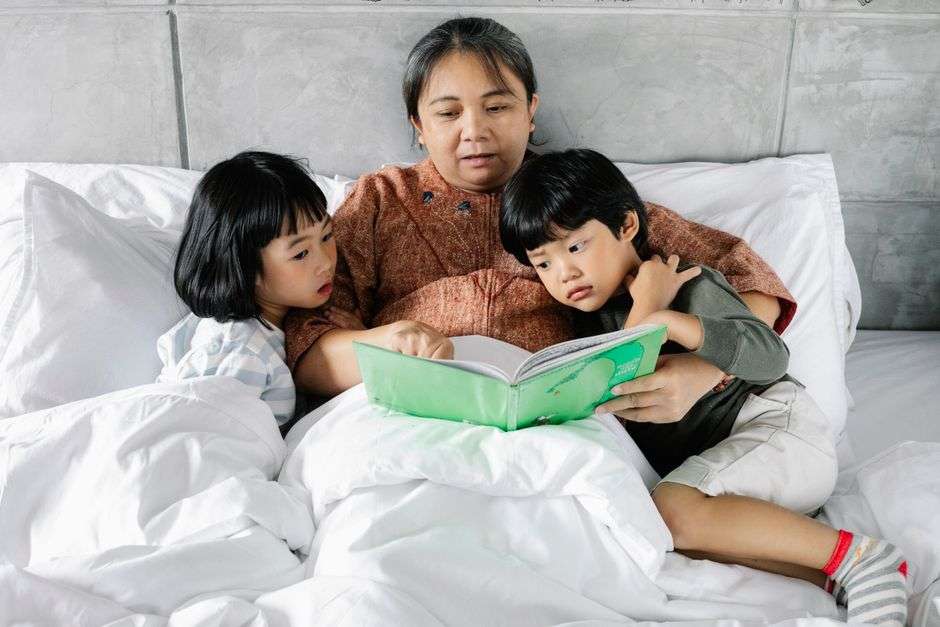
Gather a group of children around Connie Cazort and something happens that no screen can replicate. She does not read a story — she tells one, from memory, with theatrical voices, gestures and expressive pauses. She growls, grimaces, chuckles and gasps. Her whole body joins the story, and the children at her feet go with her.
Cazort, a Fairhope neighbor beloved for her infectious energy and zest for life, is a professional storyteller in the oldest sense of the craft: folk tales, fairy tales, classics and stories she created herself, delivered live, with her body and soul participating in every line. “Storytelling tunes children’s ears to the music of our language,” she says.
Why telling beats reading
The distinction matters to her. A reader holds a book; a storyteller holds the room. Eyes stay on the teller, not the page, and the story arrives with gestures, body movement, voices and expressive pauses. Children understand the world better through stories, she argues — they enter the tale with their imaginations, picturing themselves in the situation while navigating character and conflict.
Education researchers have reached similar conclusions. Studies of classroom-based oral storytelling have linked the practice to vocabulary growth, stronger narrative skills, and social-emotional development, noting that live telling creates a bridge between everyday speech and the formal language of books. Historically, storytellers served vital roles in their communities — teaching morals and values, passing down knowledge, spreading news through entertainment — and literacy advocates say the tradition remains a useful tool even in a digital age.
Connie views storytelling as an art with deep purpose and advocates for its revival.
Nana Connie goes digital
Her newest project meets that digital age halfway. “Nana Connie’s Storytime” is an Instagram page featuring weekly reels of her storytelling — short performances, typically five to eight minutes long, designed to delight children and inspire parents to begin sharing stories of their own. Recognizing how families consume media now, she puts a true storyteller in the palm of a parent’s hand, with the hope that the videos become a shared experience: parent and child listening together, then telling their own.
The videos preserve what makes her performances special — every song, chant and phrase recalled with precision, the characters fully voiced, the pauses placed like punctuation. She does not recite; she becomes the story.
A lifetime of preparation
Connie credits her parents, both accomplished public speakers, as her primary inspiration. A native of Elgin, Illinois, she studied Speech Arts — the study and performance of spoken language — at Colorado Women’s College and the University of Arizona, and earned certification in early childhood and elementary education.
Her career put storytelling at the center of her work for decades. She spent ten years as a demonstration teacher at the UCLA Lab School, taught Readers Theater and Creative Dramatics at Lake Highland Preparatory School in Orlando, and sixteen years ago moved to Fairhope, where she joined Bayside Academy as an enrichment teacher. “I loved every second of it,” she says.
Along the way she has performed at libraries, museums, schools and bookstores across the community, carrying hundreds of stories in her head at an age when most performers have long since retired the repertoire.
An art form with deep roots
Storytelling as a profession traces back to the griots of West Africa, the bards of Europe and the elders of every culture — the people responsible for remembering. In American schools, the practice survives in pockets: Readers Theater, library story hours, storytelling festivals. Practitioners like Connie keep the professional tradition alive, and educators who study the craft note that a live telling engages children differently than a recorded one, because the audience shapes the performance in real time.
That is the connection children sense when they gather at her feet. The story is being made for them, in that moment, and no two tellings are quite the same.
Storytime for everyone
At eighty years young, Connie has no intention of stopping. Through her Instagram videos, a new generation can experience her theatrical expertise — and parents and grandparents can reignite a love of storytelling in their own families, whether by screening her reels or by telling their own tales at the dinner table.
Her advice to families is implicit in everything she does: stories do not need screens, stages or special equipment. They need a voice, a listener and the willingness to perform. Children who grow up with stories enter them with their imaginations, she says — and they carry that imagination into everything else they learn.
To find her, search for conniesstorytime on Instagram, where a new story appears each week.