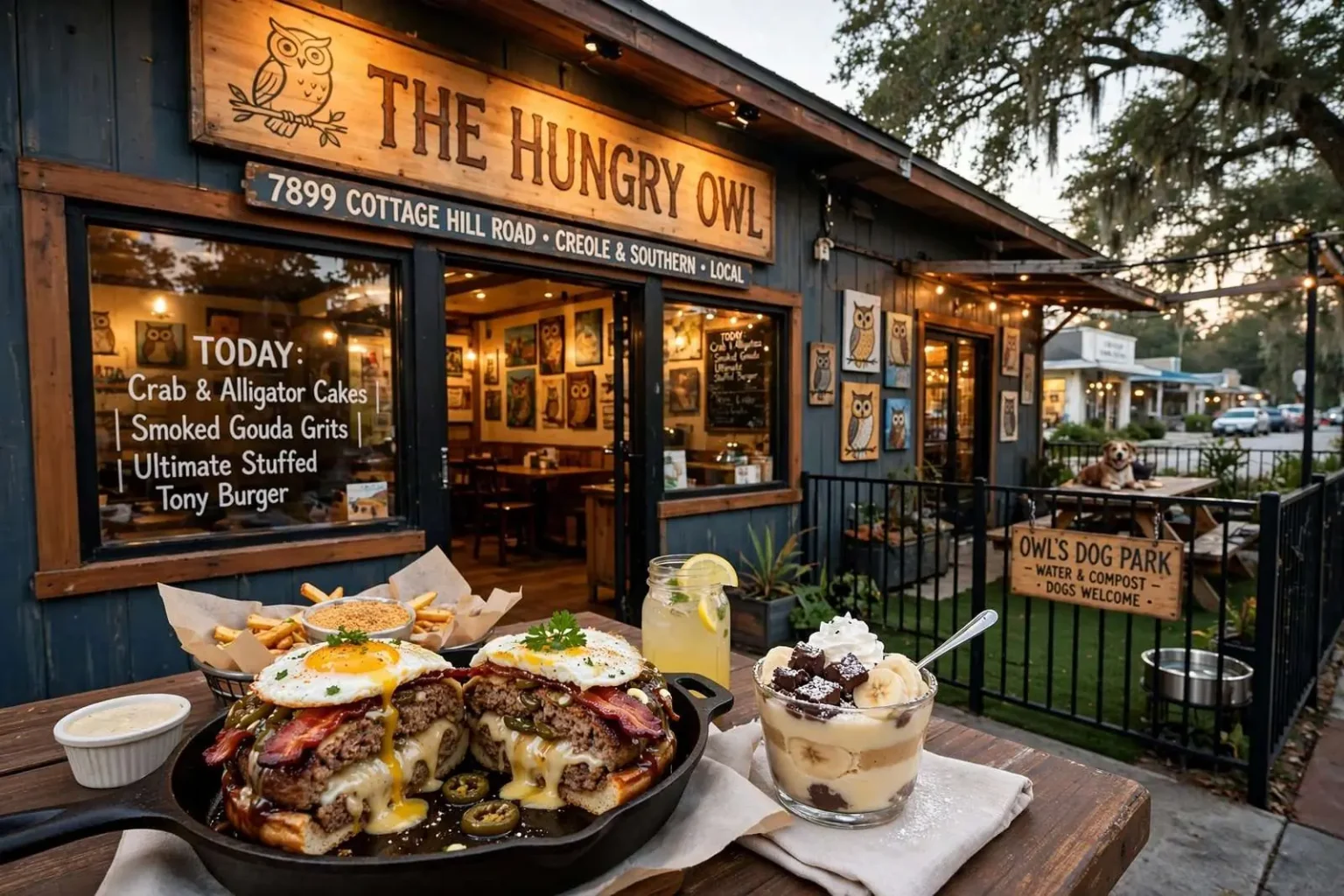
On Mobile’s Cottage Hill corridor, an independent restaurant has built a loyal following by pairing Creole and Southern cooking with a hearty dose of local character. The Hungry Owl, at 7899 Cottage Hill Road, has grown from a neighborhood kitchen into one of the more distinctive dining rooms in west Mobile, the kind of place regulars describe by dish name and out-of-towners find by word of mouth. In a corridor dominated by chain restaurants and strip-center staples, the Owl has made independence itself part of the appeal.
The kitchen sends out dishes with their own twist: crab and alligator cakes, smoked gouda grits, gourmet burgers, flatbread pizzas, sandwiches, salads and a rotating lineup of seafood pulled from local suppliers. The menu reads like a map of Gulf Coast cooking — alligator and crab alongside grits, local fish that changes with what the boats bring in — and the kitchen’s willingness to move between down-home and upscale is a large part of its draw. A table can order flatbread and burgers at one and crab cakes over smoked gouda grits at another, and neither order feels out of place in the room.
The Dessert Case and the Banana Moonpie Pudding
The dessert case’s favorite is the Banana Moonpie Pudding, a riff on a Mobile tradition that trades the banana for a fluffier finish. Banana pudding is close to sacred territory across the Deep South, and Mobile’s own version — layered with MoonPies, the marshmallow-and-chocolate snack cake born in Chattanooga but embraced across the Gulf Coast — has its own devoted following. The Owl’s take keeps the beloved architecture of the dessert while lightening the finish, and it has become the item first-time visitors are told not to leave without trying.
A signature dessert like that one does quiet marketing work. Regulars bring guests and order it for them; servers steer undecided tables toward it; and the dish becomes the thing people mention when they recommend the restaurant to friends. For an independent restaurant without an advertising budget, a dessert that generates its own word of mouth is worth more than any campaign, and the Banana Moonpie Pudding has filled that role for the Owl.
The Economics of Staying Independent
“I actually made more as a working chef than I do as a restaurant owner,” owner Tony Nicholas concedes, but he keeps the place independent by investing locally. It is an unusually candid admission from a working restaurateur, and it captures the economics of the independent dining business: ownership brings long hours, thin margins and a paycheck that can shrink below what a talented chef could command cooking for someone else. Nicholas’s answer to that arithmetic is not to sell or franchise but to keep the operation rooted where it is, spending the restaurant’s dollars with local suppliers and keeping the operation’s identity in local hands.
“The problem with large franchises is they often have generic food, which in turn can lead to a generic city,” Nicholas has said, and the observation goes to the heart of why independent restaurants matter to a community’s identity. A city’s chain restaurants are interchangeable with any other city’s; its independents are not. The menus that grow out of local suppliers, local tastes and a particular owner’s personality are the ones visitors remember and residents claim as their own. For Nicholas, keeping the Owl independent is not just a business decision but a position on what Mobile should taste like.
The dining room tells the same story of local investment. It is decorated with owl artwork made by friends and artistically inclined regulars, a collection that has grown into one of the restaurant’s defining features. Rather than ordering generic decor from a restaurant supply catalog, the Owl turned its own customers into contributors, and the walls now function as a rotating gallery of the neighborhood’s creative output. Diners who spot their own piece — or a friend’s — become part of the room, which is precisely the point.
The local-character commitment extends outdoors. The parking spot that used to be wasted space is now a fenced dog park with compost and a water source where customers can bring their companions to dinner. In a corridor where outdoor space usually means more parking, the Owl converted asphalt into one of the few dog-friendly dining setups in west Mobile, complete with a compost system that keeps the little park sustainable and a water station that keeps four-legged guests comfortable through Gulf Coast summers. It is the kind of amenity no franchise template would approve and exactly the kind regulars remember.
The Stuffed Burger That Went National
The restaurant’s stuffed burger even earned national recognition: the Travel Channel’s “Man vs. Food” featured the Ultimate Stuffed Tony Burger, built with Creole BBQ glaze, candied jalapeños, Conecuh bacon, smoked gouda and a fried egg. National television exposure is a rare thing for a neighborhood restaurant, and the Owl’s appearance came courtesy of one of food television’s most recognizable formats — a show built around finding the most audacious local dishes in America and putting them on camera.
The Ultimate Stuffed Tony Burger earns its billing. The stuffed format — fillings sealed inside the patty rather than stacked on top — turns every bite into a cross-section of the whole burger, and this version loads that cross-section with some of Alabama’s most distinctive ingredients. Conecuh bacon comes from the famous Conecuh Sausage Company, the Evergreen, Alabama smokehouse whose products are a point of pride across the state, and the Creole BBQ glaze and smoked gouda pull the flavors toward the Owl’s Gulf Coast roots. The fried egg on top completes a burger built to be photographed, which is exactly what happened.
The television feature changed the restaurant’s reach. Travel Channel appearances send road-trippers to the kitchens they profile, and the Owl began drawing burger pilgrims alongside its neighborhood regulars. For a family-run place on Cottage Hill Road, the national spotlight confirmed what the regulars already knew: the kitchen was doing work worth driving for.
The bar program has kept pace with the kitchen. Recent additions include the Owltini, Cajun Lemonade and Three Rum Punch specialty drinks, a lineup that gives the Owl a signature pour to match its signature burger. Specialty cocktails have become a competitive necessity for independent restaurants — they lift the check average, they give guests a reason to linger, and they generate the same word-of-mouth buzz that a famous dessert does. Names like Owltini and Three Rum Punch signal the room’s personality before the first sip, equal parts Gulf Coast and tongue-in-cheek, and they fit a menu that has never taken itself too seriously even while cooking seriously well.
The restaurant also planned to debut a Sunday brunch and live music on weekdays, moves that deepen its hold on the neighborhood’s dining calendar. Sunday brunch is the most fiercely competitive daypart on the Eastern Shore and in west Mobile alike, and adding it puts the Owl in the running for the post-church, late-morning crowd that sustains local restaurants through the week. Weekday live music does different work: it builds a reason to come on slower nights, gives local musicians a venue close to home, and turns a dinner service into an evening out. Together, the two additions move the Owl from a lunch-and-dinner kitchen toward a full entertainment destination on the Cottage Hill corridor.
Where the Owl Fits in Mobile’s Dining Scene
Mobile’s dining scene has always run on two tracks: the downtown districts that draw visitors from across the region, and the neighborhood kitchens scattered along corridors like Cottage Hill Road, Government Boulevard and Schillinger Road where the city’s regulars actually eat. The Hungry Owl belongs firmly to the second track, and its success argues for the strength of that track. West Mobile’s population has pushed the city’s growth south and west for decades, and corridors like Cottage Hill have accumulated the density to support serious independent kitchens — places that could never survive on traffic alone but thrive on regulars who come weekly.
The Owl’s formula — Creole and Southern cooking, local seafood, a signature burger with national credentials, a room full of customer art and a dog park where the parking used to be — is difficult for a chain to copy and easy for a neighborhood to adopt. That is the position independent restaurants occupy at their best: they cannot outspend the franchises, so they out-local them, and the customers who make that trade are rewarded with a restaurant that could exist nowhere else.
The Practical Details
Open Tuesday through Thursday from 11 a.m. to 9 p.m. and Friday and Saturday from 11 a.m. to 10 p.m., The Hungry Owl is at 7899 Cottage Hill Road in Mobile. The hours cover lunch through late dinner six days a week, with the kitchen running the full menu into the evening and the bar program extending the stay for guests who come for the Owltinis and stay for the music. The address places the restaurant deep in the Cottage Hill corridor, convenient to the neighborhoods of west Mobile and an easy drive from Tillman’s Corner and the Airport Boulevard districts.
For first-time visitors, the regulars’ advice holds: start with the crab and alligator cakes or the smoked gouda grits, work up the nerve for the Ultimate Stuffed Tony Burger, and leave room for the Banana Moonpie Pudding. Bring the dog if the weather allows — there is water in the bowl and a fence between the picnic table and the parking lot — and expect the walls to start a conversation before the food does. The restaurant that Tony Nicholas built on his own terms, against the economics of ownership and the gravity of franchise food, remains one of the truest things on Mobile’s Cottage Hill corridor: a neighborhood place with a national burger, a local heart and a dessert worth the drive.