

On an ordinary August morning in 2023, Fairhope-based musician Molly Thomas left her house with her dog, pointed her car toward Pensacola, and crossed U.S. Highway 98 just south of Fairhope. It was 9:30 a.m. Another driver T-boned her car, which flipped several times before coming to rest. Thomas had to be cut out of the wreckage and life-flighted to University of South Alabama Hospital in Mobile, where she spent a week before beginning a recovery that would stretch across a full year.
She remembers leaving the house. She does not remember the crash itself. What she does remember, in the minutes before impact, was an uncharacteristic bit of foresight: worrying that her dog’s leash would tangle in an accident, she pulled over at a stop sign about a mile from the intersection and took the leash off. And in and out of consciousness while rescue workers cut her from the vehicle, she held on to one clear thought. “I want to live,” she says. “Until you’re looking death in the face, it’s not something you think about.”
An album that almost wasn’t
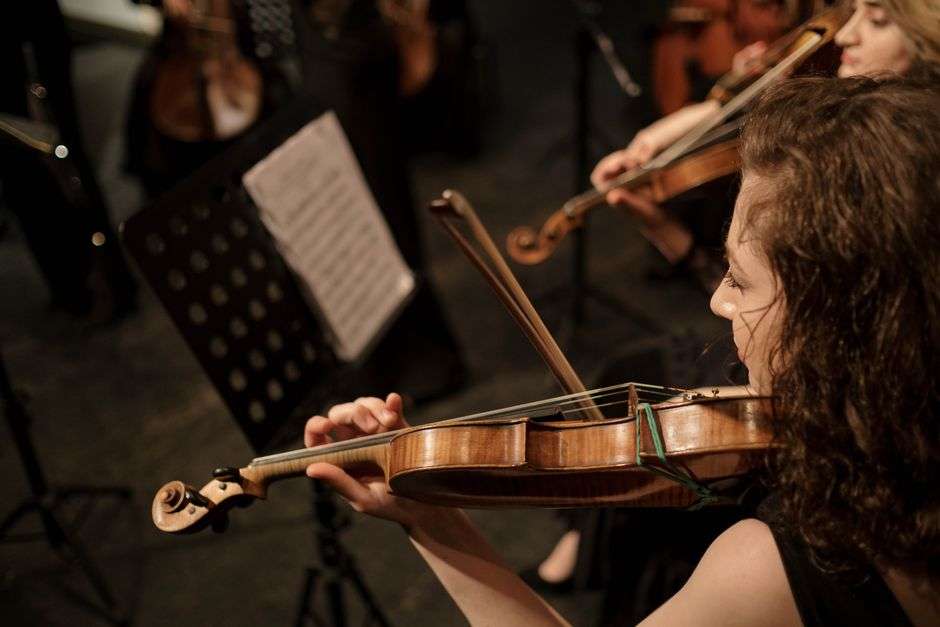
The timing could hardly have been worse for the project that would become Tumble Home. Thomas, an accomplished singer, songwriter, violinist and jewelry maker, was two months into writing songs for a new album when the crash happened. The wreck shattered the hand she uses to play the violin — an instrument she has handled since childhood — leaving her with a plate in her hand and a long rehabilitation ahead, with no guarantee she would ever play the way she had before.
The album’s title is a nautical term. A tumblehome is the gradual tapering of a ship’s hull above the waterline, a design feature that keeps a vessel stable and afloat. Thomas, who had already borrowed the phrase in a song, came to see it as a description of her own recent life. “It’s symbolic of what my life has been,” she says.
Work on the record continued in fits and starts through her recovery. When Tumble Home finally arrived in the fall of 2025, it landed as a collection of original songs co-written and co-produced with Ken Rose, shaped unmistakably by the year behind it — patience, resilience, and the experience of being carried by other people. Alongside the music came songs written in the accident’s shadow, and the record’s themes of endurance and connection run through arrangements that pair Thomas’s folk instincts with full, symphonic strings. A cameo from longtime collaborator Todd Snider is among the record’s highlights.
Just as important to Thomas, the album became a tribute to the people who lifted her up. Financial support, flowers, handwritten notes and texts arrived from across the coastal community while she was in the hospital and through the long months of rehab. She counts that support as part of the record itself.
A musical family, a moving childhood
Thomas was born in Ocean Springs, Mississippi, into a family where music was less a hobby than a birthright. Her father was a Methodist minister, and the parsonage moves that followed — Hattiesburg, Gulfport, Jackson — gave her childhood a rolling rhythm. Rather than resenting the uprooting, she embraced it. “I liked it. I got to recreate myself with each move,” she says. In Gulfport she was a cheerleader; in Jackson she turned her focus to music.
The family’s credentials ran deep. Her grandmother taught voice and later earned a degree from Columbia University. Her grandfather, who studied at both Columbia and Harvard, went on to serve as a college president. Her mother founded and directed the Mississippi Boychoir and taught voice. The house they lived in kept two pianos, one for each daughter, and Thomas’s sister would play in one room while Molly played in the other.
Music arrived early and naturally. At three years old she was picking out songs by ear on the piano. When her sister began violin lessons in the third grade, Molly started at age six. From six to sixteen she trained through the Suzuki method, which teaches children by listening, memorizing and practicing before introducing written music. In high school in Jackson she joined the state’s Academic and Performing Arts Complex, and later made a weekly drive to Hattiesburg for private lessons with a University of Southern Mississippi instructor.
Along the way came classical orchestras and jazz quartets — and eventually the fiddle, which she taught herself. Asked to explain the difference between a violin and a fiddle, she has a stock answer: “About $100 and the size of the belt buckle.” The real distinction, she says, is the style of music, not the instrument.
From Hattiesburg bars to the Ryman
Thomas enrolled at the University of Southern Mississippi intending to major in violin performance, then thought better of a practice schedule that demanded eight hours a day at the instrument. She switched to sociology and graduated with honors. The detour proved fateful: a year in, a fellow student invited her to play in his folk band, the Picardi Three — one guitar player, two violinists — and a door opened.
“Picardi Three was great fun. It opened me up to the underground music scene,” she says. The band played Hattiesburg rooms like The Pub Down Under and Tal’s Dart Bar, and Thomas began recording in studios, learning the analog craft of the era. She recorded with Pat Sansone, the multi-instrumentalist best known for his work with Wilco.
It was another invitation — this one from Mobile — that changed her address. Pascal Balthrop’s brother Ryan asked Thomas to join his band, and she moved to Mobile after college in 1994. Slow Moses, the group she fronted on fiddle, played Widespread Panic covers alongside originals in a style she describes as song-crafted indie rock. The band stayed busy enough to hire a booking agent and draw regular paychecks, recorded an album called Blend at Allen Toussaint’s studio in New Orleans, and cut a single, “Joe Cain,” honoring Mobile’s Mardi Gras legend Chief Slackabamorinico. Thomas stayed four years, and it is where she first began writing her own songs in earnest.
Twelve years in Nashville
When Slow Moses ran its course, Thomas moved to Nashville, where she spent twelve years building a working musician’s life: solo gigs, songwriting, session work, sitting in with other bands, and bartending to keep the lights on. She aligned herself with the East Nashville scene rather than the commercial world of Music Row.
The résumé that followed is the kind most session players only dream about. She toured Europe, Canada and the United States, played in Todd Snider’s band, and appeared with him on The Tonight Show with Jay Leno, the Late Show with David Letterman and Imus in the Morning. She performed at the Ryman Auditorium in Nashville, the Troubadour in Los Angeles, and theaters across the country. “I truly had some unbelievable experiences,” she says. Over the years she has also shared stages and studios with artists including Will Kimbrough, Matthew Ryan, Guster and Abe Partridge.
But the hustle wore on her. Around 2012 she began drifting back toward the Eastern Shore of Mobile Bay, and an old friend from her early Mobile days helped convince her to leave Nashville and start a new chapter.
The Rare Birds and a life made by hand
In 2014 she launched her own band, Molly Thomas and the Rare Birds, with a lineup anchored by guitarist Rick Hirsch of Wet Willie fame, drummer John Milham, and multi-instrumentalist John Keuler. The band became her primary creative vehicle, and Thomas its frontwoman — though she describes herself as more artist than entertainer. “Music is my path. It has to have meaning,” she says.
Creativity, for Thomas, has never stayed inside one medium. In the mid-1990s she took a pottery class in Mobile and worked in Mary Elizabeth Kimbrough’s studio, a pursuit she set aside in Nashville and picked back up when she returned to the coast. More recently she has added bracelets, earrings and silverwork, selling her jewelry at gigs and preparing to sell locally. Working with her hands, it turns out, is not a hobby but a through-line — one that made the prospect of a shattered hand all the more frightening.
Still playing
Today, the plate in her hand is a permanent fixture, but the playing came back. She performs throughout the coastal area — solo, in music-in-the-round settings, and with the Rare Birds — and still reports a case of stage fright before every show, which no one who has watched her play would ever guess.
Her advice to other artists is as unglamorous as it is honest: keep going, ask for help when you need it, and take the community around you seriously. Her own recovery proved the point. The flowers and the benefit contributions mattered, but so did the steady drumbeat of texts and notes from people who had watched her play over the years and refused to let the story end on Highway 98.
Tumble Home stands as the record of that journey — an album about staying afloat, written by someone who learned the term from the inside. For a coastal town that claims its musicians fiercely, it is a local story as much as a musical one: a Fairhope artist who nearly lost everything, and who turned the wreck into the best work of a thirty-year career.