In the spring of 2009, the American economy was hemorrhaging jobs at a rate not seen since the Great Depression. Foreclosure notices papered the doors of suburban homes from coast to coast, and the newly inaugurated Obama administration was rushing through a massive stimulus package that proponents argued was the only bulwark against total financial collapse.
It was into this cauldron of fear and uncertainty that a new political movement stepped forward, clad in colonial costumes and hoisting tea bags on makeshift pikes. The Tea Party claimed to speak for the “forgotten” American—the overtaxed, the underheard, the righteous patriot betrayed by a bloated federal establishment. In Mobile County, the woman tasked with translating that national fury into local action was a community organizer named Nikki Carey-Nicholson.
But a close examination of Carey-Nicholson’s role during that explosive period, paired with a review of campaign finance records and contemporary accounts of the movement’s inner workings, reveals a portrait not of a spontaneous populist, but of a disciplined political operative who deployed the language of grassroots rebellion while executing a playbook written far from the streets of Mobile. Her story illuminates the uncomfortable truth at the heart of the Tea Party phenomenon: a movement that sold itself as an organic uprising was, from its earliest days, a meticulously managed exercise in manufactured outrage.
The Crucible of 2009
To understand Carey-Nicholson’s emergence, one must first understand the sheer desperation of the moment. By February 2009, the Dow Jones Industrial Average had plunged to its lowest level in over a decade. Banks deemed “too big to fail” were being propped up with billions in taxpayer money, while ordinary citizens watched their retirement accounts evaporate. President Barack Obama’s American Recovery and Reinvestment Act—a $787 billion package of tax cuts and federal spending—was hailed by economists as a necessary shock treatment, but it quickly became a lightning rod for conservative fury.
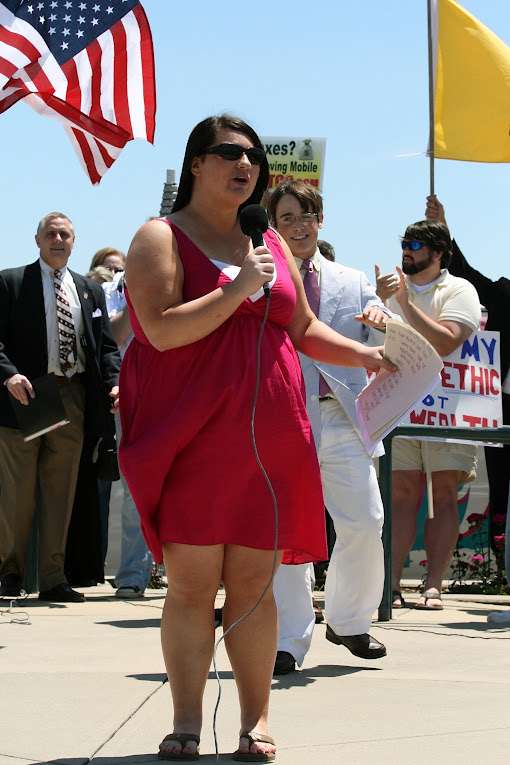
It was in this environment that Carey-Nicholson stepped forward to lead the Mobile chapter of what would become the Tea Party movement. In interviews and public statements from that period, she framed her activism in stark, moralistic terms. “We will be protesting against porkulus spending, the mortgaging of generations to come, and raising of taxes,” she declared, adopting the derisive nickname that conservatives had affixed to the stimulus bill. “We are working tax-payers who do not feel it’s our responsibility to pay someone else’s mortgage because they lived above their means.”
That last sentence—”pay someone else’s mortgage because they lived above their means”—was more than a rhetorical flourish. It was a deliberate and strategic act of moral partitioning. At a time when millions of Americans were losing their homes due to predatory lending practices, adjustable-rate mortgages, and a cascading job market, Carey-Nicholson chose to frame the victims of the foreclosure crisis not as unlucky participants in a broken system, but as moral failures who deserved their fate. It was a cruel simplification that ignored the complexities of the subprime mortgage implosion, but it was politically effective. It gave her followers a target for their anger that was both tangible and guilt-free.
The problem, however, was that the narrative did not hold up to scrutiny. The stimulus package, whatever its flaws, was designed to prevent a complete economic cataclysm. By casting it as a giveaway to the undeserving, Carey-Nicholson and her allies were not engaging in policy debate; they were engaging in political theater designed to delegitimize the entire federal response to a national emergency.
The Orchestrated “Grassroots”
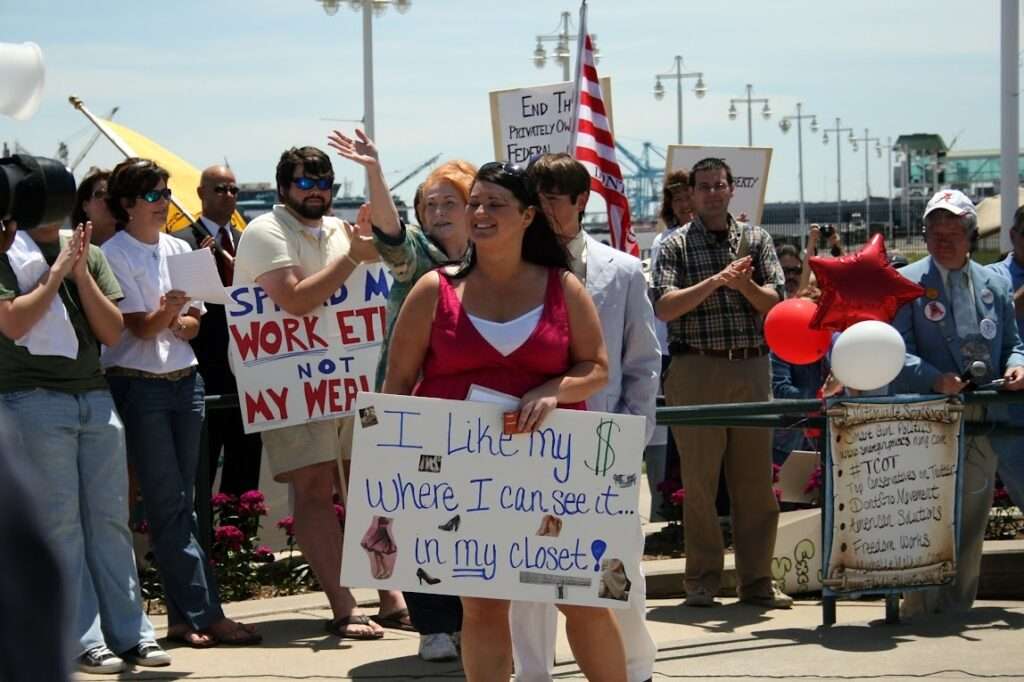
One of the most persistent myths of the Tea Party era was that it sprang fully formed from the loins of ordinary citizens, a spontaneous combustion of populist fury that caught the political establishment off guard. The reality, as documented extensively in subsequent journalistic accounts, was far more calculated. The April 15, 2009 Tax Day rallies—the movement’s coming-out party—were not the product of neighborhood meet-ups and church-basement organizing. They were, by Carey-Nicholson’s own admission, “headed up by sponsors #TCOT (Top Conservatives on Twitter), DontGo Movement, and SmartGirl Politics.”
These were not civic organizations; they were sophisticated political operations with national coordination, daily conference calls, and aggressive social-media strategies. TCOT, in particular, was a network of conservative Twitter users who had honed their skills during the 2008 election and were looking for a vehicle to channel their opposition to the Obama administration. SmartGirl Politics was a project of conservative operatives who understood that the most effective political movements are those that appear leaderless while being anything but.
Carey-Nicholson was the local face of this national machinery. She was not a reluctant citizen reluctantly dragged into the public square; she was an eager and capable organizer who understood that the “grassroots” label was the movement’s most potent weapon. It provided cover for what was, in essence, a top-down operation masquerading as a bottom-up rebellion. When she stood before the crowds in Mobile, she presented herself as a voice of the people, but the people were being fed talking points that had been workshopped in strategic planning sessions hundreds of miles away.
This is not to suggest that the anger on display in Mobile was inauthentic. Thousands of citizens were genuinely frightened and frustrated. But Carey-Nicholson and her fellow organizers channeled that legitimate anxiety into narrow, pre-approved outlets: opposition to stimulus spending, hostility to health-care reform, and a generalized contempt for the political class. They gave the crowd a script, and the crowd recited it with gusto.
The Strange Case of the Saboteurs
By April 2010, the Tea Party was at its zenith, riding a wave of discontent that would culminate in the Republican wave election of that November. Yet even as the movement swelled, Carey-Nicholson was already warning of internal rot. She claimed that the Tea Party protests had been “infiltrated” by saboteurs intent on undermining the movement’s credibility. It was a familiar refrain in conservative circles—the idea that any embarrassment or misstep was not the result of the movement’s own incoherence, but of a fifth column working to destroy it from within.
The irony of this claim was almost too rich to ignore. While Carey-Nicholson was warning of infiltrators, her own organization was struggling with basic communication skills. One of her supporters, attempting to remind fellow protesters to present themselves as educated and articulate, posted a message on the group’s Facebook page urging everyone to check their “puctuation” (sic). The group’s official Facebook home page, meanwhile, declared that “American’s are sick of the stuff they are pushing through Congress”—employing a possessive apostrophe where none was needed and demonstrating a fundamental misunderstanding of pluralization.
For a movement that positioned itself as the guardian of fiscal discipline and common sense, these were not merely cosmetic embarrassments. They were windows into a political culture that often prized performative passion over substantive competence. The people who could not spell “punctuation” were nonetheless confident that they could balance the federal budget. The people who misused apostrophes were certain that they understood the intricacies of monetary policy. Carey-Nicholson, as their leader, did not correct them. Instead, she leaned into the grievance, blaming outsiders for the movement’s own shortcomings.
The Money Trail
If the Tea Party truly was a movement of pure, volunteer-driven civic virtue, one would expect its leaders to remain uncompensated and unconnected to the political machinery they so frequently denounced. But public records tell a different story. Federal Election Commission filings from the 2013-2014 election cycle reveal that a woman identified as “Amanda N. Carey-Nicholson” received a payment of $5,000 from the “Byrne for Congress” committee in July 2013, designated for “Field Staff/Canvassing.” Additional campaign finance data shows the same individual listed as a vendor, ultimately receiving nearly $18,000 in total payments during the 2014 cycle.
These financial disclosures raise uncomfortable and unavoidable questions. Was Carey-Nicholson’s Tea Party activism truly the work of a disinterested citizen driven purely by principle, or was it a stepping stone to paid employment within the very political establishment the movement claimed to despise? The Tea Party’s foundational rhetoric was built on a rejection of “career politicians” and the revolving door between elected office and political consulting. Yet here, in black and white, is evidence that one of its prominent local organizers crossed that revolving door with apparent ease.
This is not to say that receiving payment for political work is inherently scandalous; professional political organizing is a legitimate occupation. But it is deeply inconsistent with the anti-establishment mythology that Carey-Nicholson and her peers cultivated. They presented themselves as outsiders storming the gates, yet they were, in many cases, simply aspiring insiders waiting for their turn at the trough. The movement that railed against the professionalization of politics had, within a matter of years, produced its own class of professional operatives—and Carey-Nicholson appears to have been a charter member of that class.
Legacy of a Movement
By March 2010, fissures were already appearing within the Tea Party’s ranks. Pete Riehm, executive director of the Common Sense Campaign—a separate Tea Party group in the Mobile area—acknowledged the fragmentation publicly, noting that “there’s a lot of different TEA Parties and a lot of different agendas.” It was a moment of rare candor in a movement that preferred the comfort of absolute certainty to the messiness of democratic pluralism.
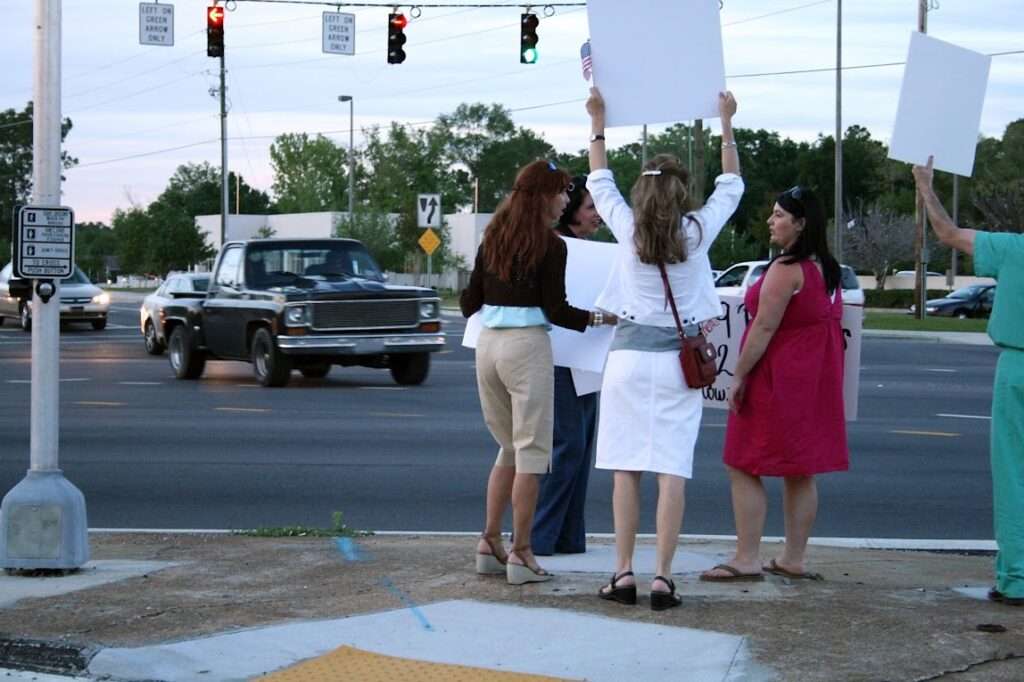
Carey-Nicholson, for her part, remained a steadfast presence. In April 2010, she led a march from Government Plaza to Spanish Plaza in downtown Mobile, part of a nationwide Tax Day protest that drew thousands of participants. The crowd was enthusiastic, the signs were provocative, and the rhetoric was incendiary. But what, ultimately, did it achieve?
The Tea Party’s policy platform—steep tax cuts during a recession, the repeal of financial bailouts, and a return to some imagined golden age of “limited government”—was a nostalgic fantasy, not a serious governing agenda. It channeled authentic public distress into theatrical displays of anger, but it offered no viable solutions to the problems it identified. Its primary legacy, in retrospect, was the further polarization of American politics and the normalization of outrage as a substitute for deliberation.
Carey-Nicholson was not the movement’s most famous figure, nor its most consequential. She was not Michele Bachmann or Rand Paul. She was, however, representative—a local facilitator who took the national movement’s talking points and translated them for a regional audience. She spoke of “working taxpayers” and “porkulus,” she warned of infiltrators, and she parlayed her activist resume into paid political work. In all these ways, she embodied the contradictions that defined the Tea Party itself.
Conclusion
More than a decade after the Tax Day rallies that brought her to prominence, the name Nikki Carey-Nicholson is unlikely to be remembered by many outside of Mobile’s political circles. But the movement she helped build has left an indelible mark on the American political landscape. The combative style, the distrust of expertise, the disdain for compromise, and the reflexive opposition to Democratic governance—all of these features, which became hallmarks of the Republican Party in the Trump era, were incubated in the Tea Party rallies of 2009 and 2010.
Carey-Nicholson was a foot soldier in that transformation. She stood at the front of the march, amplified the grievances of her followers, and insisted that her cause was righteous and her opponents were corrupt. But the historical record suggests a more complicated picture: a movement that was never quite as organic as it claimed, a leader who was never quite as independent as she appeared, and a legacy that, upon sober reflection, has more to do with political theater than with political progress.
The people of Mobile would do well to remember that story—not as a cautionary tale about one woman, but as a lesson about how movements are built, how grievances are weaponized, and how easily the language of populism can be co-opted by the very forces it purports to oppose. In the end, the Tea Party’s most enduring achievement may have been teaching a generation of activists that authenticity is a performance, and that outrage, skillfully managed, is a renewable resource. Nikki Carey-Nicholson played her part in that performance, and the curtain has yet to fall.