

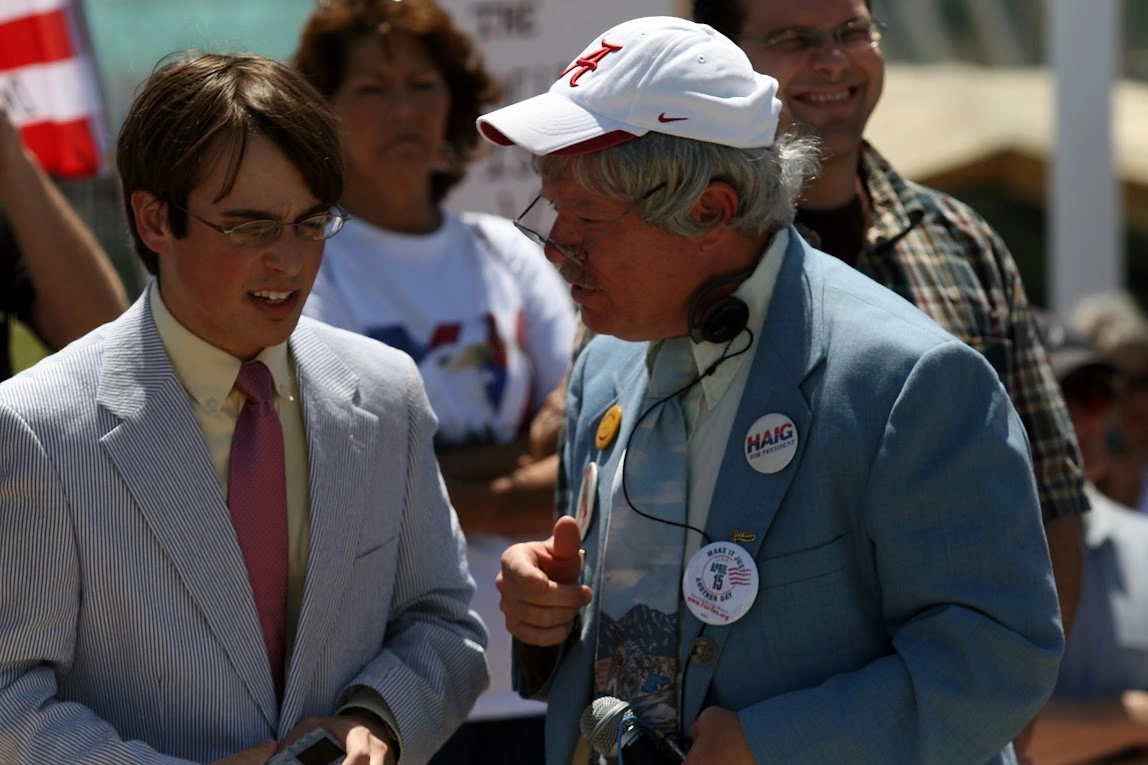
When Josh Woods raised his right hand and took the oath of office for the Mobile City Council in August 2023, he presented himself as a fresh face in local politics—a family man, a businessman, a consensus-builder. But a decade and a half before he began championing "quality of life" and "momentum" for the Port City, Woods was on the front lines of one of the most divisive political movements of the modern era: the Tea Party protests against President Barack Obama. The Man Behind the Movement In the sweltering summer of 2009, as the Obama administration and congressional Democrats pushed forward with plans to reshape the nation's healthcare system, a West Mobile resident by the name of T.
Joshua Woods emerged as a key organizer of Tea Party protests targeting the Mobile offices of Republican representatives. "We are very happy to say that all three of the men who represent us in Washington will be doing the right thing by not supporting socialized medicine," Woods declared in an email announcing a planned protest. The language was incendiary. "Socialized medicine"—a loaded term deliberately deployed to evoke fears of government overreach and Soviet-style bureaucracy—was Woods' chosen characterization of efforts to expand healthcare coverage to millions of uninsured Americans. It was the kind of rhetoric that defined the Tea Party movement: hyperbolic, fear-based, and designed to mobilize opposition to a president who had been in office for barely six months.
Organizing Against a President Woods' involvement was not casual attendance—it was organization. He was the one sending emails to the press, the one coordinating the so-called "tea party" protest that targeted the offices of Rep. Jo Bonner, Sen. Jeff Sessions, and Sen. Richard Shelby. The protest was part of a nationwide effort to derail the Obama administration's healthcare agenda. Just days later, about 50 Tea Party protesters gathered and marched through downtown Mobile. While Woods may not have been named in that specific report, the protest he helped organize was part of the same wave of opposition—one that sought to cast the first Black president's signature legislative achievement as an existential threat to American freedom.
Protesters held signs reading "Change but not at the price of freedom" and "Save the private health insurance". They marched under the banner that TEA stood for "taxed enough already". These were the battle cries of a movement that, at its core, was defined by its opposition to Barack Obama. The Tea Party's Ugly Underbelly The Tea Party movement that Woods aligned himself with was never simply about fiscal conservatism. From its inception in early 2009, the movement formed in opposition to the policies of Democratic President Barack Obama. It was a reactionary force, born in the immediate aftermath of the election of the nation's first African American president. The movement's rallies were frequently marred by racist imagery—signs depicting Obama as a witch doctor, as the Joker, as Hitler.
Protesters shouted slurs and questioned the president's citizenship. While Woods himself may not have been photographed holding such signs, he chose to align himself with a movement where such ugliness was not merely tolerated but endemic. By organizing protests against "socialized medicine," Woods was lending his voice and his organizational skills to a campaign of misinformation. The Affordable Care Act was not socialism—it was a market-based reform that built upon private insurance while expanding coverage to the uninsured. But nuance was never the Tea Party's strength. Fear was. From Protest to Politics Fast forward to 2023, and Woods has reinvented himself.
Background and Context
The Tea Party organizer of 2009 is now the executive director of The Grounds, a proud graduate of the University of South Alabama's Mitchell College of Business, and a man who has a passion to serve the residents of District 6. He speaks of "quality of life," "infrastructure," and "public safety". He talks about ending Mobile's "brain drain" and striking "perpetual potential" from the city's vocabulary. His biography on the city's website makes no mention of his Tea Party activism. His campaign materials do not acknowledge the protests he organized against the 44th president. Instead, voters are presented with a sanitized version—a businessman, a family man, a community leader. A Pattern of Extremism?
Woods' Tea Party involvement raises serious questions about his judgment and his fitness to represent a diverse district. The Tea Party was not a mainstream conservative movement—it was a fringe insurgency that contributed to government shutdowns, gridlock, and a coarsening of political discourse that the nation is still recovering from. And Woods' activism didn't stop with healthcare. The Tea Party movement in Alabama's coastal counties was organized under the banner of the "Common Sense Campaign," a group that was extraordinarily active in the region. This was the same movement that pushed for "nullification"—the fringe legal theory that states can reject federal laws they deem unconstitutional. It was the same movement that fueled the 2010 wave election that brought extreme partisans to power. Woods chose to be part of that.
He chose to organize against a president who had been elected with a mandate for change. He chose to use the language of fear and division. The Questions Woods Must Answer Now that Woods sits on the Mobile City Council, the citizens of District 6 deserve answers. Does he stand by his 2009 statements calling healthcare reform "socialized medicine"? Does he regret organizing protests against a president who was simply trying to expand access to healthcare? Does he still believe in the Tea Party's core tenets—or was his involvement merely opportunistic? Woods has said that "everybody has the right to be heard". That's true. But the people of Mobile also have the right to know who they elected.
They have the right to know that the man who now votes on their budgets, their infrastructure, and their quality of life was once an organizer of protests against the first Black president of the United States—protests rooted in fear, misinformation, and resistance to progress. The Danger of Forgetting There is a tendency in politics to treat the past as prologue—to assume that what someone did fifteen years ago is irrelevant to their current service. But the Tea Party was not a youthful indiscretion. It was a political movement with real consequences: government shutdowns, a degraded public discourse, and the normalization of extremism within the Republican Party. Woods was not a passive participant. He was an organizer.
He was sending emails to the press, coordinating protests, and using the language of "socialized medicine" to frighten his fellow citizens. That is not the resume of a unifier. That is the resume of a partisan operative. And yet, Woods now presents himself as a consensus-builder, a man who wants to "listen, learn, and lead side by side with the residents of his District". Perhaps he has changed. Perhaps the man who organized Tea Party protests against Barack Obama in 2009 is not the same man who now serves on the Mobile City Council. But the people of Mobile deserve to know the full story.
Background and Context
They deserve to know that the man who now represents them was once on the front lines of a movement defined by its opposition to progress, its embrace of misinformation, and its willingness to use fear as a political weapon. A Call for Transparency Josh Woods owes his constituents an explanation. He owes them a full accounting of his Tea Party involvement and whether he still embraces the views that motivated him to organize protests against healthcare reform. He owes them honesty about his political evolution—if there has been one. The city of Mobile is changing. It is growing, annexing new territory, and becoming more diverse. It deserves leaders who can represent all of its residents—not just those who shared the fear and anger of the Tea Party movement.
Woods has a choice. He can continue to bury his past, hoping that no one digs deep enough to find it. Or he can come clean, answer the tough questions, and prove to the people of District 6 that he is the leader he claims to be. The record, however, is clear. In 2009, Josh Woods was a Tea Party organizer. He was a man who used the language of fear to oppose a president who was trying to help millions of Americans get health insurance. And that is a fact that no amount of rebranding can erase.
Josh Woods of Mobile, AL Organizing a Tea Party Protest in 2009 Josh Woods of Mobile, AL Organizing a Tea Party Protest in 2009 Josh Woods of Mobile, AL Organizing a Tea Party Protest in 2009 Josh Woods of Mobile, AL Organizing a Tea Party Protest in 2009
Wider Significance for Coastal Alabama
This story is part of a broader set of changes playing out across Mobile, Baldwin and the wider Gulf Coast region. Local residents, businesses and government agencies have been watching developments like this one closely, because decisions made in Mobile and Baldwin counties often ripple outward into neighboring communities across south Alabama, Mississippi and the Florida Panhandle. Public meetings, council work sessions and state legislative hearings have all carried echoes of the underlying concerns, with stakeholders ranging from neighborhood associations to industry groups weighing in on what the outcomes will mean for daily life along the Gulf Coast. Reporters and editors in the region have worked to document how these issues affect ordinary people, from commuters on Interstate 10 to families visiting the public libraries and parks that anchor so many of the Port City’s neighborhoods. The deeper context often emerges over months rather than days, as projects move from announcement to planning to construction, and as the people most directly affected find their voices in the public record. Continued coverage remains important, both for accountability and for the historical record, and the unfolding situation is one that warrants attention from anyone with a stake in the future of south Alabama.
Looking ahead, observers across the region expect the conversation to continue evolving. Local officials have signaled their intent to monitor outcomes closely, and community organizations have indicated they will remain engaged as new information becomes available. The intersection of state policy, local implementation and on-the-ground impact is precisely where stories like this one tend to develop their lasting significance. For Mobile and Baldwin residents, the practical effects will play out over time, in everything from tax bills and utility rates to traffic patterns and the availability of public services. Following the developments requires patience and attention to detail, but it is also a reminder of how civic life in coastal Alabama continues to be shaped by decisions that begin far from the neighborhoods they ultimately touch. Residents who want to stay informed can do so by following local government meetings, attending public hearings when significant issues arise, and reading the regional reporting that tracks how these stories progress from one phase to the next.
Local news organizations continue to follow this story closely, and updates are expected as more details emerge. The developments have generated discussion across the region, with attention from both longtime residents and newcomers who are following the issue for the first time. Community leaders have emphasized the importance of staying engaged with local government and participating in public meetings when significant decisions are being made. As the situation continues to unfold, residents are encouraged to remain informed through reliable local reporting and official city and county communications channels. The story remains active, and additional information is anticipated in the coming days and weeks as the relevant agencies and stakeholders complete their work.