

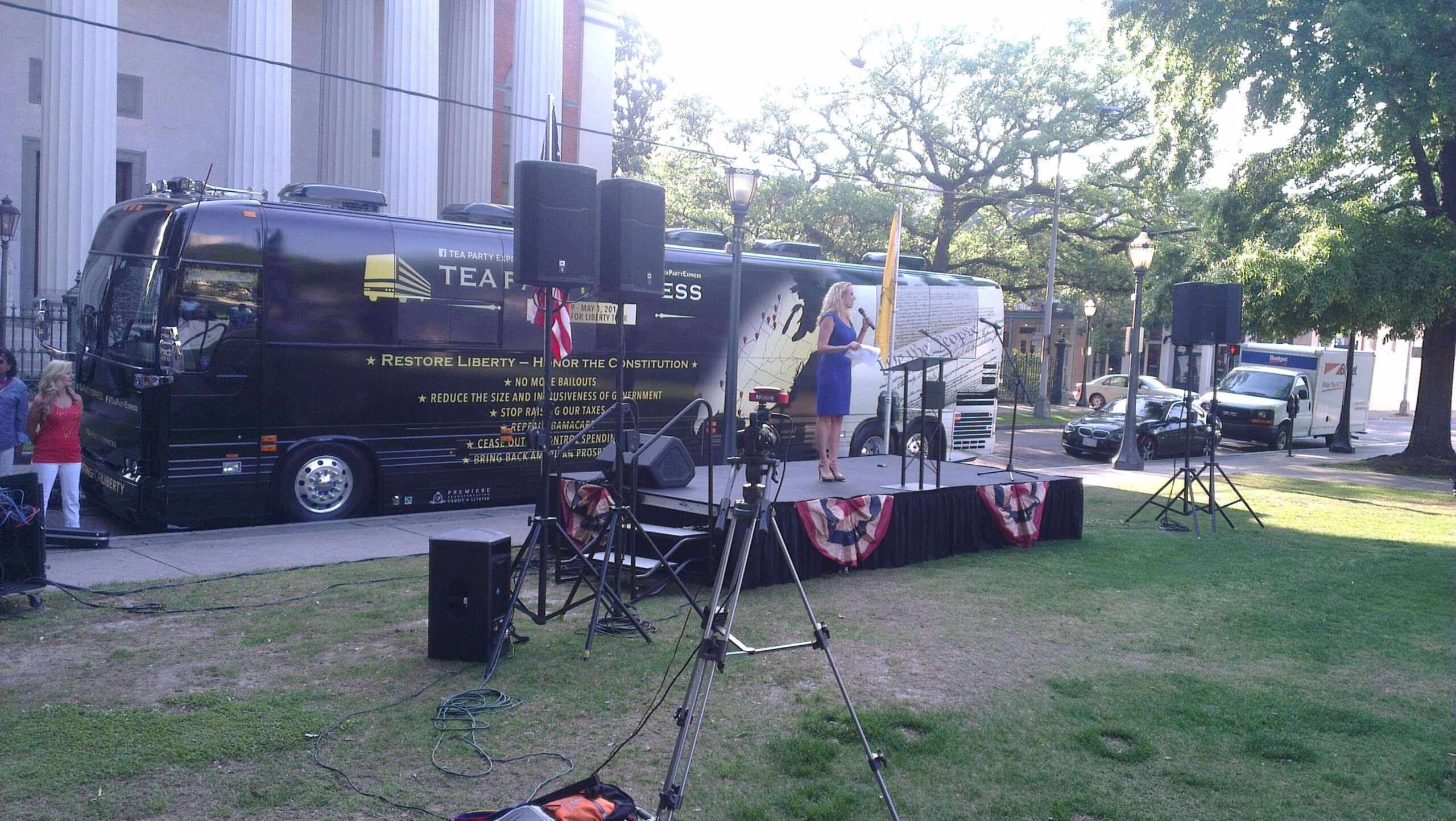
The Tea Party Express brought its “Fighting for Liberty” national bus tour to Cathedral Square in downtown Mobile on Wednesday, April 23, 2014, rallying conservative supporters with a message focused on fiscal responsibility and taking control of the U.S. Senate. The event, which kicked off at 5:00 PM at 300 Conti Street, put one of Alabama’s most prominent national political figures in front of the movement’s grassroots base at the precise midpoint of a midterm-election year that both parties viewed as a hinge point in Washington.
Cathedral Square, the brick park in the heart of the city’s Church Street East historic district, has long served as downtown Mobile’s most accessible gathering place for rallies, festivals, and public events. The square’s setting, beneath the spire of the historic cathedral that gives it its name and within sight of Government Street, offered the tour’s organizers a centrally located stage within walking distance of the businesses and residents the movement hoped to reach.
U.S. Senator Jeff Sessions (R-AL) served as the main speaker. Sessions, a prominent conservative voice, told the crowd that if Republicans were successful in taking control of the Senate in the upcoming November elections, Congress would have an “option to pass a budget that would put America on a sound path”. The remark reflected his position at the time as the senior Republican on the Senate Budget Committee, where he had built a national profile through years of floor speeches and committee exchanges over federal spending, deficits, and debt.
He also criticized the Obama administration’s handling of the Affordable Care Act and immigration, arguing that the nation was on a “path of destruction financially”. Both subjects were at their peak salience in the spring of 2014: the health law’s major coverage provisions had taken effect months earlier amid a turbulent rollout, and an immigration overhaul that had passed the Senate the previous summer had stalled in the House, leaving the issue as a live fault line heading into the midterms. Sessions had been among the most vocal opponents of that Senate immigration bill, and his remarks in Mobile tied the two debates to the same underlying argument about spending and enforcement.
A Tour Built for the Midterms
The rally was part of a broader two-week, 10-state tour through key battleground states that organizers hoped would energize grassroots conservatives ahead of the midterm elections. The tour, which began on April 19th in Fort Myers, Florida, made stops in Alabama, Mississippi, Louisiana, Texas, Oklahoma, Kansas, Iowa, Nebraska, and Minnesota. The route traced a deliberate arc across the South and Plains states where Senate contests and House districts would decide whether Republicans could capture a majority, before reaching states where the movement aimed to pressure sitting legislators.
The bus-tour format has been a signature of the Tea Party Express since its earliest cycles, carrying a traveling stage, sound equipment, and a rotating cast of speakers from city square to city square. The approach trades the scale of an arena event for frequency and reach, allowing a national organization to touch dozens of communities in a fortnight and to generate local coverage in each market it visits, as the Mobile stop did.
Taylor Budowich, executive director of the Tea Party Express, said the tour’s goal was to rally and engage conservative Americans on issues that matter to them. “2014 will be the year we rip the gavel out of Harry Reid’s hand and return it to the people,” Budowich declared. The reference was to the Senate majority leader from Nevada, whose control of the chamber’s calendar had become the movement’s shorthand for legislative gridlock, and whose gavel was, in the arithmetic of the coming election, the single most consequential prize on the ballot.
For the organizers, the Mobile stop served a dual purpose: rewarding a home-state base that had reliably supported the movement since its emergence, and signaling to Alabama voters that their senior senator stood at the center of the national fight over the Senate’s direction.
The Convoy and the Crowd
Approximately 25 people arrived in Mobile aboard two colorful buses, one of which was adorned with the likeness of President Ronald Reagan. The Reagan imagery has been a fixture of Tea Party Express tours since the movement’s rise, invoking the conservative standard-bearer of the 1980s as a touchstone for the fiscal arguments at the center of the 2014 campaign. The buses themselves functioned as rolling billboards, announcing the tour’s arrival in each city before the first speaker took the stage.
The Mobile stop was the only one scheduled in Alabama during the tour, which gave local activists a rare chance to participate in the national event without traveling. Tea Party organizations across the state had built local chapters in the years following the 2010 elections, and gatherings of this kind served as much as networking opportunities as political theater, connecting volunteers with the groups that would staff phone banks and precinct work in the fall.
Budowich noted that Senator Sessions’ presence was a major draw for the rally, calling him a “stalwart conservative”. The endorsement ran in both directions: Sessions had courted the movement’s supporters since his earliest fights over immigration enforcement and federal spending, and the tour’s stop in his home state gave him a national stage on which to make the closing argument for the election he was watching take shape.
In addition to Sessions, the event featured speeches from national and local Tea Party leaders, as well as performances from the conservative band Rivoli Revue and singer/songwriter Diana Nagy. Music has been part of the Tea Party Express’s identity since its founding, with the tour’s name itself borrowed from its musical origins, and the Mobile program followed that tradition by alternating speakers with performances designed to hold families and early-evening crowds through the full program.
About 10 local politicians and candidates were on hand, using the gathering to introduce themselves to the movement’s most engaged voters ahead of qualifying deadlines and the summer primary season. For candidates in local races, a rally crowd of committed activists represents an audience that votes reliably and volunteers readily, which explains why local officeholders and hopefuls make appearances at such events a priority in election years.
The 2014 Stakes Behind the Message
The fiscal argument at the center of the Mobile rally reflected the numbers dominating Washington that spring. Federal deficits had receded from their post-recession peaks but remained elevated, the national debt had climbed past $17 trillion, and fights over the debt ceiling and continuing resolutions had repeatedly brought the government to the edge of shutdown in the preceding years. Conservative activists argued that only a change in Senate control could force structural budget reforms, while Democrats maintained that the recovery called for patience rather than austerity.
On health care, the Affordable Care Act’s first open enrollment had closed weeks before the tour launched, and Republicans had made repeal a central midterm theme, betting that lingering frustration with the law’s rollout and premium changes would drive turnout. On immigration, the House’s refusal to take up the Senate’s 2013 bill had left enforcement questions unresolved, and Sessions had positioned himself as the leading Senate critic of any compromise that included a path to legalization, an argument he pressed with the Mobile crowd.
History would record the fall of 2014 as the wave election the tour anticipated: Republicans expanded their House majority and took the Senate with nine seats, ending the Democratic majority that Budowich’s remarks had targeted. Sessions, whose Mobile audience heard the argument months in advance, would spend the following year as chairman of the Senate Budget Committee, holding the gavel-adjacent post his party had promised to win.
For the activists who gathered at Cathedral Square that April evening, the rally compressed the entire theory of the 2014 election into a single program: a home-state senator framing the stakes, a national organization supplying the machinery, and a promise that grassroots energy, organized early and applied locally, could change the direction of a chamber of Congress. The buses rolled west the next morning toward the remaining stops, leaving behind the local volunteers who would do the precinct work the tour was designed to ignite.
The evening at Cathedral Square also illustrated how national political infrastructure and local organizing reinforce one another in Alabama. The Tea Party Express supplied the stage, the schedule, and the media attention, while the Mobile-area chapters provided the crowd, the volunteers, and the follow-through that outlasts any single event. That division of labor, refined over several election cycles by the time the 2014 tour passed through, is what allowed a movement built on decentralized local groups to project a consistent national message from city to city, and it is the reason organizers made sure the state’s only stop landed in the district of one of the Senate’s most reliable conservative voices.