Thomas Hospital Opens New $40 Million Tower With Helipad, 25 Patient Rooms
Thomas Hospital in Fairhope has opened a new $40 million patient tower with 25 technology-equipped rooms and a rooftop helipad to speed critical patient.
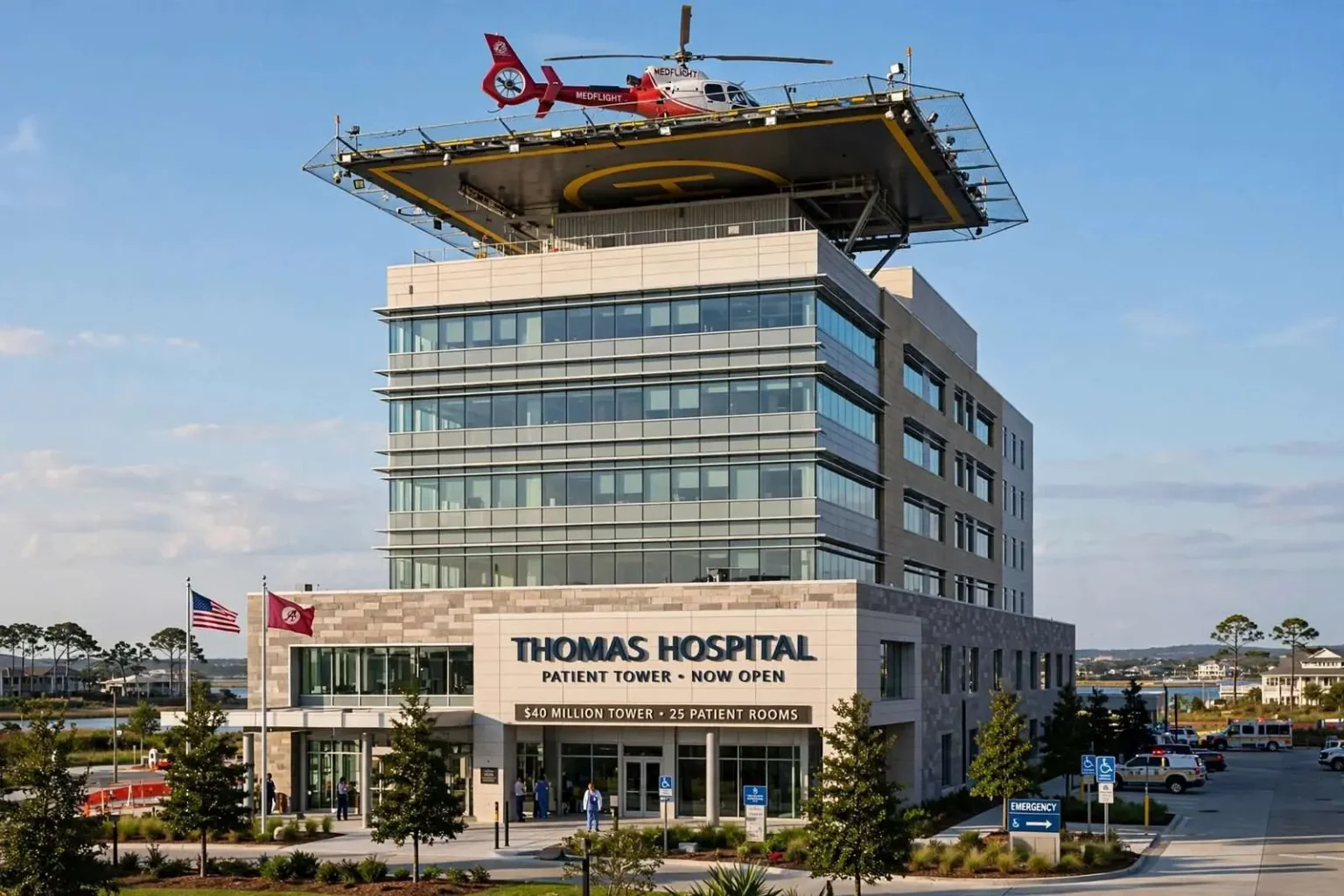
FAIRHOPE, Ala. — Thomas Hospital has opened a new $40 million patient tower designed to keep pace with Baldwin County’s growth, featuring 25 technology-equipped rooms and a rooftop helipad meant to speed critical transport for heart attack, stroke and trauma patients.
“We’re standing in the hospital room of the future,” said Dr. Paul Glisson.
The tower adds a visible landmark to the Fairhope skyline and a substantial chunk of capacity to the hospital that serves the Eastern Shore’s growing communities of Daphne, Fairhope, Spanish Fort and the county beyond. Each of the new rooms was built as a private, technology-equipped space, wired for the monitoring, imaging and bedside equipment that modern acute care demands, so that patients can be treated in place rather than moved from room to room as their conditions change.
Infirmary Health President and CEO Mark Nix said the expansion responds to years of strained capacity. “The demand has been overwhelming,” Nix said. “We’ve been running at capacity or greater than capacity for many, many years.”
The statement described a problem that hospital leaders had documented across the system. Baldwin County ranked among the fastest-growing counties in Alabama through the past two decades, its population swelling along the I-10 corridor and the beaches while hospital infrastructure lagged. Emergency rooms ran full, inpatient beds were scarce during winter visitor season, and transfers to Mobile hospitals in search of an open bed became routine.
The tower is also expected to add an expanded Cath lab and additional beds as it grows.
A cardiac catheterization lab is the working heart of a hospital’s cardiovascular program, the suite where cardiologists thread catheters to diagnose blocked arteries and, increasingly, to open them on the spot during a heart attack. An expanded lab at Thomas meant faster door-to-treatment times for Eastern Shore cardiac patients, who previously faced the choice of a transfer across Mobile Bay or a delay in intervention.
The helipad and the golden hour
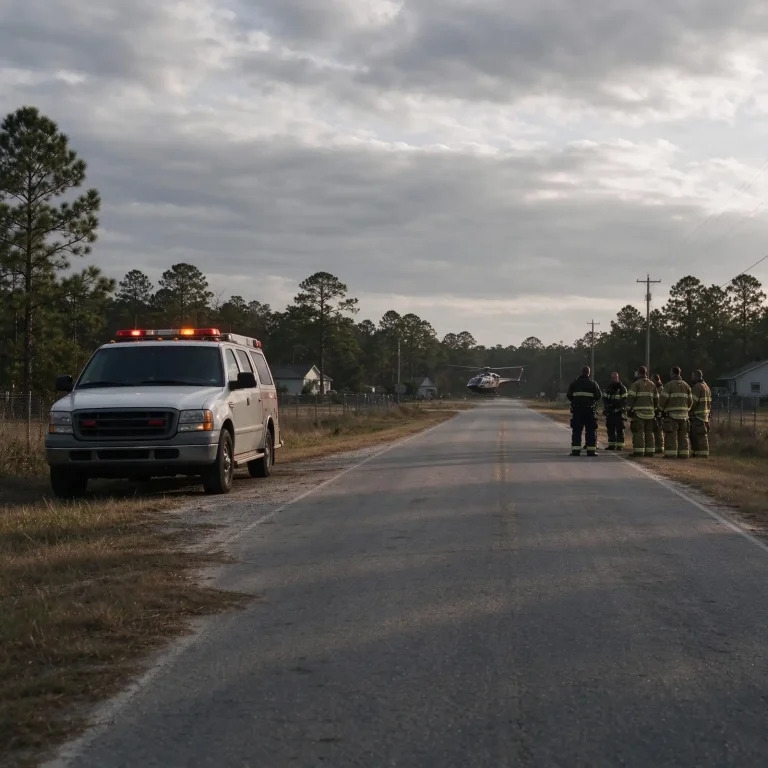
The helipad is designed to cut down on transport time for patients in rural, outlying parts of the Eastern Shore.
“Historically, we’ve had to fly to the airport or outside the area, and that takes time,” said Thomas Hospital President Ormond Thompson. “This will give us direct access to those patients in the outlying areas, rural areas.”
The difference matters most in emergencies measured in minutes. Before the rooftop pad, a helicopter carrying a critically injured or seriously ill patient had to land at a regional airport or another facility and complete the trip to the hospital by ground ambulance, adding an extra leg to every flight. With a pad directly atop the tower, flight crews can deliver patients to the emergency department’s doorstep and to the upper floors where trauma and critical care teams wait.
For the rural stretches of northern and eastern Baldwin County — communities far from the interstate, where volunteer rescue squads and long ambulance runs are a fact of life — the rooftop pad effectively pulls the hospital closer. A stroke patient in Stockton or a farm accident victim near the county line can now be flown directly to the care they need rather than routed through an intermediate stop.
Helicopter emergency transport has become a fixture of Gulf Coast medicine, with programs staging aircraft across the region to reach patients within the narrow windows that heart attacks, strokes and severe trauma demand. A hospital-side pad turns those flights from two-part journeys into direct ones, which is exactly the arithmetic trauma and stroke protocols are built on.
Hospital leaders said the new tower positions Thomas Hospital to keep growing alongside the Eastern Shore.
That positioning required planning on a countywide scale. Baldwin County’s growth has run roughly double the state average for years, fed by coastal migration, the aerospace and industrial expansion across Mobile Bay, and the steady conversion of farmland south of Malbis and along the Foley corridor into subdivisions. Every new roofline adds patients to emergency rooms, delivery wards and physician waiting lists, and the county’s hospitals have raced to keep pace with construction projects of their own.
Thomas Hospital has long been the anchor of health care on the Eastern Shore, serving Fairhope, Daphne, Spanish Fort and the communities around Mobile Bay’s eastern edge. As part of Infirmary Health, the Mobile-based system that ranks among the largest health care providers in the region, the hospital draws on system specialists, shared technology and referral pathways to Mobile facilities for the most complex cases while handling the bulk of care locally.
What it means for Eastern Shore patients
For residents of Fairhope and its neighboring cities, the practical effect of the tower shows up in waiting rooms, on surgery schedules and in the geography of emergencies.
A hospital running at or above capacity, as Nix described, pushes its strain onto patients: emergency department boarding, delayed admissions and long drives for scheduled procedures. Adding 25 modern rooms and an expanded Cath lab relieves that pressure at the point where it binds first, and it lets the hospital keep more specialty care on the Eastern Shore instead of sending patients across the Bayway to Mobile.
The delivery side matters as well. Baldwin County’s family growth has made obstetric capacity a perennial concern on the Eastern Shore, and modern private rooms are the standard for maternity care, where mothers and newborns stay together and family space is part of the room’s design. Technology-equipped rooms also mean telemetry and bedside monitoring that older units could not accommodate.
For older residents, the tower’s opening lands at a moment when the Eastern Shore’s population is aging in place. Retirees drawn to Fairhope and Point Clear for decades have aged with the community, and the medical needs of that population — cardiac care above all — sit squarely in the services the expanded tower emphasizes.
Growth medicine in a growing county
The $40 million project also reflects how hospital finance works in a fast-growing market. Systems like Infirmary Health reinvest revenue into capacity where demand is proven, and few places in Alabama have proven demand like Baldwin County. The tower’s price tag — spread across construction, medical technology and the infrastructure that supports a rooftop helipad — represents one of the larger single-site investments on the Eastern Shore.
The opening also tightened the medical link between the two sides of Mobile Bay. With the U.S. 98 and I-10 corridors carrying a daily tide of commuters and patients, Eastern Shore hospitals and Mobile’s downtown medical district function as a single regional network, and the rooftop helipad plugs Thomas Hospital directly into the air-ambulance routes that tie the Gulf Coast’s hospitals together.
Hospital leaders said the tower is designed to grow with the community it serves, with room to add beds and expand services as the county’s population continues to climb. For the patients it will house, the opening means a hospital room built for the medicine of the present — and, as Glisson put it, for the future.
Emergency care behind the tower
The emergency department that anchors the tower’s daily workload has been absorbing the Eastern Shore’s growth for years, and the expansion reaches it indirectly as well. New inpatient rooms keep the hospital’s beds flowing, which in turn keeps the emergency department from backing up with admitted patients waiting for a room — the congestion that turns a busy ER into a slow one.
The hospital’s role in the regional trauma and stroke network is the other half of that equation. Stroke care in particular runs on strict clocks: clot-busting medication and mechanical intervention are graded in minutes from the moment symptoms begin, and hospitals are certified by their ability to meet those windows. A facility with direct helicopter access can accept patients that distance and ground transport would otherwise push past the treatment window.
Cardiac emergencies follow similar arithmetic. When a heart attack patient reaches a Cath lab quickly, outcomes improve dramatically; when transfer is required, every added minute compounds the damage to heart muscle. The expanded lab and the rooftop pad together shortening those intervals is precisely the combination the tower was built to deliver.
A hospital that grew with its city
Thomas Hospital’s story tracks Fairhope’s own transformation from a bayside colony of artists and reformers into one of the fastest-growing small cities on the Gulf Coast. The hospital began as a modest community facility serving the bay’s eastern settlements and grew, decade by decade, as the Shore filled in with subdivisions, schools and shopping centers.
Joining the Infirmary Health system gave the hospital reach it could not have sustained alone — specialist coverage from Mobile, shared purchasing power and the capital base for projects like the tower — while preserving the community-hospital character that Eastern Shore patients expect. Local physicians, local nursing staff and a local board sensibility remained the hospital’s identity even as the system behind it grew regional.
That balance between local access and system scale is what the new tower extends. Patients admitted to the new rooms get modern acute care without leaving the bay’s eastern shore; patients who need the region’s highest levels of care can be stabilized on the rooftop and flown or transported to the downtown Mobile medical district in minutes.
For a county that adds new residents by the thousands every year, the opening of the $40 million tower is less a finish line than a down payment — a bet by hospital leaders that the growth that has defined the Eastern Shore for two decades is not finished, and that the community’s hospital should be ready when it isn’t.