Thomas Hospital Helipad Opens in Fairhope, Letting Medical Helicopters Land at the Door
A new emergency helipad at Thomas Hospital in Fairhope lets medical helicopters land at the hospital instead of transferring critical patients to ground ambulances elsewhere in town.
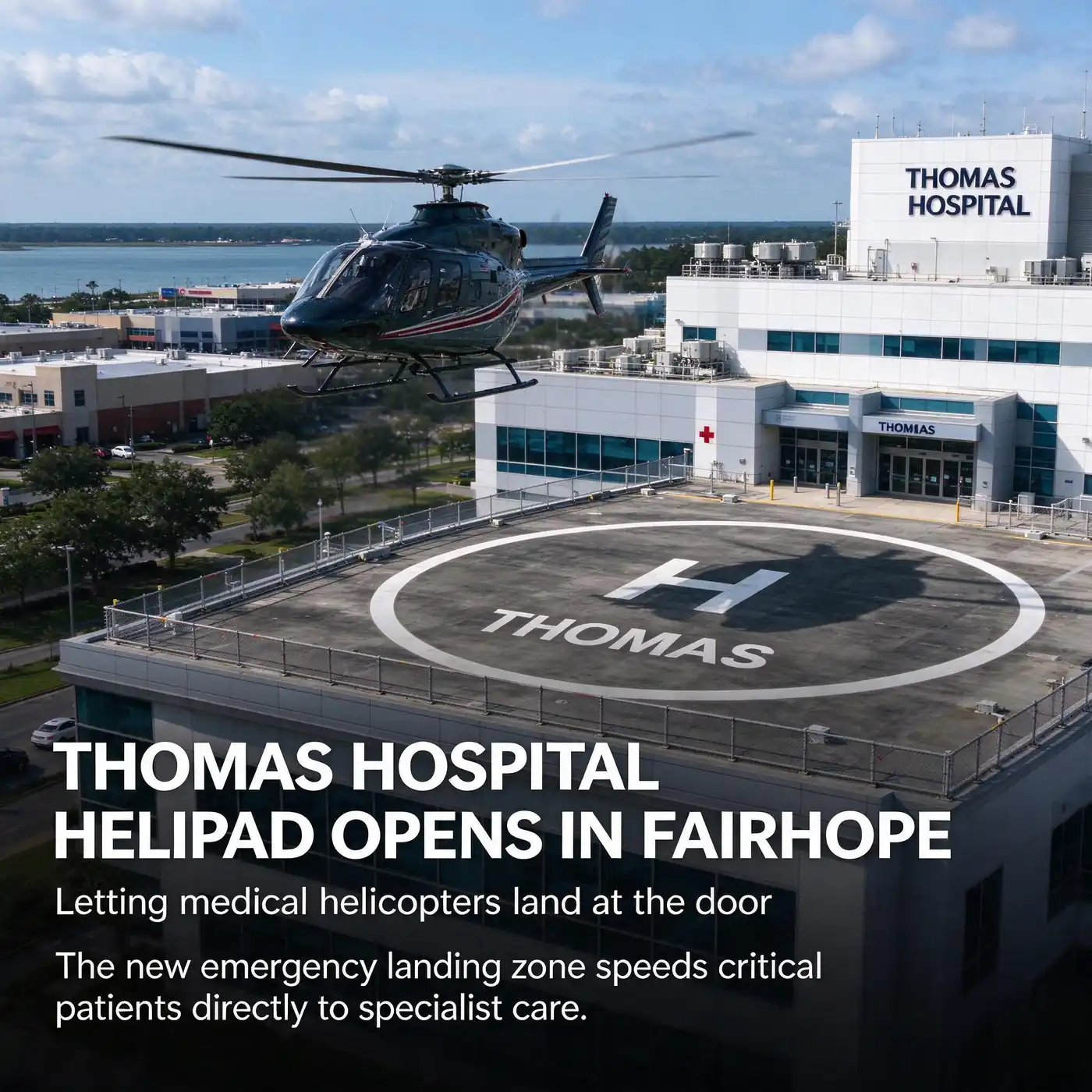
FAIRHOPE, Ala. — Medical helicopters can now land directly at Thomas Hospital in Fairhope, where a new emergency helipad has officially opened to speed critically ill and injured patients from across the region to the hospital’s specialists.
Until now, air ambulances bringing patients to Thomas Hospital sometimes had to land elsewhere in Fairhope, where the patient was moved to a ground ambulance for the final leg of the trip. The new helipad removes that handoff and gives medical helicopters a direct route to the hospital’s doors.
“This is a great service for us because it helps us bring those critical patients to a hospital facility in those time-critical moments,” said Landra Qualls with MedStar AirCare.
A growing county and fewer places to land
Hospital leaders said Baldwin County’s rapid growth was a driving force behind the project. As new homes, businesses and roads fill open land, finding a safe spot for a helicopter to set down near the hospital has become harder.
“As the county grows and the area grows, it’s gotten more and more difficult to find a place to have the helicopters land,” Thomas Hospital President Ormond Thompson said.
Baldwin County has been one of the fastest-growing counties in Alabama for years, and the population boom along the Eastern Shore and in the county’s rural areas has put new demands on everything from roads and schools to emergency medical services. A landing zone that requires a clear open field, safe approach paths and a waiting ground crew is harder to come by as development spreads.
Why minutes matter
For patients suffering a heart attack, a stroke or a serious traumatic injury, the time it takes to reach definitive care can shape the outcome. Each transfer between a helicopter and a ground ambulance adds time, requires additional crews and means moving a fragile patient one more time. Landing at the hospital itself lets flight crews hand patients directly to the emergency team.
“Immediate access provides better outcomes,” Thompson said. “That’s what we’re excited about is to be able to care for those patients quickly, get them here, be seen by our talented team here, and have great outcomes. It’s really a benefit for the entire region.”
Bringing rural patients to specialty care
The helipad is aimed especially at patients who live in rural communities, where the nearest hospital may not offer the specialized treatment a critical patient needs. For those patients, getting to that level of care can mean traveling many miles from home.
Thompson stressed that the hospitals in those areas provide good care, but said Thomas Hospital can offer advanced services that are not available everywhere.
“They’ve got great care in those areas, but we can provide advanced lifesaving support. We’ve got an award-winning cardiology program, an open-heart program, robotic surgery, and stroke care. There’s just things that we can provide that those areas unfortunately can’t provide right now,” Thompson said.
Hospital leaders said the goal is simple: get patients from across the region in front of the right specialists as quickly as possible.
How air medical transport works
Medical helicopters are typically called in when a patient is critically ill or injured and ground transport would take too long, when roads are blocked or congested, or when a patient needs to be moved from a smaller hospital to one with specialized services. Flight crews generally include critical care nurses and paramedics who can provide advanced treatment in the air, including cardiac monitoring, medications and airway support.
Air ambulances are dispatched by emergency medical services, fire departments and hospitals rather than by patients themselves. In Baldwin County, helicopters are often called to serious crashes and other emergencies, particularly in areas far from a trauma center or when traffic on busy routes would slow a ground ambulance.
When a helicopter cannot land at the receiving hospital, crews must coordinate a separate landing zone, often a ballfield, parking lot or open field, and arrange for a ground ambulance to meet them there. A hospital helipad simplifies that process and frees up the ground units and first responders who would otherwise be needed to secure a landing site.
About Thomas Hospital
Thomas Hospital, on the Eastern Shore of Mobile Bay in Fairhope, is part of Infirmary Health, the Mobile-based health system. It is one of the main hospitals serving Baldwin County’s fast-growing population, offering emergency care along with specialty services that, according to hospital leaders, include cardiology, open-heart surgery, robotic surgery and stroke care.
For patients, the change will be largely invisible, but hospital leaders say it could make a meaningful difference on the worst day of someone’s life. When a life is on the line and time is critical, cutting out a landing-zone transfer can save precious minutes.
In an emergency
The new helipad does not change what residents should do in a medical emergency. Anyone experiencing symptoms of a heart attack or stroke, or anyone who witnesses a serious injury, should call 911 immediately. Emergency dispatchers and first responders decide whether a patient needs a ground ambulance or an air ambulance and which hospital is the best destination.
Warning signs of a heart attack can include chest pain or pressure, shortness of breath, and pain spreading to the arm, back, neck or jaw. Stroke warning signs can be remembered with the acronym BE FAST: balance problems, eye or vision changes, face drooping, arm weakness, speech difficulty and time to call 911.