Thomasville and Daphne Theater Kids Team Up for Week-Long TikTok Fundraiser
Thomasville teen Sawyer Knight is leading a week-long TikTok fundraiser pairing theater kids from Thomasville and Daphne to benefit two Alabama performing arts programs.
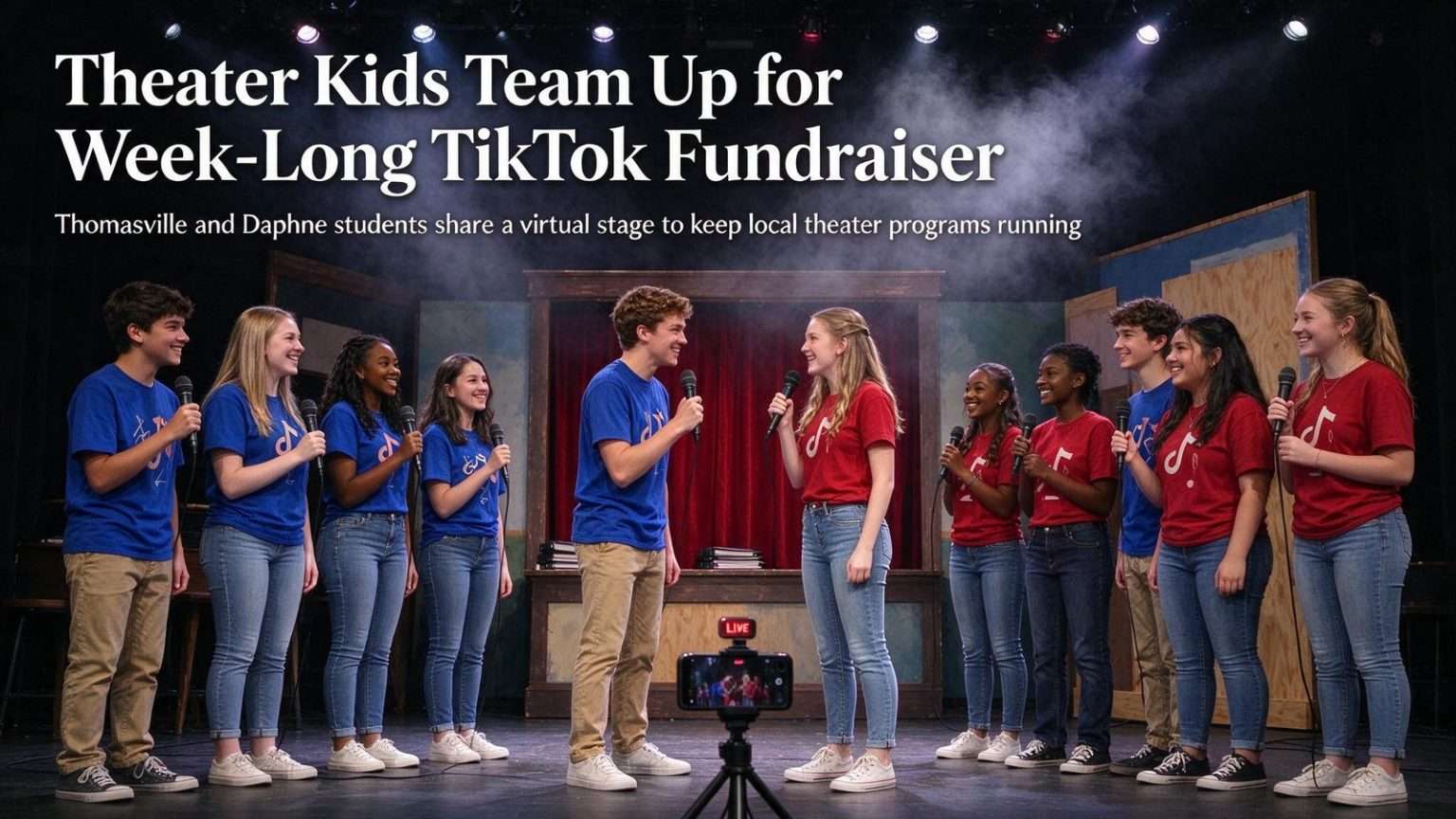
THOMASVILLE — Theater students from two Alabama communities are joining forces this week for a livestreamed fundraiser aimed at keeping the curtain up on their programs. Sawyer Knight is organizing a seven-day charitable streaming series beginning Monday that brings together participants from the Arts Council of Thomasville and Bay Area Performing Arts in Daphne. Daily activities will be broadcast live on TikTok, with proceeds split evenly between the two performing arts programs.
“I want to keep theatre alive and help out these two amazing programs,” Knight said.
The series kicks off with a friendly, arts-themed take on the television game show “Family Feud,” pitting a five-person team from Thomasville against a five-person team from Daphne. The two squads will meet roughly halfway between their hometowns, in Saraland, for the showdown. Thomasville’s roster includes Natalie Gates, Maddox Gates, Wyatt McAdams, Charlie Nordan and Anni Hunt. Ammon Knight and Sawyer Knight — who is involved with the Daphne program — are confirmed members of the Daphne team.
The matchup gives the fundraiser a marquee opening event and a face-off between two communities separated by roughly a hundred miles of Alabama highway. Thomasville sits in Clarke County in the state’s rural southwest, while Daphne anchors the Eastern Shore of Mobile Bay in fast-growing Baldwin County. Saraland, just north of Mobile, sits close to the midpoint of that drive, making it a natural meeting point for a joint taping.
A Week of Daily Streams
Later in the week, Knight sits down with Thomasville musician and artist Charlie Nordan for a songwriting challenge, writing a song from scratch on camera to give viewers a behind-the-scenes look at the creative process. The format lets audiences watch a song take shape in real time — lyrics, melody and all — rather than seeing only a finished performance.
Wednesday’s stream highlights both younger and older members of the Thomasville theater cast in a game of “Guess the Song,” where participants buzz in to earn points for correctly identifying tunes. The intergenerational pairing is a signature of small-town theater programs, where elementary-aged students and high school seniors often share the same stage, the same rehearsal calendar and the same fundraising goals.
On Thursday, the series moves to the Thomasville Public Library for an escape room challenge, with four Thomasville cast members racing to find clues and solve puzzles before time runs out. The library setting doubles as a showcase for one of the community’s key civic institutions, which has partnered with local arts groups on programming before.
The fundraiser continues Aug. 21-23, wrapping up with the announcement of three raffle winners on the 23rd — one for Thomasville donors, one for Daphne donors and one for online supporters donating from outside the area. Splitting the raffles by donor geography gives local supporters in each community a better shot at winning while still rewarding the viewers tuning in from elsewhere.
Two Ways to Give
Knight said supporters can contribute two ways: through a GoFundMe campaign linked in his TikTok bio, or by sending TikTok gifts during the livestreams. The two channels cover different audiences — the GoFundMe page for donors who want to give a set amount directly, and TikTok’s built-in gifting system for viewers who want to support the streams while they watch.
TikTok gifts are virtual tokens viewers purchase and send to creators during live broadcasts, with the platform converting them into payments for the streamer. For a fundraiser, that means every minute of a livestream doubles as a donation window, and energetic moments on camera can translate directly into dollars for the cause.
Why Small-Town Theater Needs the Help
Community and youth theater programs across rural Alabama operate on thin margins in the best of years. Ticket sales for a handful of productions annually rarely cover royalties, sets, costumes, lighting and the rental or upkeep of performance space, so organizations like the Arts Council of Thomasville supplement their budgets through grants, sponsorships and fundraisers like this week’s streaming series.
In Thomasville, a city of roughly 4,000 that serves as a commercial hub for Clarke County, the arts council has long been a cultural anchor, staging plays and musicals that draw families from across the county. Its casts mix students from Thomasville City and Clarke County schools with adult volunteers, and its productions are often the largest live performances the community sees all year.
Bay Area Performing Arts in Daphne serves a different kind of community — a fast-growing Baldwin County city where new subdivisions keep bringing in families — but faces the same arithmetic. Stage rights, insurance, costumes and venue costs do not shrink just because a program is volunteer-driven, and both organizations depend on adults willing to direct, build, sew and chaperone in addition to whatever tuition or ticket revenue they collect.
Fundraising that crosses county lines is still relatively rare among small Alabama arts groups, which tend to compete for the same local sponsor dollars. By teaming up, the two programs hope to pool their audiences and their appeal: each organization brings its own cast of families, its own social media reach, and its own donors to the shared effort, with the even split ensuring neither side comes away empty-handed.
Meeting the Audience Where It Scrolls
The decision to run the fundraiser on TikTok reflects where the students themselves already are. The short-video platform has become a showcase for teen theater communities nationwide, where young performers share show clips, audition tips and behind-the-scenes moments with audiences far beyond their hometowns. A livestreamed fundraiser extends that habit into direct support for the programs that train them.
The seven-day format is built for the platform’s rhythms. Daily events give viewers a reason to return each evening, and the variety — a game show, a songwriting session, a music quiz, an escape room — borrows more from internet entertainment formats than from a traditional theater benefit. That is the point: the students are producing a week of content, not a single night of speeches.
The events themselves still carry the fingerprints of live theater. The “Family Feud” showdown requires hosting, timing and a bit of staging in Saraland. The escape room at the Thomasville Public Library demands puzzle design and props. The “Guess the Song” segment puts cast members of every age in front of a live camera, where the pressure resembles opening night more than a rehearsal.
What the Money Supports
Neither organization has publicly detailed how its share of the proceeds will be spent, but the needs of programs like these are familiar. Royalties for popular shows can run into the thousands of dollars per production. Sets and costumes consume both money and volunteer hours. Sound and lighting equipment ages and breaks. And transportation for students to rehearsals and performances is a quiet, recurring cost in a rural county where families may live twenty minutes or more from the theater.
The raffle finale on Aug. 23 gives the series a closing event, with winners announced across the three donor pools. For the students involved, the week is also a crash course in production work — planning rundowns, promoting streams, troubleshooting audio and keeping an audience engaged — skills that translate directly to the stage work they are raising money to continue.
Knight’s framing of the effort was simple: keep the programs running so the shows go on. For two communities separated by a bay and a hundred miles of highway, this week at least, the stage is a phone screen — and the audience is wherever the notification lands.
The Road Between Two Stages
The drive between Thomasville and Daphne runs more than a hundred miles through some of the most varied country in south Alabama — pine forests and farmland in Clarke County, the river towns along the Tombigbee, the widening suburbs of the Eastern Shore. For two theater programs to share a week of programming means families on both ends committing to that distance, at least for the “Family Feud” taping in Saraland, which sits almost exactly at the halfway mark off Interstate 65.
That midpoint staging was practical, but it also carries symbolic weight. Saraland is a growing Mobile County city that has built a reputation in recent years for its schools and community events, and it has none of the home-court advantage that either team would enjoy in its own theater. Neutral ground keeps the game show competitive and gives both rosters an equal audience of strangers for their first on-camera outing.
The rosters themselves tell the story of how these programs work. Thomasville’s five-person team — Natalie Gates, Maddox Gates, Wyatt McAdams, Charlie Nordan and Anni Hunt — draws from a cast that routinely spans multiple grade levels. On the Daphne side, Ammon Knight and Sawyer Knight anchor a squad that continues to add members, with Sawyer’s dual role as organizer and competitor blurring the line between host and contestant.
For Knight, who is involved with the Daphne program, the series is a way to serve both communities at once. His songwriting challenge with Nordan, a Thomasville musician and artist, puts two of the region’s young creatives in the same virtual room and hands the audience a front-row seat to a song being born. The escape room at the Thomasville Public Library then moves the series into a physical landmark, giving the hometown crowd a public event to attend in person while the cameras roll.
By the time the raffle winners are announced on Aug. 23, the two programs will have shared a stage, an audience and a budget line for a full week — an unusual arrangement among Alabama’s small-town arts groups, and one that both sides hope becomes a template rather than a one-off.