Every Thomasville High Senior Meets Alabama College and Career Readiness Standard, School Board Told
All Thomasville High School seniors have met Alabama's college and career readiness standard, the city school board heard Oct. 27 as it approved finances and tutoring.
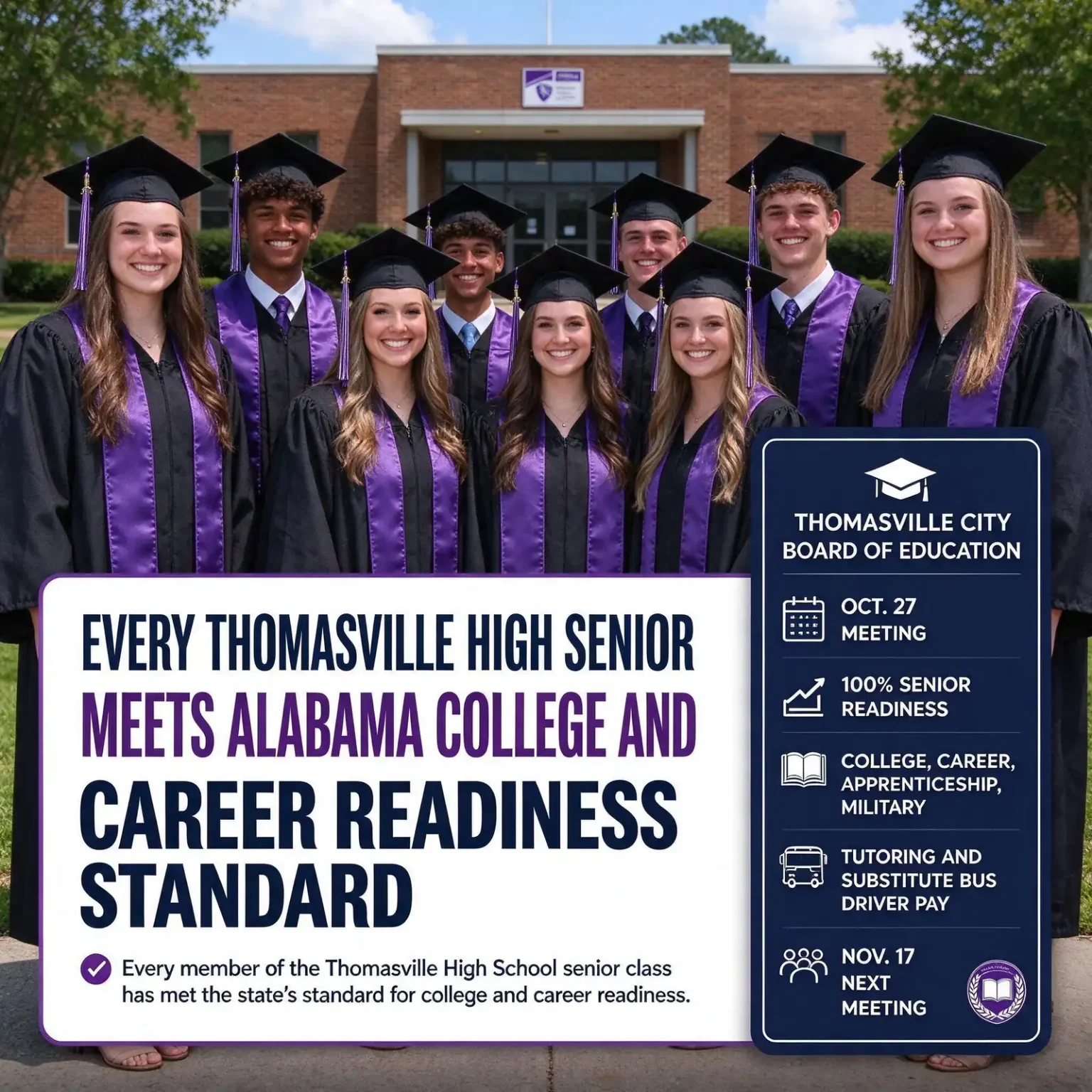
THOMASVILLE, Ala. — Every member of Thomasville High School’s senior class has met the state’s standard for college and career readiness, a milestone school leaders shared with the Thomasville City Board of Education at its Oct. 27 meeting. The result means each senior has already cleared at least one of the benchmarks Alabama uses to judge whether a student is prepared for life after high school, whether that path leads to a college classroom, a technical career, an apprenticeship or military service.
The readiness report was the highlight of a meeting in which the board also approved monthly finances, personnel changes, after-school tutoring at each of its schools and a revised pay scale for substitute bus drivers. The board will meet again Nov. 17.
What a 100% Readiness Rate Means for Families
For parents and students, the news offers reassurance that this year’s graduating class is leaving with at least one credential or score that schools, employers or the armed forces recognize. Readiness is not a single test. Instead, Alabama gives students many ways to show they are prepared, so a student focused on a skilled trade and a student headed to a four-year university can each reach the standard through work that fits their own plans.
Reaching the benchmark across an entire senior class takes coordination. Counselors and teachers generally track each student’s progress through the year, identify who still needs to earn an indicator, and steer those students toward an exam retake, a certification test, a dual enrollment course or another option before graduation. When every senior qualifies, it indicates that no student was left without a documented next step.
The Many Paths to College and Career Readiness
Under Alabama’s guidelines, a senior is counted as ready by achieving any one of the following before graduating:
- ACT benchmarks: Meeting the readiness score in at least one ACT subject area. The targets are 18 in English, 22 in math, 22 in reading and 23 in science.
- National Career Readiness Certificate: Earning a silver certificate or better, which calls for a level 4 or better on all three tests behind the credential.
- Advanced Placement: Scoring a 3 or higher on an AP exam.
- International Baccalaureate: Scoring a 4 or higher on an IB exam.
- College credit: Completing approved college or postsecondary coursework for credit while still in high school.
- Industry credential: Earning an approved career and technical credential listed in Alabama’s recognized credential compendium.
- CTE completer status: Finishing every required course in a state-approved CTE program of study.
- Youth apprenticeship: Completing a youth apprenticeship that has been approved and is offered while the student is still in school.
- Military enlistment: Being accepted into a branch of the U.S. military before graduation.
- Computer science: Passing a computer science course approved by the Alabama State Department of Education.
- Other approved indicators: Meeting any additional readiness indicator the Alabama State Board of Education formally adopts.
Understanding the measures
Several of these indicators come from national testing programs. The ACT is a widely used college admissions exam, and its subject benchmarks are designed to signal that a student has a reasonable chance of succeeding in related first-year college courses. Alabama gives the ACT to high school juniors, which gives students an early chance to meet the benchmark.
The National Career Readiness Certificate is issued through ACT’s WorkKeys assessments, which measure workplace skills in applied math, workplace documents and graphic literacy. Certificates are awarded at bronze, silver, gold and platinum levels, with each step showing stronger results.
Advanced Placement exams, administered by the College Board, are scored from 1 to 5, and many colleges award credit for a 3 or higher. International Baccalaureate exams are scored from 1 to 7. Dual enrollment allows high school students to take college classes, often through a community college, and earn credit toward both a diploma and a postsecondary degree or certificate.
On the career side, industry-recognized credentials show that a student has mastered skills valued by employers in fields such as health care, manufacturing, construction and information technology. Career and technical education completers have finished a planned series of courses in a specific career pathway, and youth apprenticeships combine classroom learning with paid, supervised work experience.
Why the State Tracks Readiness
College and career readiness is one of the measures Alabama uses when it evaluates high schools on its annual report card. The indicator encourages schools to make sure students graduate with more than a diploma alone, so that graduates have evidence they can handle college coursework, qualify for skilled jobs or enter the military.
For students, earning an indicator can also have direct benefits. College credit and AP or IB scores may reduce the time and cost of a degree, while industry credentials and apprenticeship experience can make a graduate more competitive for jobs right out of high school.
Options for Students Still Planning Their Next Step
Meeting the readiness standard is a starting point rather than a finish line. Seniors still have the rest of the school year to firm up their plans, and the options vary depending on the path each student chooses.
For students bound for college, the senior year is typically filled with applications, scholarship searches and financial aid paperwork. Completing the Free Application for Federal Student Aid, known as the FAFSA, is the first step toward federal grants, work-study and student loans, and many colleges and scholarship programs also use it to award their own aid. Students who have already earned college credit through dual enrollment or AP exams should check how those credits will transfer to the school they plan to attend.
For students headed straight into the workforce, credentials earned in high school can be listed on job applications and résumés, and the National Career Readiness Certificate is recognized by many employers as evidence of foundational workplace skills. The Alabama Community College System also offers short-term training and technical certificate programs for graduates who want to add skills after high school.
Students who have been accepted into a branch of the military typically continue working with a recruiter on the steps leading up to basic training, which can include meeting fitness requirements and finishing high school in good standing.
How parents can help
Parents can support their seniors by keeping track of deadlines, attending school information sessions and talking with counselors about the student’s goals. Younger students benefit from early planning as well. Families of freshmen, sophomores and juniors can ask about which readiness indicators fit a student’s interests, so there is time to enroll in a career pathway, sign up for dual enrollment or prepare for the ACT before senior year arrives.
Finances and Staffing Approved
Turning to routine business, the board approved the financial report for September. The report showed accounts payable totaling $706,420.36 and payroll totaling $962,675.34 for the month.
In personnel matters, the board:
- Approved hiring a worker for the Child Nutrition Program at Thomasville High School.
- Accepted the resignation of a Thomasville High math teacher.
- Approved two people to serve as school volunteers.
Personnel items like these appear on nearly every school board agenda, as districts fill openings, accept departures and add helpers throughout the school year. Child nutrition workers prepare and serve the breakfasts and lunches students eat each day, an important part of keeping students ready to learn.
School systems in Alabama typically require board approval for hiring, resignations and volunteer service, and volunteers commonly go through screening before working with students.
Tutoring Programs and Bus Driver Pay
The board gave the green light to after-school tutoring programs at each of the district’s schools. After-school tutoring generally gives students extra time with teachers to catch up on difficult material, prepare for tests or get help with homework outside the regular school day.
Members also approved a change to the 2026-27 salary schedule covering substitute bus drivers. Substitute drivers fill in when regular drivers are absent, helping keep routes running so students can get to and from school on time.
Board Picks Delegate for State Association Assembly
The board chose one of its members to represent Thomasville at the 2026 Delegate Assembly of the Alabama Association of School Boards, with another board member approved as the alternate.
The Alabama Association of School Boards is a nonprofit organization that serves local boards of education across the state, offering training for board members and advocating on education issues. Its Delegate Assembly brings together representatives of member boards to take up the association’s business, giving local systems such as Thomasville a voice in the positions the association takes on behalf of public schools.
Next Meeting
The Thomasville City Board of Education’s next meeting is scheduled for 5 p.m. Tuesday, Nov. 17, in the library at Thomasville High School. Board meetings are open to the public, and parents and residents interested in school finances, staffing or student achievement are welcome to attend.
Thomasville City Schools serves students in Thomasville, a city in northern Clarke County. Families with questions about how their students can earn a readiness indicator, such as signing up for dual enrollment, career and technical courses or a WorkKeys assessment, can contact their school’s counseling office.