Daphne Turns to Eminent Domain for Bayfront Park Boardwalk Easement as Landowner Weighs Appeal
Daphne won court approval to condemn a 30-foot waterfront easement for a $1 million boardwalk north of Bayfront Park; the landowner says the $44,616 offer is too low.
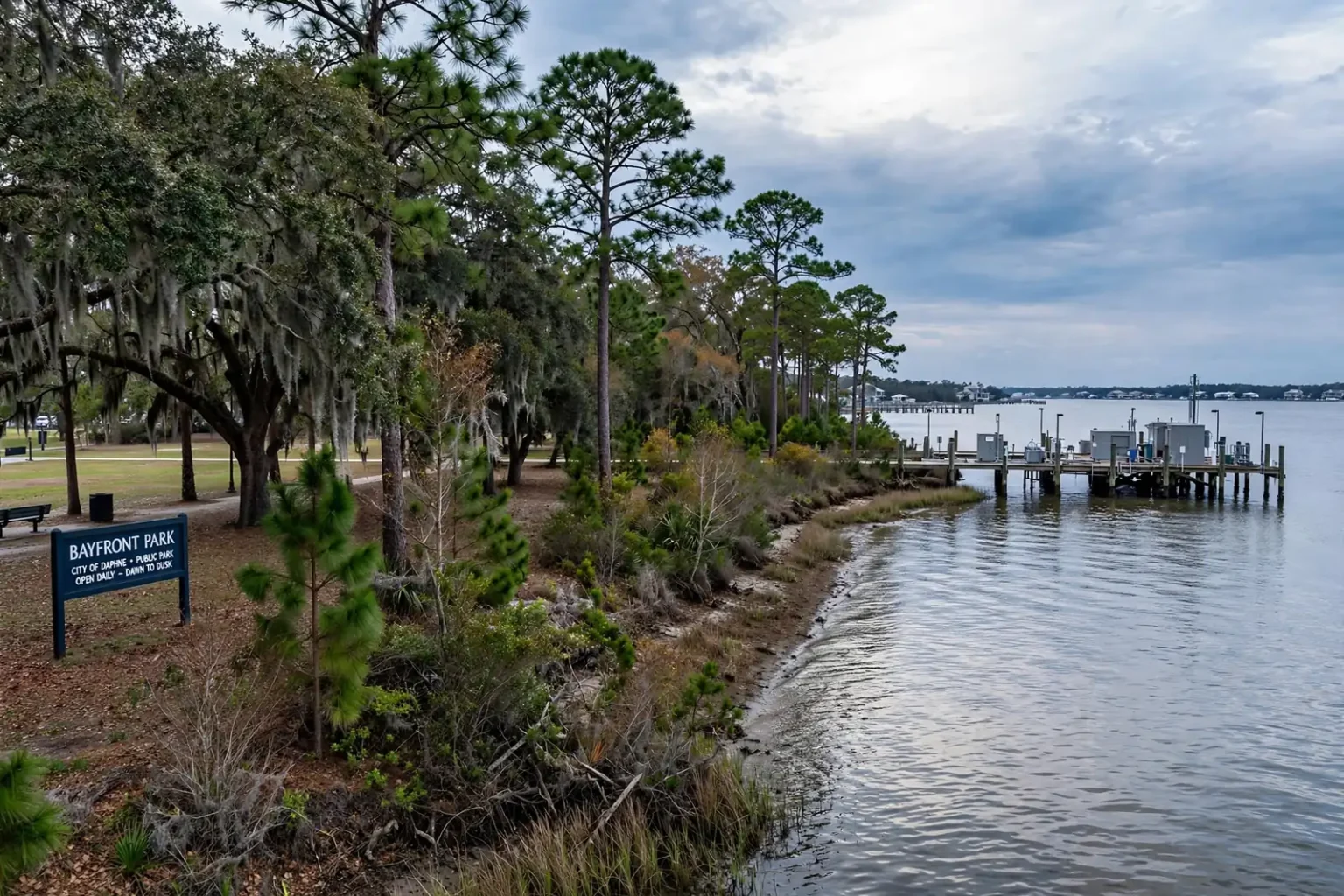
DAPHNE, Ala. — A planned public boardwalk along the Mobile Bay shoreline north of Bayfront Park has landed in court, as the City of Daphne uses its eminent domain power to secure a strip of private waterfront that the project needs and the landowner pushes back against the taking.
At issue is a permanent easement 30 feet wide running along the bay side of a 4.4-acre wooded lot. The city wants the strip for a pedestrian boardwalk that would run from Bayfront Park north to the pier owned by Daphne Utilities. The owner, whose father bought the land in the 1980s, objects to the loss of privacy and bay access, the effect on the property’s value and the cost of fighting the case, and has said she may appeal.
Where the Case Stands Now
The dispute has already moved through its first major step. On Oct. 28, Baldwin County’s probate judge approved the city’s application to condemn the easement and appointed three commissioners to determine how much the owner should be paid for it.
Those commissioners are due to report their compensation figure to the court by next Tuesday, Nov. 17. Their assessment will set the next stage of the case. The owner has said she has spent thousands of dollars opposing the city’s effort so far and may decide to appeal the outcome.
City officials declined to discuss the specifics of the owner’s situation, citing the pending legal action.
Key facts
- Property: Wooded bayfront tract of 4.4 acres located just north of Bayfront Park
- What the city seeks: A permanent easement 30 feet wide along the waterfront for a public pedestrian boardwalk
- Council action: Unanimous vote in May to acquire the easement
- City’s offer: $44,616
- Court ruling: Probate court approved the condemnation application Oct. 28
- Next deadline: Court-appointed commissioners report compensation by Tuesday, Nov. 17
The City’s Boardwalk Vision
Daphne’s plan calls for a boardwalk costing about $1 million, stretching along the water between Bayfront Park and the utility pier. Council members unanimously approved acquiring the easement in May. The resolution they adopted describes the easement as needed, and as serving the public interest, to construct and complete the Bayfront Park Improvements Project.
Only two private parcels sit between the park and the pier. City officials said the owner of the other property, located north of the contested lot, has already granted access for the easement voluntarily. That leaves the 4.4-acre tract as the remaining gap in the route.
The boardwalk is meant to be the first piece of a longer waterfront path. City officials said a later phase would carry it farther north to the D’Olive Bay Boat Launch, and the long-range goal is to eventually tie the route into the Gator Boardwalk near Interstate 10.
The Landowner’s Objections
The owner said the city’s offer of $44,616 falls far short of what she believes the bay frontage is worth. She also questioned whether taking private land is a sensible use of public money when walking trails could be built in other places.
Her concerns go beyond the dollar amount. She said a public path along her shoreline would bring strangers across the property, raising the prospect of litter and damage and changing views she values. She said her family had future plans for the land, which has been in the family for decades, and described the process of having to defend her ownership of the waterfront before a judge as upsetting and stressful.
She has also argued that the city could avoid her land entirely. Because the city already owns property next to the parcel to the north, she said, the boardwalk could be routed around her lot without any payment to her. She has encouraged other bayfront owners to pay attention, saying they may not realize a similar request could come to them.
How Eminent Domain Generally Works
Eminent domain is the power of government to acquire private property for public use, even when the owner does not want to sell. The Fifth Amendment to the U.S. Constitution allows such takings but requires that owners receive just compensation, and state constitutions and laws add their own procedures and limits.
Government bodies do not always take full ownership of land. In many cases, including this one, they seek an easement, which is a legal right to use a defined portion of someone else’s property for a specific purpose while the owner keeps the underlying title. A permanent easement for a public walkway can still significantly affect how an owner uses and enjoys the land, which is one reason compensation for easements can be disputed.
In Alabama, condemnation cases typically begin in probate court. When the court grants an application to condemn, it appoints commissioners, people with no stake in the outcome, to assess the damages owed to the landowner. Their report is filed with the court, and either side that disagrees with the result generally has a limited window to appeal to circuit court, where the question of compensation can be decided anew, often by a jury.
Alabama also tightened its eminent domain law in 2005, following the U.S. Supreme Court’s decision in Kelo v. City of New London, to limit the use of condemnation to transfer property for private economic development. Public infrastructure such as roads, utilities and parks generally falls within traditional public uses.
Balancing Public Access and Private Property
Waterfront access is a recurring issue along Mobile Bay, where much of the shoreline is privately owned and public places to walk along the water can be limited. Communities on the Eastern Shore have invested in parks, piers and boardwalks to give residents and visitors a way to enjoy the bay, and connected paths are often viewed as a way to link those amenities into a single route.
For the owners whose land lies in the way, however, the calculation is different. A path along the water can change the character of a lot that was bought for its privacy and views, and it can affect what a future buyer might be willing to pay. Disputes over how much an easement is worth often hinge on appraisals that consider both the strip being taken and any effect on the value of the land the owner keeps.
Courts in condemnation cases generally focus on two questions: whether the government has the authority and a valid public purpose for the taking, and how much compensation is due. With the probate court having granted the condemnation application, the focus in Daphne now turns largely to the second question.
What Compensation Usually Considers
When appraisers and commissioners value an easement, they generally look beyond the size of the strip itself. The location of the strip matters, and frontage on open water is typically among the most valuable portions of a bayfront parcel. They may also consider whether the easement limits how the owner can build on or use the rest of the property, whether it affects access to the shoreline, and how a reasonable buyer might view the land with a permanent public path across it.
Because those factors can be weighed differently, it is common for owners and governments to reach very different estimates of value. The city’s figure in this case was $44,616, while the owner has said the frontage is worth far more. The court-appointed commissioners’ report will provide an independent assessment, though it is not necessarily the final word if either side appeals.
What Happens Next
The three court-appointed commissioners have until Nov. 17 to submit their compensation recommendation. Once that figure is filed, both the city and the owner will be able to weigh whether to accept it or seek a higher or lower amount through an appeal.
If the owner appeals, the case would move to a new stage in which the value of the easement is argued again. If neither side appeals, the process would move toward finalizing the city’s right to use the strip for the boardwalk.
Construction timing for the boardwalk has not been announced. The city’s broader plans, including the extension toward the D’Olive Bay Boat Launch and a possible connection to the Gator Boardwalk, remain longer-term goals that would depend on future funding, design work and access to land along the route.
Why It Matters for Daphne Residents
For residents, the case touches on two values that are both widely shared: the desire for more ways to reach and enjoy the bay, and the expectation that private property will be protected. A finished boardwalk could give walkers a continuous waterfront route from Bayfront Park northward, adding to the city’s existing public spaces along the bay. Supporters of connected waterfront paths often point to the way such routes link parks, launches and piers so that people can travel between them on foot rather than by car.
At the same time, the dispute highlights the cost and uncertainty that condemnation can bring for individual owners, and the questions that can arise about whether alternatives exist. How the compensation question is resolved, and whether the case goes to appeal, will shape the timeline for the first phase of Daphne’s bayfront boardwalk.