Spring Hill College NCLEX Pass Rate Hits 100% Again as Alabama Faces a Growing Nursing Shortage
For the second straight year, every Spring Hill College nursing graduate passed the NCLEX licensing exam, as Alabama faces a projected shortage of about 14,000 nurses by 2027.
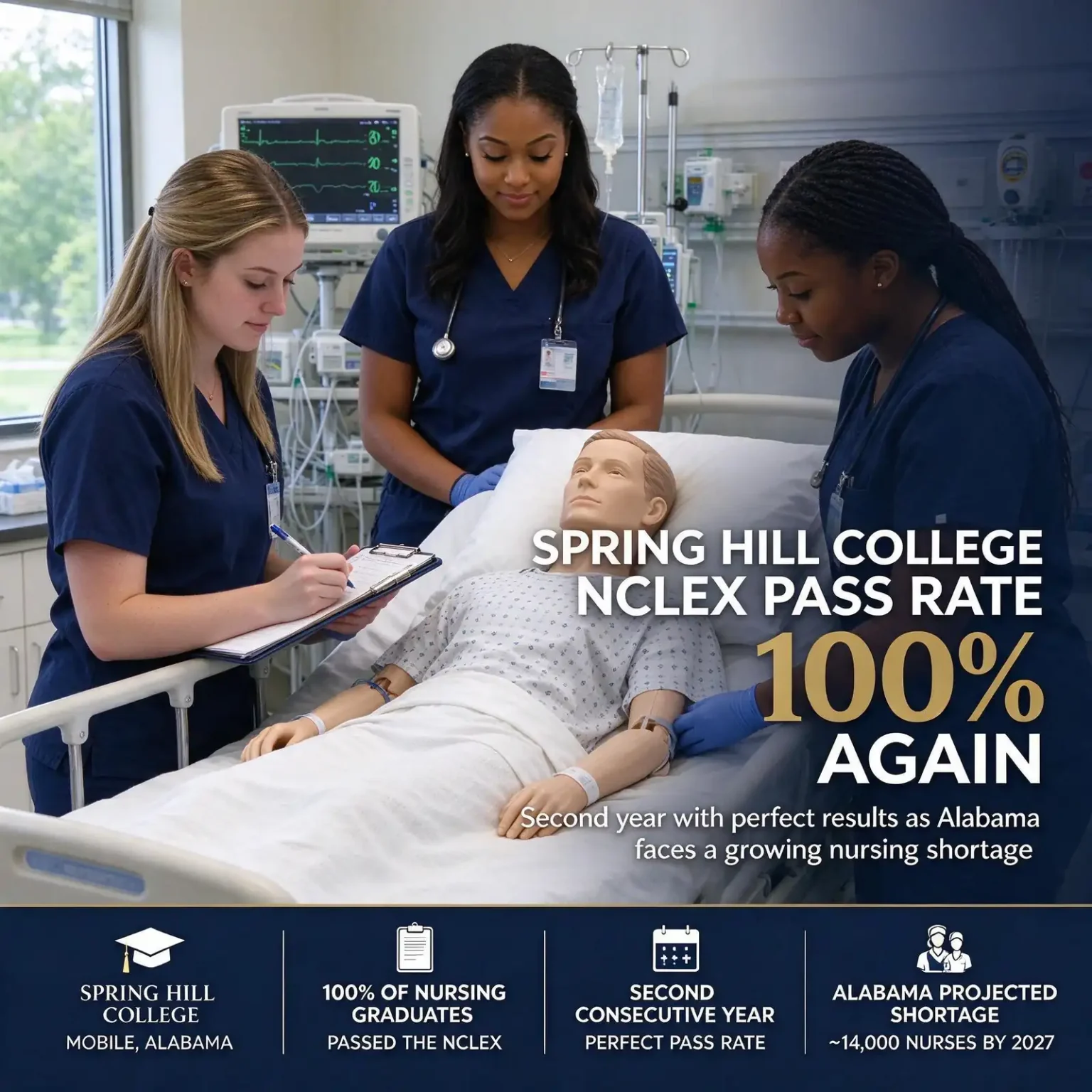
MOBILE, Ala. — Every nursing graduate from Spring Hill College who sat for the national licensing exam passed it, marking the second year in a row that the Mobile school’s nursing program has posted a perfect result. The Spring Hill College NCLEX pass rate of 100% arrives at a moment when Alabama is bracing for a serious nursing gap, with the state projected to be short roughly 14,000 nurses by 2027.
For patients and hospitals along the Gulf Coast, the numbers matter. Each graduate who passes the exam is cleared to pursue a registered nurse license, and every new nurse who enters the workforce helps ease pressure on hospitals, clinics, long-term care facilities and home health agencies that are competing to fill open positions.
A Perfect Score, Two Years Running
The NCLEX is the national licensing examination that nursing graduates must pass before they can practice as registered nurses. A program’s first-time pass rate is one of the most closely watched measures of how well a nursing school prepares its students, and state boards of nursing track those results.
Posting a 100% pass rate once is a notable result for any program. Repeating it in back-to-back years suggests consistency in how students are taught, tested and supported before they ever sit down at the testing center.
College leaders said they view the exam results as an important benchmark but not the only goal. Faculty members said nursing calls for a broad set of abilities, including specialized knowledge, technical skill, communication, critical thinking and sound judgment, and that the program aims to develop all of those together rather than simply teaching to a test.
At a glance
- School: Spring Hill College, Mobile
- Result: 100% of nursing graduates passed the NCLEX
- Streak: second consecutive year with a perfect pass rate
- Statewide need: Alabama projected to face a shortage of about 14,000 nurses by 2027
- New facility: a $35 million health and science building named for Annette N. Shelby
Understanding the NCLEX
The exam is developed by the National Council of State Boards of Nursing, an organization that brings together the boards that regulate nursing in each state. Passing the version known as the NCLEX-RN is a requirement for licensure as a registered nurse in every state. In Alabama, licenses are issued by the Alabama Board of Nursing.
The test is computerized and adaptive, which means the questions a candidate sees can change based on how that candidate answers earlier items. In 2023, the exam was updated into what is called the Next Generation NCLEX, which places greater weight on clinical judgment. Instead of only recalling facts, test-takers work through case scenarios that ask them to recognize what is happening with a patient, decide what matters most and choose appropriate actions.
That shift lines up with the approach Spring Hill faculty described. Nursing educators across the country have been reworking their programs to emphasize decision-making in realistic situations, and the exam now measures that skill more directly.
Learning Built Around Real Patient Care
At Spring Hill, nursing students train through a mix of hands-on skills practice and patient care situations designed to feel like the real thing. Faculty members said they also study how students perform and look closely at areas where more preparation is needed, so instruction can be adjusted before graduates take the licensing exam.
Program leaders described watching students grow from early nervousness, such as uncertainty about carrying out a patient assessment or talking with a patient, into graduates who can spot a problem, explain how they reached their conclusion and speak up for a patient who needs help. That progression, they said, is the part of the work that makes them proudest.
Faculty with bedside experience
Students said one strength of the program is the range of clinical backgrounds among its instructors. The faculty includes people with experience in labor and delivery, intensive care and emergency departments, along with nurse practitioners who have worked in hospice and family medicine. Many instructors have spent time as bedside nurses themselves.
A senior in the program, who will soon sit for the licensing exam herself, said instructors know students personally and care about them as people. She tied that approach to the Jesuit mission of caring for the whole person, and said learning directly from working health care professionals has helped her connect with patients and feel ready during clinical rotations.
A $35 Million Building Designed for Hands-On Learning
The college’s newest building was designed with the same idea in mind. Named for Annette N. Shelby, the $35 million Shelby Health and Science Innovation Center gives nursing students space that blends skills training with realistic patient care scenarios.
Faculty members said the facility allows the different pieces of nursing education to be brought together more intentionally, combining knowledge, technical skills, communication and judgment in one setting. They said the building will widen the learning environment for students, give them more hands-on experience and help them practice building meaningful connections with the people they care for.
Simulation has become a central part of nursing education nationwide. In a simulation setting, students can practice responding to changes in a patient’s condition, work as part of a care team and make decisions without putting a real patient at risk. Faculty can then review what happened with students and talk through what went well and what could be done differently, a process that helps build the clinical judgment the licensing exam is designed to measure.
From Graduation to the Bedside
Passing the NCLEX is one of the final steps between finishing a nursing degree and starting work as a registered nurse. In general, graduates first complete an approved nursing program, then apply to the board of nursing in the state where they want to be licensed and register to take the exam. After a candidate passes and the board completes its review, which typically includes a background check, the license is issued.
Alabama is a member of the Nurse Licensure Compact, an agreement among participating states that allows a nurse holding a multistate license from a home state to practice in other member states without obtaining a separate license in each one. That flexibility can be useful for nurses near state lines, including those in the Mobile area who may consider jobs in neighboring Mississippi or Florida, though individual eligibility rules apply.
New registered nurses can pursue a wide range of paths. Many begin in hospital medical-surgical units, while others move into emergency care, intensive care, labor and delivery, pediatrics, behavioral health, hospice or community and public health settings. With experience and further education, some later become nurse practitioners, nurse educators or nursing leaders.
The role of clinical rotations
Before they graduate, nursing students complete clinical rotations, supervised placements in hospitals and other health care settings where they care for real patients under the guidance of instructors and staff nurses. These rotations expose students to different specialties and help them connect classroom lessons with what happens on an actual unit. Students and faculty said the variety of real-world experience among Spring Hill’s instructors helps prepare students for those placements.
Why the Alabama Nursing Shortage Matters
The projected shortfall of about 14,000 nurses by 2027 reflects pressures felt across the country. An aging population needs more care, many experienced nurses are approaching retirement, and the demands of the job have pushed some nurses to leave the bedside. Rural communities, where a single hospital or clinic may serve a wide area, can feel staffing gaps especially sharply.
Nursing schools play a direct role in closing that gap, but their impact depends on more than enrollment. A graduate who does not pass the licensing exam cannot work as a registered nurse until passing on a later attempt, which delays entry into the workforce. High first-time pass rates mean more graduates move quickly from the classroom into jobs where they are needed.
For the Mobile area, which is home to several hospitals and a large network of clinics, nursing homes and specialty practices, a steady pipeline of locally trained nurses is an important part of keeping care available close to home.
About Spring Hill College
Spring Hill College is a private Catholic and Jesuit college located in the Spring Hill area of west Mobile. Founded in 1830, it is among the oldest Catholic colleges in the United States. Like other Jesuit schools, it emphasizes education of the whole person, with attention to character, service and concern for others alongside academic study.
College leaders said the investment in nursing education reflects a broader commitment to the community. They described the goal as preparing nurses who bring not only clinical skill but also compassion and a willingness to advocate for patients.
What Comes Next for Spring Hill Nursing
The next group of Spring Hill nursing seniors is now preparing for its own turn at the licensing exam, and the program will be watching to see whether it can extend its streak to a third year. As more classes move through the new health and science center, faculty expect the building to become a central part of how students practice the skills they will use on the job.
Students interested in the nursing program, and families exploring health care careers, can contact the college’s admissions office for information on requirements and clinical training opportunities.