Alabama Screen Time Survey Finds Parents and Teachers Want Device Breaks Ahead of Dec. 1 Report
Early results from an Alabama screen time survey show parents, teachers and school leaders favor regular device breaks and more printed books, as a commission prepares its Dec. 1 report to Gov. Kay Ivey.
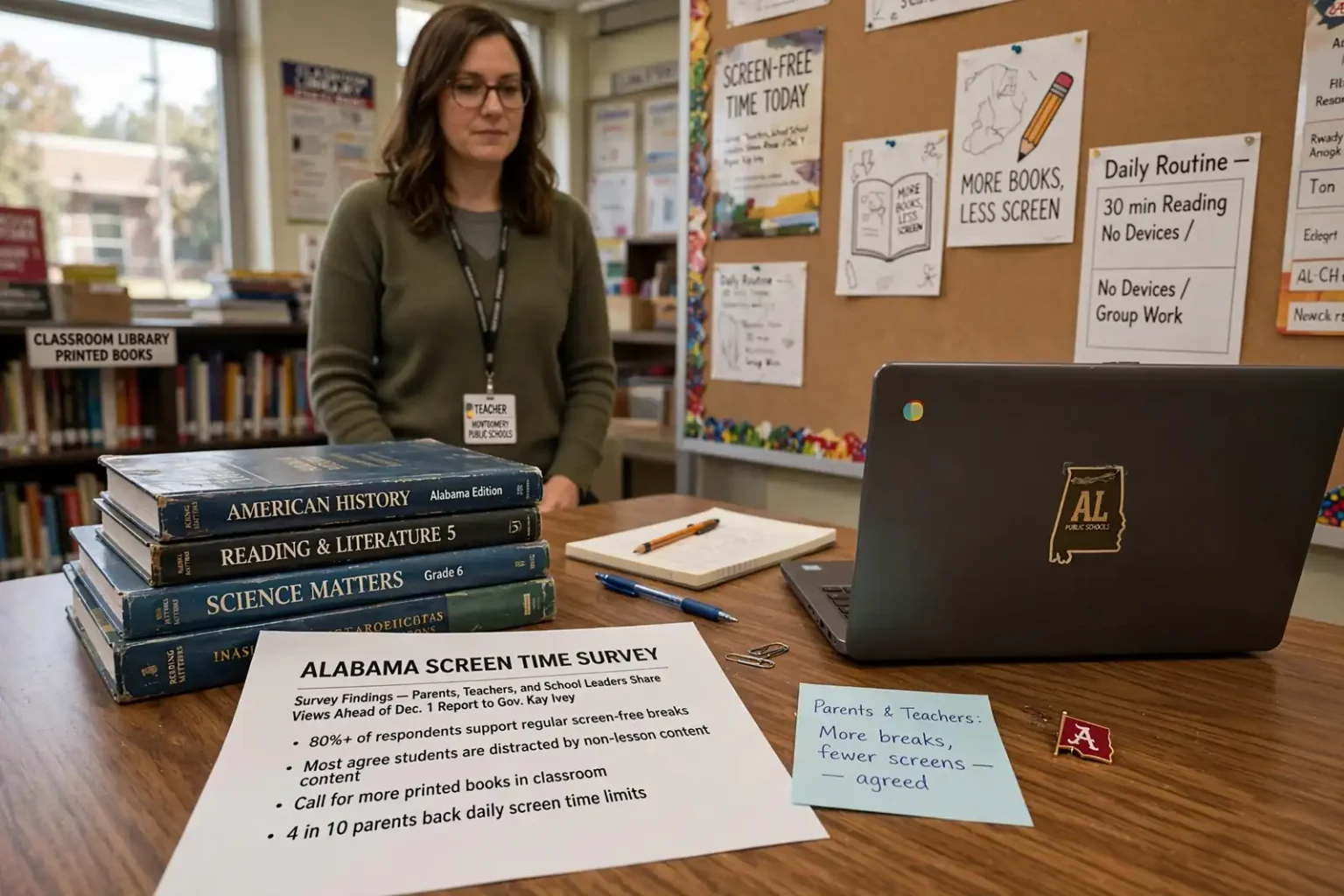
MONTGOMERY, Ala. — Parents, teachers and school leaders across Alabama largely share the same view of classroom technology: devices have a role in learning, but students would benefit from more regular breaks from screens and more time with printed books. That was the picture painted by early results of a statewide screen time survey presented Tuesday to a commission formed by Gov. Kay Ivey to study screen use in public schools.
The commission held its last in-person meeting in Montgomery and is now assembling a final report, which members expect to deliver to the governor on Dec. 1. The survey findings, along with recommendations from the commission’s smaller working groups, will shape that report and could lay the groundwork for new state guidance or legislation.
What the Findings Could Mean for Students
For families, the most practical takeaway is that the people closest to the classroom are not far apart. Large majorities of parents, teachers and school leaders agreed that students need regular screen-free periods during the school day, with more than 80% of each group saying such breaks would help students.
Respondents also agreed on the main drawbacks. Half of the parents, teachers and school leaders who answered strongly agreed that students get pulled away by content on their devices that has nothing to do with the lesson. At least 30% in each group agreed or strongly agreed that once students have been on a device, it can be hard to bring their attention back to the material being taught.
At the same time, each of the three groups agreed that technology skills will pay off for students later in life. Parents and teachers listed expanding the use of printed books and other physical classroom materials as one of their top priorities, and a majority of parents felt their children are on screens too much during the school day.
Survey by the Numbers
- Who took part: Thousands of teachers and parents, close to 400 school leaders and several dozen district technology directors and staff.
- How long it ran: The survey was open for two weeks.
- How participants were chosen: It was self-selecting, meaning anyone in those groups could volunteer to respond.
- Screen-free breaks: Upward of 80% in each respondent group backed regular breaks from devices.
- Daily limits: About four in 10 parents supported daily screen time limits, compared with roughly one in four teachers.
- Tracking ability: Only about 40% of technology directors and staff said their districts can measure how much time students actively spend on devices.
How Teachers Say They Use Devices
Teachers reported using classroom technology for a wide range of purposes. The most common were testing students and monitoring their progress, giving students a way to practice and review skills, independent work, research and delivering core instruction.
A University of Alabama researcher who worked on the survey said the team found it notable that teachers reported using every one of those activities at least some of the time. The uses ran the full spectrum, from passive drills and review to projects in which students create their own work.
On time spent, most teachers said students use technology somewhere between 20 minutes and an hour and a half per school day. Reports of much heavier use came more often from high school teachers, some of whom put daily device time anywhere from 3.1 hours to upward of 4.5 hours.
Where Parents and Teachers Differ
The clearest split came over firm daily caps. Parents were noticeably more open to a set limit on daily screen time than teachers were. That gap reflects a broader tension in the responses between the desire to reduce overall screen exposure and the practical demands of running a classroom.
Written comments added texture to the numbers. One school leader argued that heavy screen use interferes with how the brain retains and transfers information, and expressed concern that learning apps built like games can boost engagement without producing real learning. A parent wrote that devices can be useful but should not be used the same way in every grade, saying a kindergartner should not already know how to log into a Chromebook and an online classroom platform.
A teacher, on the other hand, wrote about the value of having information at students’ fingertips. That teacher noted that while a typical day might involve half an hour on a screen, a research project could stretch that to an hour simply because a device is the quickest and most useful way to look things up, and said clearer guidance would help.
Why Minutes Alone May Not Tell the Story
A school superintendent who serves on the commission said the results were encouraging overall but cautioned against judging classrooms only by how long a device is open. A student may have a Chromebook in front of them while the teacher is at the board leading a lesson and working through questions with the class. Counted by minutes, that looks like screen time, the superintendent said, but in reality it is guided instruction with back-and-forth between teacher and students.
The same commission member said enforcing a strict daily limit would be difficult, especially at the middle and high school levels, since students rotate among several classrooms and teachers in a single day. No one teacher would necessarily know how much time a student had already spent on screens elsewhere.
That challenge is compounded by the tracking data. With only about 40% of technology staff saying their districts can measure active device time, many schools may not currently have a reliable way to know how much screen time students actually accumulate.
Possible Changes to Teacher Evaluations
One idea under discussion would use a tool schools already have. The commission is weighing changes to Alabama’s Teacher Observation Tool, the framework principals and other administrators use when they observe and evaluate teachers. Updated questions could ask how teachers are using technology during a lesson.
The superintendent on the commission noted that the tool has no questions today about whether a lesson’s screen use serves a clear goal, or whether teachers are balancing it with other kinds of instruction, and said adding such questions to an existing tool would be a straightforward step.
Observation frameworks like this one are a routine part of how schools support and evaluate teachers. Administrators typically visit classrooms, record what they see against a set of standards and then discuss the results with the teacher. Adding technology questions would put screen use into conversations that already happen in schools across the state.
Legislation Is Possible, but Not Settled
A state lawmaker serving on the commission said the level of agreement among parents, teachers and school leaders stood out to her, with similar trends showing up across nearly every topic in the survey. She said the results suggest Alabama may need to rethink exactly how technology is used in classrooms.
She described new legislation as a possibility but said the first step is to review the commission’s recommendations in detail. She also said she wants further conversations with teachers and local school districts, stressing that teacher autonomy is important to her. At the same time, she said statewide guidance could give teachers something to rely on so they are not left to work out every decision about classroom technology on their own.
A researcher who helped lead the survey said the team was pleased with the turnout during the survey’s two-week window and wanted every group to have a voice in the results. Researchers are still analyzing the data, and the findings presented Tuesday are preliminary. Because the survey was voluntary and reflects the opinions and experiences of those who chose to respond, it offers a snapshot of views rather than a precise measurement of every Alabama classroom.
Part of a Wider Conversation
Alabama’s review comes as schools nationwide reconsider the role of devices that became widespread during the shift to remote and hybrid learning earlier in the decade. Many districts issued laptops or tablets to every student during that period, and those devices have since become part of daily instruction, homework and testing.
Alabama has already acted on one related issue: state law now restricts students’ use of personal phones and similar devices during the school day. The commission’s work focuses on a different question, namely the school-issued devices and digital tools teachers use for instruction.
Questions about classroom devices tend to involve trade-offs that schools weigh differently. Digital tools can deliver quick feedback on student progress, give access to a wide range of reading material and help students build skills they will need in college and the workforce. Concerns center on distraction, the amount of total daily screen exposure once homework and personal use are added in, and whether some digital activities are as effective as hands-on or teacher-led instruction. The Alabama survey suggests that, at least among those who responded, families and educators see both sides of that balance.
What Happens Next
The commission’s working groups are wrapping up their recommendations, which will be combined in the report for Ivey, with a target delivery date of Dec. 1. Once the report is public, lawmakers, the state education department and local school boards will decide which recommendations to pursue, whether through legislation, state guidance, changes to the teacher observation process or local policy.
Parents who want to know how devices are used in their own child’s school can ask teachers and administrators directly about daily routines, the purpose of assigned digital work and any screen-free time built into the schedule. Those conversations may become more common as the statewide recommendations take shape in the months ahead.