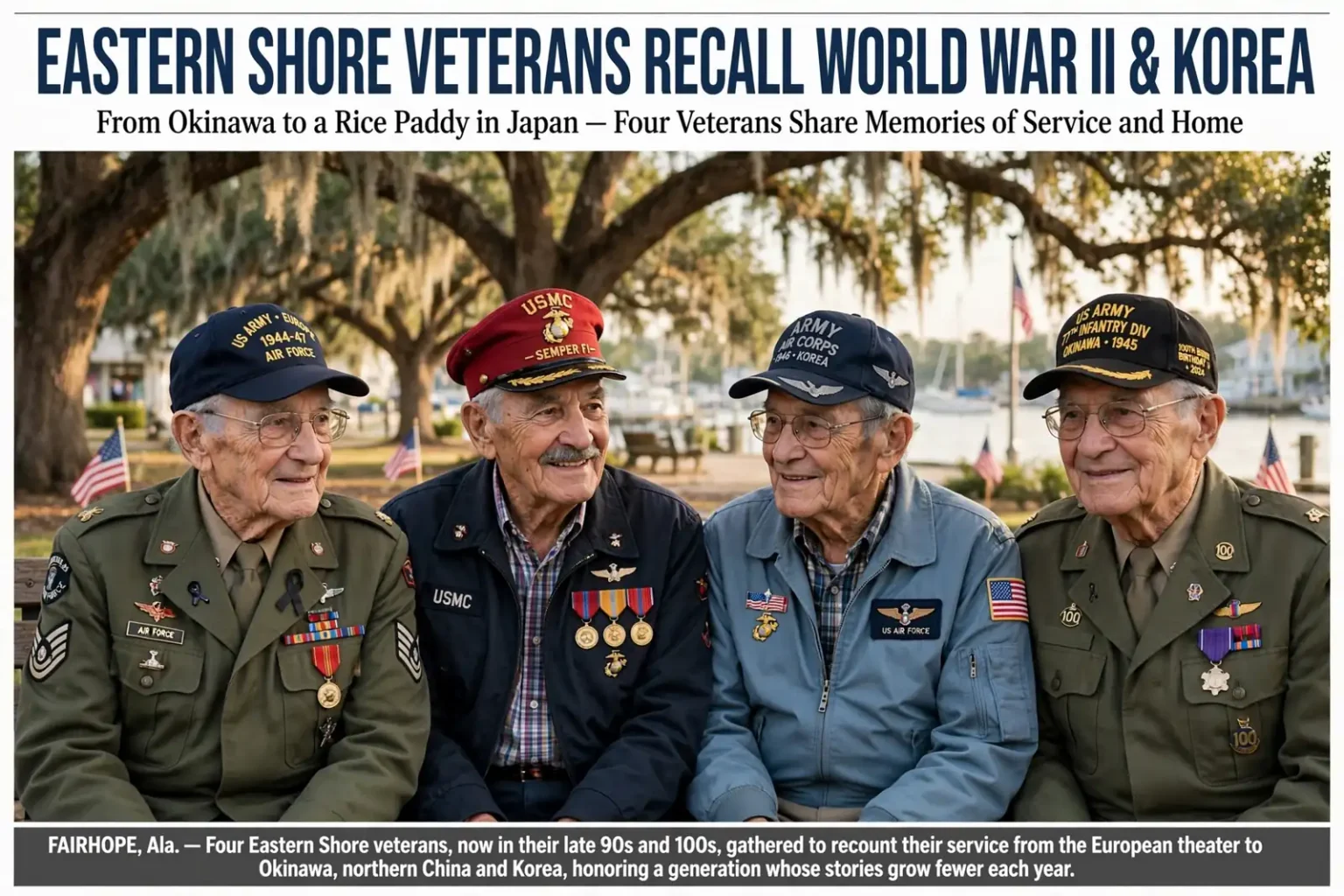
FAIRHOPE, Ala. — For four Eastern Shore veterans, military service shaped everything that came after it: the families they raised, the work they took on and the way they looked back on long lives. As the community marked Veterans Day, their memories offered a personal window into World War II and the Korean War, two conflicts whose living witnesses grow fewer every year.
Their stories span Europe, the Pacific, northern China, the Korean Peninsula and the skies over Japan. One of the men died earlier this year. The other three are now in their late 90s or older.
The Four Veterans at a Glance
- The Clanton native: Born in 1924, he served in the U.S. Army in Europe during World War II and later in the Air Force. He died June 11, 2026, a few months short of what would have been his 102nd birthday on Nov. 3.
- The Mobile-born Marine: Born in 1928, he served in northern China after World War II and in Korea during the Korean War. He is 98.
- The airman from Washington state: A native of Everett, Washington, he joined the Army Air Corps in 1946 and flew missions out of Japan during the Korean War. He lives in Barnwell.
- The Indianapolis native: Drafted in 1944, he fought with the Army on Okinawa. He turned 100 on Dec. 31 and has called Fairhope home since 1993.
Answering the Call in Different Ways
The paths that led these men into uniform were as varied as their hometowns. The Clanton native was drafted into the Army during World War II. Long before that, as a young teenager, he had made trips to Montgomery to visit an older brother, and during those visits he played guitar alongside a then-little-known singer named Hank Williams, who was performing around the capital city.
The Mobile-born Marine grew up in a household steeped in service. His father was a Coast Guardsman, and an older brother was already a Marine. He wanted to follow his brother right away but was told he first had to finish high school. He went to Murphy High School, then Marion Military Institute, finishing in 1946, and enlisted in the Marines at 17.
The Indianapolis native came of age in modest circumstances. His father died when he was 10, and he was raised by his widowed mother. He was a high school freshman when Japan attacked Pearl Harbor. When he graduated in the summer of 1944, he became eligible for the draft immediately. Under an arrangement that allowed men who accepted immediate induction to pick a branch, he asked for the Navy, as several of his friends had done. After a wait of several weeks, he reported to the draft board, only to see the Navy marking on his paperwork overruled by a large red letter assigning him to the Army.
The airman from Washington entered the Army Air Corps in 1946, the service that would soon become the independent U.S. Air Force. His first assignment, in central Georgia, lasted about three years and involved flying patients and medical staff to military hospitals around the country.
Far From Home: Europe, Okinawa, China and Korea
Supplying the Front in Europe
The Clanton native spent roughly three years in Europe, hauling ammunition and supplies through France and Germany. After Germany surrendered, he was put in charge of about 500 prisoners of war. Among the honors he earned was the French Croix de Guerre, a decoration that recognizes acts of heroism and valor. His widow says he was nearly reassigned to the war against Japan in the Pacific before last-minute orders sent him home. She has long believed military leaders already knew the war was nearing its end.
Wounded on Okinawa
After 17 weeks of infantry training, the Indianapolis native shipped out to Hawaii, where he and other soldiers spent seven to eight weeks in further preparation and processing that, as he came to understand it, was meant to prepare them for what combat would be like. A troop ship then carried him to the Philippines, where American forces were fighting the Japanese, and he joined the 77th Infantry Division as a replacement.
Next came Okinawa, where U.S. forces drove south toward Japan’s main defensive line. While his unit was trying to take a hill, a fragment from a mortar shell struck him. Crew members in an American tank spotted the wounded men and called for help by radio, and a Jeep was sent up to retrieve them. A medic tied a tourniquet on his arm, treated the wound with sulfa powder and gave him morphine. Piecing the events together years later, the veteran has said he is all but certain that the medic was Desmond Doss, the conscientious objector who refused to carry a weapon and received the Medal of Honor for saving dozens of wounded men on Okinawa. Doss’s story was later told in the 2016 film Hacksaw Ridge.
Doctors at a field hospital told him the arm wound was not life-threatening but would keep him out of further combat, the kind of injury soldiers of that era considered a lucky ticket home. He was moved away from the fighting for treatment and returned from military service in 1946.
Christmas Cards From China
In the fall of 1946, the Marine was sent to North China, where he spent 19 months with an engineer battalion that helped repatriate Japanese soldiers and assisted Chinese Nationalist forces against the Communists. A gifted artist, he made pen-and-ink drawings of scenery and buildings, which also helped with mapping.
One day, while he was sketching his general’s former headquarters, he sensed someone behind him and turned to find the general studying the drawing. The general asked whether the artwork could be used for the division’s Christmas card that year. The young Marine, then 18, agreed, and roughly 22,000 cards were printed and sent throughout the division. He also picked up Mandarin during his time in China.
Inchon and the Chosin Reservoir
That language skill came in handy in 1950, when his reserve unit was activated for the Korean War. He took part in the landing at Inchon. As his unit advanced toward the Yalu River, the Marines learned that 10 enemy divisions had encircled them. They held out, and two of those divisions were destroyed in the fighting. He also fought at the Chosin Reservoir, a battle remembered as one of the most punishing of the war. Today, he says the painful memories have faded, and what remains are the lighter moments, such as young Marines throwing snowballs at each other, and the comfort of knowing his family was likely praying for him.
Close Calls in the Skies Over Japan
During the Korean War, the airman from Washington was based in Japan for about two and a half years. His crew ferried service members to and from Korea and to destinations around Asia and all over Japan.
Around midnight one night, the crew lost control of their aircraft in poor visibility and had to bail out. As he struggled to open the door and jump, he broke his jaw. The men parachuted down onto a narrow path in a rice paddy. A master sergeant living in a tent nearby heard them shouting to one another and came running, at first believing they were North Koreans trying to infiltrate a camp under his watch. Once he realized they were Americans, he brought them to the camp, and it took four days before the crew could be safely moved out.
Love Stories That Lasted
The war years also shaped the men’s family lives. When the Marine, then a student at Auburn University, learned his reserve unit was being called up, he had already fallen for a young woman he met there. With little time before he had to report, the young couple had their mothers speak by phone, and she came down for a week together on the Gulf Coast while friends threw going-away parties for him. He spent a year in Korea, returned home in 1951 and married her one month later. Today the couple’s family counts six children and 29 grandchildren, plus eight great-great-grandchildren and 51 great-grandchildren.
While stationed at Brookley Field in Mobile, the airman was set up on a blind date with a Barnwell native, and the pair went to a party together. The couple wed in 1951, and she later traveled by ship to join him in Japan, a reunion he had not expected to be possible. After the war, the family made homes in New Jersey and California, raising two daughters, and came back to Barnwell in 1986. His wife died March 18, 2025. He still carries a small book of photographs and keepsakes from their life together in his pocket.
The Clanton native had come to Fairhope for a job with Mercury Freight Lines, and he met his future wife through mutual acquaintances. At the time, she lived behind him, on land owned by her grandmother along Greeno Road. They married in 1968 and stayed together until his death this June.
Building Lives After Service
Coming home was an adventure of its own for the Clanton native. After landing in New York, he took a train to Birmingham and then hitchhiked the rest of the way to Clanton. He received an honorable discharge from the Army in 1947.
Years later, after back surgery left him unable to keep working, the couple relocated to Dublin, Georgia, home of a nephew who owned a Dari Delite. About three years later, they returned to Fairhope and opened a restaurant in the 1970s where Greeno Road meets Morphy Avenue, on the site now home to a Dollar Tree. They operated it until their youngest son graduated from Fairhope High School and then sold the business.
He also drove trucks until the age of 80. With his wife along, he covered all 48 continental states, as well as Canada and Mexico, and he made a habit of tracking down old Army friends along the way. His widow recalls nights when he stayed up talking with them at truck stops, saying it made him feel like an 18-year-old again. He was a devoted Alabama Crimson Tide fan and a NASCAR enthusiast who got to drive around Talladega Superspeedway three times. She remembers him as fair, honest and dependable, a man whose word could be trusted and who loved his family deeply.
The Indianapolis native enrolled at Butler University after the war, though he did not finish a degree. He went on to work for a maker of industrial batteries for the automotive field and later in sales and marketing, retiring in 1988. Before moving to Fairhope in 1993, he and his wife had also lived in Wisconsin and Minnesota.
A Generation Growing Smaller
Federal veterans data show that 30,607 World War II veterans were still living as of 2026, a number that shrinks every year. The Indianapolis native, who reached his 100th birthday on Dec. 31, says he often wonders why he survived when so many others did not.
He still remembers where he was when the war ended. He was watching a USO show at the amphitheater at Schofield Barracks in Hawaii, with Pearl Harbor, still under blackout, visible in the distance. Word had spread that the lights would come back on if Japan gave up. In the middle of the performance, the harbor suddenly lit up, and the soldiers in the audience erupted in celebration.
For the Marine, now 98, looking back brings mostly gratitude. He describes his life as one filled with beauty and love, and he holds firmly to the idea that being a Marine is a lifelong identity, not something a person leaves behind when the uniform comes off.
Their stories are a reminder that many Eastern Shore neighbors carry remarkable histories of their own.