SS United States Sinks Off Destin, Becoming World’s Largest Artificial Reef; Divers Could Visit by Friday
The SS United States sank Wednesday night about 22 nautical miles southwest of Destin after leaving Mobile, creating a massive artificial reef that divers may explore as soon as Friday.
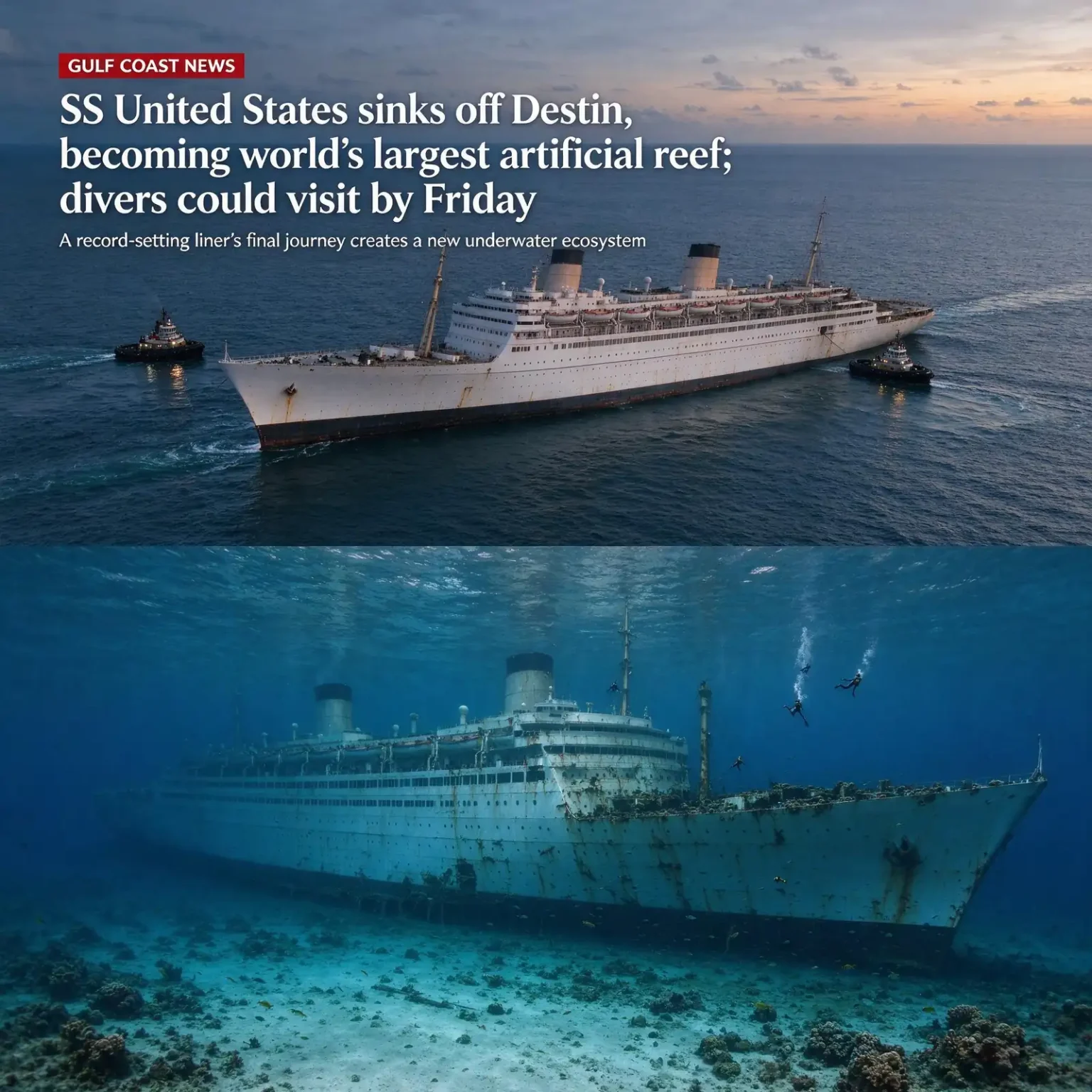
DESTIN, Fla. — The SS United States is now on the floor of the Gulf. The record-setting ocean liner, which spent roughly 20 months docked in Mobile while it was prepared for its final assignment, rolled onto its side and went under shortly before 9 p.m. Wednesday, Nov. 11, becoming what Okaloosa County, Fla., bills as the largest artificial reef in the world.
Crews started the deployment Wednesday afternoon at the site roughly 22 nautical miles southwest of Destin, two days after tugboats pulled the 990-foot ship away from its berth on the Mobile River. The vessel now rests in about 180 feet of water, and divers from around the world are already lined up to see it.
A Veterans Day Farewell
The sinking took place on Veterans Day, a date that came about because of the weather rather than by original design. Okaloosa County had planned the deployment for Thursday but moved it up a day after forecasts called for rough seas and strong winds later in the week. County leaders described the new date as a fitting way to honor the nation’s veterans along with a ship that carries the country’s name.
The scuttling capped a long journey. The liner was towed to Mobile from Philadelphia in early 2025, arriving through the pass between Fort Morgan and Fort Gaines that March. At a ship repair and recycling yard on the Mobile River, workers spent many months stripping it of fuel tanks, windows, paint and its two 65-foot smokestacks, cleaning it so it could safely be placed on the seabed. The ship left Mobile on Monday, Nov. 9, for the trip down Mobile Bay and east along the coast to the Florida Panhandle.
What Happens Now for Divers
The new reef will not open to visitors immediately. Dive operators expect a waiting period of at least 24 hours after the sinking before anyone goes down to the wreck, to give the hull time to settle on the bottom.
Local dive charter operators explained the reasons for the pause. A ship of this size can strike the seafloor hard, which may shake loose equipment or pieces of the structure. Pockets of trapped air can also escape suddenly as the vessel settles. A similar waiting period was observed in 2006, when the aircraft carrier Oriskany was sunk off Pensacola to create what was then a record-setting artificial reef.
Charter operators said divers from many countries have already booked trips to explore the SS United States, with the first dives expected as soon as Friday, Nov. 13, if conditions allow.
Okaloosa County has said the ship’s upper decks sit roughly 55 to 60 feet below the surface, while the deepest parts of the wreck lie near 180 feet. That range is meant to give both recreational divers and experienced technical divers something to explore.
From Steel Hull to Living Reef
The transformation from shipwreck to thriving habitat will take time. A marine biologist who works in the area said algae, coral and other organisms will begin to grow on the hull over the next couple of months. That early growth draws small fish looking for food, and those small fish in turn attract larger predators seeking food and shelter. The process repeats and builds on itself.
By spring, the wreck could already be a busy ecosystem, just as the tourist season gets underway. A charter boat captain noted that the timing works in the area’s favor, since winter is usually a slower period for the fishing and diving business, giving the reef several months to develop before visitors return in large numbers.
Charter captains also said well-placed underwater structures, provided they have been inspected and installed properly, create excellent habitat for local fish populations. That benefits anglers as well as divers.
How Artificial Reefs Work
Much of the northern Gulf seafloor is flat sand and mud with relatively little natural hard structure. Artificial reefs fill that gap by giving marine life something solid to attach to and hide around. Over the years, states and counties along the Gulf have sunk a wide variety of materials for this purpose, including concrete modules, bridge rubble, decommissioned vessels and purpose-built reef structures.
Large ships are especially attractive for reef programs because they rise high off the bottom and contain a maze of rooms, passageways and decks that provide shelter for fish at many depths. Before a vessel can be sunk, it must be cleaned of fuel, oils and other materials that could harm the environment, which is why the SS United States spent so long being prepared in Mobile.
Artificial reefs can also take some fishing and diving pressure off natural reefs, spreading visitors across more sites. Because a sunken ship is a fixed landmark with known coordinates, charter captains can plan trips around it with confidence, and divers can return again and again to watch how the marine community changes from season to season.
Okaloosa County leaders have said they expect the reef to attract thousands of divers, along with other visitors, to the Destin-Fort Walton Beach area in the years ahead.
The Fastest Liner Ever Built
The SS United States was launched in 1951 and built in Newport News, Va. On its maiden voyage in 1952, it set a trans-Atlantic speed record for passenger liners that has never been broken, averaging more than 35 knots. The SS United States Conservancy, the nonprofit that owned the ship for years, describes it as the fastest passenger ship ever constructed and the last of America’s great 20th century ocean liners.
For years the liner carried travelers across the Atlantic. It left passenger service in 1969 and then sat idle for decades, much of that time at a pier in Philadelphia, as a series of owners and preservationists searched for a way to give it a new purpose. Okaloosa County bought the ship from the conservancy in 2024 for $1 million.
For people who sailed aboard it, the ship still holds powerful memories. One former passenger, who crossed the Atlantic on the liner as an 8-year-old in 1961, has described the thrill of standing on deck in the North Atlantic wind as the ship raced along at about 35 knots, an experience he called impossible to forget.
A Plan That Drew Opposition
Not everyone supported sending the ship to the bottom. Preservationists, environmental advocates and several New York City Council members fought the plan. Opponents argued that sinking the vessel could pose environmental risks and that a ship of such historic importance deserved to be restored and opened to the public for tours rather than having its funnels removed and being sent to the seabed as a wreck.
A preservation group took the fight to federal court in the days before the departure, but a federal judge in Florida declined to halt the project, and the tow from Mobile went ahead as scheduled.
Okaloosa County officials and other supporters of the reef plan have said the ship had deteriorated too much during its long years in Philadelphia for a restoration to be realistic. In their view, turning it into a reef gives the liner a second life instead of sending it to a scrapyard or leaving it to decay at a dock.
A Museum Planned on Shore
Parts of the ship will remain above water. The two smokestacks removed in Mobile, along with thousands of artifacts gathered from the vessel, are being held for a planned land-based museum in the Fort Walton Beach area. That project is still in its early stages, but it is intended to tell the ship’s story to visitors who may never dive the wreck.
The museum will give the ship’s long history a home on land, from its record-setting crossings to its decades of waiting at the pier and its final months on the Gulf Coast, so that people who will never strap on scuba gear can still connect with the vessel.
For Mobile, the departure of the liner closes an unusual chapter on the waterfront. During its stay, the ship became a sightseeing attraction of its own, with harbor cruises carrying visitors past its towering hull and onlookers lining the riverfront to watch it leave.
Safety Reminders for Boaters and Divers
As interest in the new reef builds, boaters and divers headed to the site are urged to plan carefully:
- Follow any instructions from the U.S. Coast Guard and local authorities, especially in the first days after the sinking.
- Dive within your training and certification limits. Deep wreck penetration requires specialized training, equipment and experience.
- Use a reputable local charter operator familiar with the site, currents and conditions.
- Check marine forecasts before heading offshore, since the reef sits more than 20 nautical miles from shore.
- Display a dive flag when divers are in the water, and watch for other vessels in what is expected to be a busy area.
With the ship now in place, the next few months will show how quickly marine life claims the hull. If the reef performs as its backers hope, the former queen of the Atlantic could become one of the most visited dive sites on the Gulf Coast by the time warm weather returns.