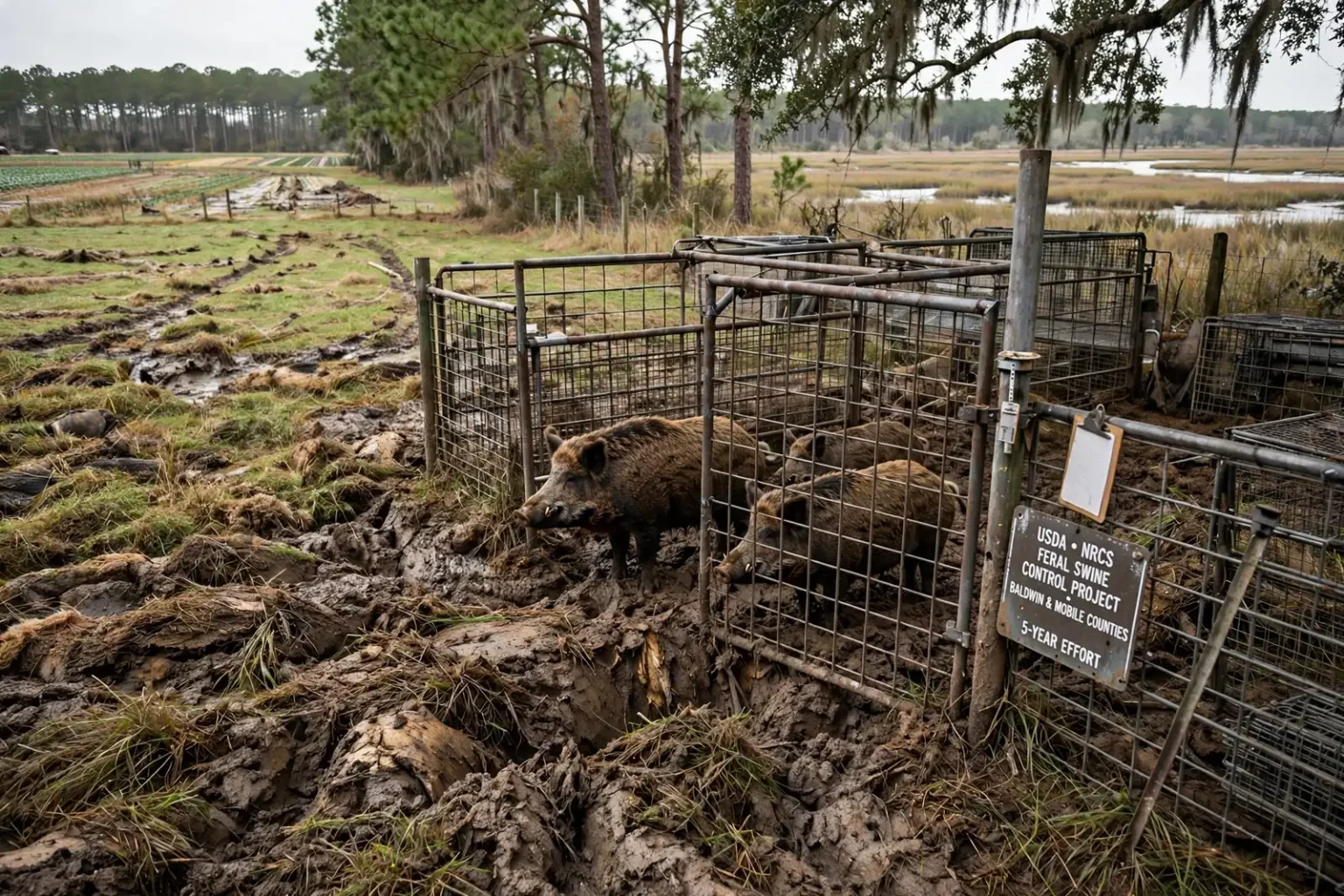
MOBILE, Ala. — Landowners and farmers in Baldwin and Mobile counties who have watched wild hogs tear up pastures, crop rows and timber stands are in line for new help. A five-year effort aimed at the two coastal counties will receive $2,021,684 in federal money for feral swine control, aiming to cut hog numbers, repair damaged ground and teach property owners how to keep the animals in check long after the grant ends.
The Baldwin-Mobile project is one of four Alabama projects chosen in the latest round of the U.S. Department of Agriculture’s Feral Swine Eradication and Control program, a pilot effort now several years old. Together, the four Alabama awards total $8,007,224, and all of them will be led by Alabama’s Soil and Water Conservation Committee.
What the Money Means for Baldwin and Mobile Counties
For property owners along the coast, the most important details are where the work will start and how much ground it is expected to cover. The project plan calls for crews to begin in blocks of roughly 5,000 connected acres where hog activity and damage are heavy and where neighboring owners have agreed to take part. Working across property lines matters with feral swine, because a sounder that is pushed off one farm will often simply move next door if the adjoining land is left untreated.
Over the full 60-month life of the project, organizers have set several targets:
- Treating a minimum of 25,000 acres for feral swine
- Helping at least 120 eligible agricultural producers and landowners
- Restoring about 980 acres of land the animals have damaged
Beyond trapping and removal, a central goal is building local capacity. The idea is that landowners who learn effective control methods during the five years will be able to continue the work on their own once federal dollars stop flowing.
Alabama’s Four Projects at a Glance
The Baldwin-Mobile effort is joined by three other Alabama projects spread across the southern and western parts of the state. Each one shares the same broad aims: shrink hog populations, give landowners tools and know-how, and restore land the animals have torn up.
- Baldwin and Mobile counties: $2,021,684 over five years, with targets of at least 25,000 acres treated, 120 producers and landowners assisted and about 980 acres restored.
- Barbour and Bullock counties: $2,021,684, with the same acreage, landowner and restoration targets. Eligible producers there can also tap cost-share help to buy approved traps and to carry out approved land restoration work.
- Lamar, Sumter and Pickens counties: $1,942,172. Roughly 50 landowners in this area have asked for feral swine help in the last four years through the state’s Conservation Incentive Program, even though that program had limited funding and little publicity.
- Monroe and Wilcox counties: $2,021,684. About 70 landowners in these two counties have sought help through the same state program during the last four years.
The Lamar-Sumter-Pickens and Monroe-Wilcox projects carry the same goals of at least 25,000 treated acres, at least 120 assisted producers and landowners, and roughly 980 restored acres each, and both will offer cost-share help for approved trapping gear and restoration work to eligible producers. Taken together, the four Alabama projects are expected to reach a minimum of 100,000 acres statewide.
Why Wild Hogs Are Such a Costly Problem
Feral swine are not native to North America. They are descended from domestic pigs brought by early European explorers and settlers, later mixed with Eurasian wild boar released for hunting, and today they roam much of the South. They are intelligent, adaptable and prolific, and a population can grow quickly when it is left unchecked.
The damage they cause comes largely from rooting, the habit of digging into the soil with their snouts in search of roots, grubs, seeds and other food. A group of hogs can turn over a field or a food plot in a single night. Federal officials point to a long list of harms:
- Destruction of crops, pastures and planted seedlings
- Disturbed soil that can lead to erosion and runoff
- Muddied streams, ponds and wetlands that affect water quality
- Damage to habitat used by native plants and wildlife
- Diseases that can be passed to livestock, pets and people
In coastal counties like Baldwin and Mobile, where row crops, sod farms, timberland, cattle pastures and sensitive wetlands sit close together, those impacts can affect both a farmer’s bottom line and the health of rivers and bays downstream.
How the Federal Pilot Program Works
Congress created the feral swine pilot program in the 2018 Farm Bill. It is a joint effort between two USDA agencies: the Natural Resources Conservation Service (NRCS), which works with private landowners on conservation, and APHIS, the Animal and Plant Health Inspection Service, whose wildlife specialists carry out much of the hands-on removal work around the country.
Under the program, partners chosen in each state provide landowners with help on land restoration, trapping and related services such as training. The money moves through grant agreements between those partners and NRCS, and every project involves coordination among the local partners, NRCS and APHIS.
The USDA announced the latest awards on Nov. 3. Nationally, the department is sending $51.9 million to 29 projects in 13 states, part of a larger $105 million investment that involves both NRCS and APHIS. The department said the funding was made available by the Working Families Tax Cuts Act, a law it credits with the biggest long-term boost to NRCS conservation programs in decades.
Federal leaders said the program brings farmers and partners together to fight a threat to the nation’s working lands, and that the chosen projects target places where hogs are causing the most harm. APHIS leadership said the agency will keep working alongside NRCS and its partners to shrink feral swine populations and protect farms, ranches and natural resources.
A Regional Fight Across the South
Alabama is one of 13 states sharing in this round. The others are Florida, Georgia, Mississippi, Louisiana, Tennessee, Texas, Arkansas, Oklahoma, Missouri, North Carolina, South Carolina and California, a list that reflects how deeply wild hogs have spread across the Southeast and beyond.
Two of Alabama’s neighbors along the Gulf landed some of the larger single awards:
- Louisiana will get $3 million for a project spanning about 16.6 million acres in 27 parishes in portions of the Mississippi River and Red River basins. That effort will widen surveillance and trapping, educate landowners and coordinate removal work.
- Florida will also receive $3 million. Its project, in the south central part of the state, is designed to protect farm production areas, guard water quality and give producers training and tools for managing hogs.
Projects in the other states will concentrate on trapping, landowner education, population monitoring, restoring damaged property and coordinating removal.
Because hogs do not recognize state or county lines, regional efforts like these can reinforce one another. Reducing populations in one area helps limit how many animals wander into neighboring farms and forests.
The Program’s Track Record
The pilot program has been running long enough to show results. Since 2020, NRCS has put $92.9 million into 63 projects under the program. Those projects have helped more than 6,700 landowners on close to 9 million acres reduce damage from feral swine, and partners have held more than 800 events to teach landowners trapping methods.
NRCS itself traces its partnerships with farmers, ranchers and forest owners back more than 90 years, with a focus on better soil, cleaner water and air, and healthier wildlife habitat. It offers technical and financial help through voluntary conservation programs meant to protect working lands and keep farms productive.
What Landowners Can Do Now
Details on how individual Baldwin and Mobile county landowners can sign up for the new project had not been released. Property owners interested in taking part can generally start by contacting their local NRCS service center or county soil and water conservation district, which serve as the front door for most federal and state conservation assistance.
Wildlife and extension specialists generally offer a few points of advice for anyone dealing with hogs in the meantime:
- Work with neighbors. Control is far more effective when adjoining properties are treated at the same time.
- Remove whole groups. Large corral-style traps that catch an entire sounder at once are usually more effective than catching a few animals at a time, which can leave the rest of the group wary.
- Watch for signs. Rooted ground, wallows, rubbed trees and tracks near water are common indicators that hogs are present.
- Take precautions with handling. Because hogs can carry disease, hunters and trappers are advised to wear gloves when field dressing and to cook pork from wild hogs thoroughly.
- Know the rules. Alabama has regulations on hunting, trapping and transporting feral swine, and landowners should check current state requirements before starting a control program.
What Comes Next
With the awards announced, the next step is for the state conservation committee and its partners to finalize grant agreements with NRCS and begin lining up participating landowners in the first target areas. In Baldwin and Mobile counties, that means identifying the initial 5,000-acre blocks with heavy hog pressure and willing neighbors, then expanding outward over the five-year project period.
If the project meets its goals, at least 25,000 acres across the two counties will have been treated by the time it wraps up, and the landowners who took part should be equipped to keep the pressure on wild hogs for years afterward.