University of South Alabama Mobile
Legacy Oak Grown From a Single Acorn Takes Root at Mobile’s Geri Moulton Children’s Park
A live oak grown from an acorn of a 300-year-old tree now stands in Mobile's Geri Moulton Children's Park, and USA Health honored the grounds crew behind it on Nov. 4.
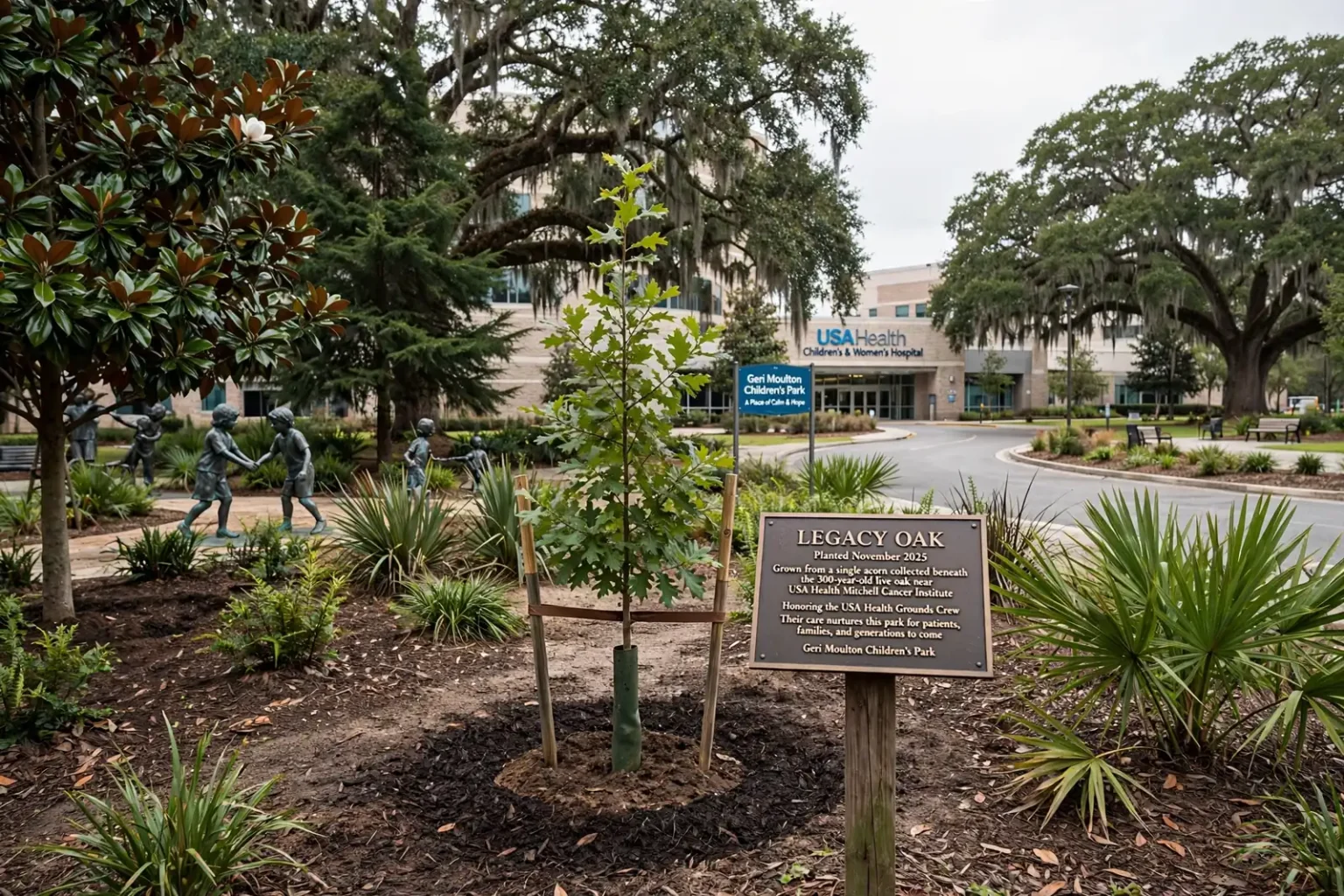
MOBILE, Ala. — A young live oak now rooted in the Geri Moulton Children’s Park began as a single acorn picked up off the ground by a member of the grounds team at USA Health Children’s & Women’s Hospital, and this month the hospital honored him and his crew for the years of work behind it and behind the park itself.
The tree, roughly 4 feet tall when it went into the ground, has been dubbed the legacy oak. A permanent bronze plaque is being made to stand beside it, marking the contributions of the groundskeeper who grew it and of the crew that cares for the park every day.
A Gift for Families Who Visit the Park
For the patients, parents and staff who walk through the children’s park, the new oak is a small addition today that is meant to become something much larger over the coming century. Its caretaker explained that he hopes the tree will eventually help form a line of oaks shading the curving road that leads to the hospital. He acknowledged that he will not live to see the canopy reach its full size, but said he wanted to leave something behind for those who come after him.
The park has long been intended as a place of calm next to a busy medical campus. Families facing a child’s hospital stay, a difficult pregnancy or a cancer diagnosis can step outside among trees, flowering plants and sculpture. Hospital leaders said the park’s atmosphere of peace and hope is the direct result of the grounds crew’s daily effort, and they described the oak as a living record of that work.
From Acorn to Sapling
The project started about four years ago, when the groundskeeper decided to try propagating a tree himself. He wanted to know whether he could coax an acorn from a live oak estimated to be more than 300 years old into becoming a healthy young tree.
The parent tree stands near the entrance to the USA Health Mitchell Cancer Institute, inside the children’s park, its broad limbs heavy with Spanish moss. He collected a handful of acorns from beneath it and planted them in small containers of rich potting soil. The pots were set out on a paved area a few blocks away on USA Health’s midtown campus, where he watered and watched them until the acorns sprouted.
He said his main goal was simply to see whether he could pull it off. He also made a point of sharing the credit, saying the entire grounds department deserves recognition for what it does in the park.
Surviving Storms and Snow
Raising a tree outdoors on the Gulf Coast means facing whatever the weather delivers. Over the years, the seedlings endured heavy Mobile downpours and tropical storms. They also faced the rare snowstorm of January 2025, when a historic snowfall covered the city.
The groundskeeper said he was worried the young oaks would not survive the cold. He decided against covering them, reasoning that once they were moved to the park they would have to withstand extreme conditions on their own. The gamble worked. The strongest seedling came through the snow and every other challenge without lasting harm.
Planting Day
Close to two years after that winter storm, the groundskeeper and a co-worker settled on the right location for the young tree. On an overcast day, the two dug a wide hole, wheeled the containerized oak to the spot and worked fertilizer into the soil before setting the tree in place.
The site is surrounded by cedars, magnolias and bronze sculptures of children playing, the kind of setting that gives the park its character. The new oak sits along the winding road to the hospital, where its future shade is meant to greet people arriving for care.
A Surprise Celebration
What the groundskeeper did not know was that colleagues were already arranging a tribute. On Nov. 4, his friends, relatives and co-workers met at nearby Magnolia Manor for a surprise ceremony recognizing his work in the park and the green spaces around it.
During the program, a hospital executive said he had carefully tended the little oak so that it could grow for the next hundred years. She said the tree will tell the story of him and every member of his crew, whose daily labor makes the park such a meaningful place for patients, their families and hospital staff.
Following the ceremony, the groundskeeper and members of the crew were treated as guests of honor at a lunch hosted at the home of the park’s namesake. She is the widow of the University of South Alabama’s second president, and for years she devoted herself to adding sculpture and native plantings to the park, both before and after it opened in 2001.
The Work Behind a Hospital Garden
Green spaces on hospital campuses do not maintain themselves. Grounds crews handle mowing, pruning, irrigation, mulching, seasonal planting and storm cleanup, often working around patients, visitors and emergency traffic. In a coastal city like Mobile, that work also includes preparing for hurricane season and clearing debris after storms so that walkways and entrances stay safe and open.
Gardens and parks of this kind are a common feature of hospital campuses because they give people a place to rest outside clinical settings. A parent waiting on news about a child, a patient between appointments or a nurse on a short break can step into fresh air and quiet. Keeping those spaces inviting year-round takes steady, mostly unseen labor, which is what hospital leaders set out to recognize this month.
The Geri Moulton Children’s Park has been part of that landscape since 2001. Its statues of children at play, its native plants and its large shade trees give the area around the hospital a softer feel than a typical medical campus, and the grounds crew is responsible for keeping it that way.
Why Live Oaks Matter in Mobile
Live oaks are among the most recognizable trees of the Gulf Coast. The species is native to the coastal plain of the southeastern United States and is known for its massive, spreading limbs, which can stretch far wider than the tree is tall. Unlike many oaks, it keeps most of its leaves through winter, replacing them gradually in spring, so it stays green nearly year-round.
The trees are prized for their toughness. Their low, broad form and strong wood help them stand up to coastal winds, and they tolerate the heat, humidity and sandy soils common along the coast. With good conditions, live oaks can live for several centuries, which is why some of Mobile’s best-known trees predate the modern city around them.
Spanish moss, the gray, trailing plant that drapes so many local oaks, is not a parasite. It is an air plant that draws moisture and nutrients from the air and rain, using the tree’s branches only for support.
Mobile has a long relationship with its oaks. Canopies of mature trees line many historic streets and shade parks and neighborhoods across the city, and residents often treat individual trees as landmarks. Planting new oaks today is one way to ensure those canopies continue for future generations.
Growing an Oak From an Acorn
Starting a live oak from seed is a project many home gardeners can try, though it takes patience. Acorns of white oak group species, which includes the live oak, typically ripen in a single season and are ready to sprout soon after they fall in autumn. Gardeners generally gather fresh, healthy acorns from the ground, discard any that are cracked or have small holes from insects, and plant them shallowly in pots of well-drained soil.
Seedlings need regular water while they establish roots, and many growers keep them in containers for a year or more before moving them to a permanent spot. Choosing that spot carefully matters, because a mature live oak needs plenty of room overhead and around its trunk. Anyone planting near sidewalks, driveways, utility lines or buildings should consider how large the tree will eventually become.
Caring for a Newly Planted Tree
The first few years after a tree moves from a container into the ground are the most critical. General guidance from arborists and extension services is to water deeply and regularly until the roots spread into the surrounding soil, especially during dry spells. A ring of mulch a few inches deep helps hold moisture and keep mowers away from the trunk, though the mulch should not be piled directly against the bark. Heavy pruning is usually unnecessary for a young tree beyond removing broken or damaged branches.
What Comes Next
The bronze plaque now being produced will be installed beside the legacy oak, so future visitors to the park will know the story of how the tree came to be there and who cared for it. In the meantime, the grounds crew will continue maintaining the young tree along with the rest of the park.
If the oak follows the path of its centuries-old parent, it could still be shading families at the children’s park long after everyone who attended this fall’s ceremony is gone, which, by the groundskeeper’s own account, was exactly the point.