Lawmakers Hold Two ADOC Contracts, Press for Prison Lawsuit Costs and Escambia Construction Plans
Alabama lawmakers placed two Department of Corrections legal contracts on hold while seeking answers on prison construction delays, Braggs v. Dunn compliance costs and the transition to a new governor.
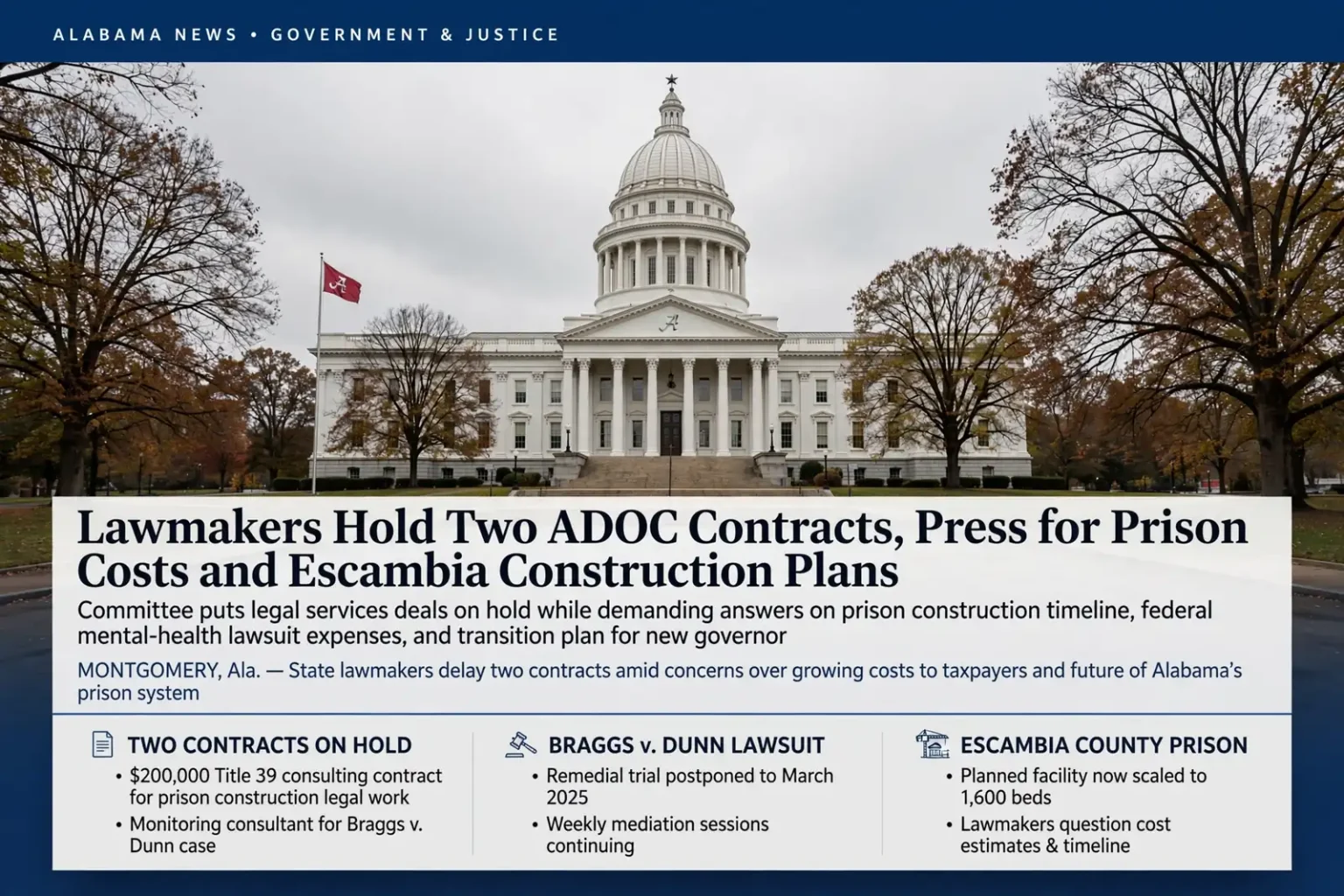
MONTGOMERY, Ala. — Alabama lawmakers have put two legal services contracts for the Alabama Department of Corrections on hold, saying they want clearer answers on the state’s prison construction program, the potential cost of a long-running federal lawsuit over mental health care behind bars, and how the department will hand off those challenges when a new governor takes office.
Both agreements came before the Legislature’s contract review committee at a recent meeting. Neither was rejected outright. Instead, members used the hold process to press the department for information that its representative at the meeting said she did not have on hand and would need to request from ADOC leadership.
Key Details at a Glance
- Contract one: A $200,000 agreement, renewable each year, with an attorney at the law firm Maynard Nexsen for consulting on Title 39, the section of Alabama law that governs public works projects.
- Billing so far: Less than $20,000 billed under the existing consulting arrangement across fiscal years 2025 and 2026 combined.
- Contract two: An agreement with Correctional Improvement and Sustainability Consultant LLC to place a consultant on the external monitoring team in the federal Braggs v. Dunn case.
- Court timeline: The remedial trial phase has been moved to March, and the parties are meeting in mediation every Friday.
- Status: Both contracts are on hold until the department supplies more information.
What the Holds Mean for Taxpayers
For residents outside the Capitol, the debate centered on a simple question: how much will Alabama ultimately pay to fix its prison system, and does the state have a plan to pay for it?
A lawmaker on the committee pointed out that the state has already spent heavily defending itself in the mental health lawsuit. He said legal fees for that defense were probably in the neighborhood of $40 million, and that the state lost the case anyway. He warned that the next step, complying with whatever remedies the federal court eventually orders, could add significant new costs to the state General Fund.
He floated a possible annual cost in the range of $50 million to $75 million, particularly if the court requires new buildings or additional space for treatment and programming for incarcerated people with mental illness. With budget writing approaching, he cautioned that the price tag could eventually become difficult for the state to afford.
The General Fund is the budget that pays for most non-education state services in Alabama, including prisons, Medicaid, courts and public safety agencies. Large, recurring new expenses in one area can squeeze funding available for the others, which is why legislators who write the budget tend to watch prison spending closely.
The lawmaker also said legislators were told earlier on that ADOC lacked any estimate of the case’s potential cost, even though he understood presentations had been made to state officials about possible settlement expenses and the consequences of losing in court. He questioned whether fighting the lawsuit rather than settling had actually saved the state money.
The department’s representative said she did not bring those estimates to the meeting but would carry the questions back to ADOC.
Cost estimates of this kind matter because remedies in prison conditions cases can take many forms. Courts may order more mental health staff, new treatment space, changes to how people in crisis are housed and watched, or better record keeping, and each of those steps can carry both one-time and ongoing expenses. Without a working estimate, legislators say it is hard to plan budgets that will satisfy the court while still funding other state services.
The Construction Consulting Agreement
The first contract on the agenda would extend legal consulting work under Title 39, the public works law in Alabama. Under that law, public construction projects in the state generally must follow set procedures for bidding, contracting and oversight, and agencies often bring in outside legal help to make sure large building programs stay in compliance.
The attorney already advises the department on the new correctional facility under construction in Elmore County. The proposed agreement would widen that role to cover both of the state’s planned new prisons. Her rates under the new contract are higher than under previous agreements, and the contract would renew on an annual basis.
Committee members wanted to know what work was actually being done. The department’s representative told them that billing under the existing consulting arrangement totaled less than $20,000 over fiscal years 2025 and 2026 combined. A lawmaker questioned why the department would need a $200,000 contract when it had spent comparatively little under the current one.
Members also asked about the status of the Elmore County prison. The department’s representative acknowledged that progress there has been slow but could not give an estimated completion date or details on how the project is being financed. Lawmakers also asked whether the next prison project would be competitively bid; she said she was not prepared to address that question and would seek an answer.
The disparity between a $200,000 ceiling and actual billing of under $20,000 was the core of the committee’s concern. Contract amounts in state agreements are typically maximums rather than guaranteed payments, but lawmakers said they wanted to understand what new work would justify the larger figure before signing off.
Several members placed the contract on hold until ADOC explains where its building projects stand and what its broader plans are.
The Court Monitoring Agreement
The second contract is tied directly to Braggs v. Dunn, the federal class-action case over how Alabama prisons care for incarcerated people who have serious mental illness. A federal judge in the U.S. District Court for the Middle District of Alabama found that conditions in the state’s prisons violated the Constitution, and the case has since moved into the phase of deciding and enforcing remedies.
The agreement would pay a consultant through Correctional Improvement and Sustainability Consultant LLC to serve on the external monitoring team appointed by the judge. That team is charged with evaluating whether the department is meeting the requirements the court has ordered. The department’s representative said the monitoring work is set to start next year, and that the judge personally chose this consultant.
Court-appointed monitors are common in large institutional reform cases. They typically review records, visit facilities, interview staff and incarcerated people, and file reports with the court so the judge can measure whether a state is following the orders in place. Their fees are usually paid by the government agency that is subject to the court’s orders.
The representative said more members could be added to the monitoring team once monitoring starts, which could lead to additional contracts later. For now, this agreement is the last appointment currently planned.
She also told the committee that the remedial trial phase of the case has been pushed back to March, and that the parties are continuing weekly mediation sessions, held on Fridays, in hopes of settling the dispute.
Questions About Escambia County and Prison Closures
The prison construction program has direct ties to southwest Alabama. The state’s second planned new prison is to be built in Escambia County, home to Atmore and several existing state correctional facilities.
During the meeting, a lawmaker said the Escambia County prison’s planned size had shrunk to 1,600 beds, down from 4,000. He also pointed to uncertainty over when construction there will start and when the Elmore County facility will be finished.
Those questions carry practical consequences. The new prisons are meant to replace aging facilities, and ADOC’s strategy for relocating people now housed in older buildings, and deciding which of those buildings can eventually close, depend on how many beds the new prisons will have and when they open. A smaller Escambia facility or a delayed Elmore opening could change which existing prisons stay in use and for how long.
Handing Off to a New Administration
Lawmakers repeatedly returned to the question of what happens when Alabama’s next governor takes office. With construction delays, a pending remedial trial and a court-ordered monitoring program all in motion, one legislator said the incoming administration will inherit a problem he described as being worth roughly a billion dollars from the day it starts.
He asked whether the department had prepared a transition plan explaining how responsibility for the construction projects, the litigation and day-to-day operational issues would be passed to new leadership. The department’s representative said she would seek information about any such plan.
How Contract Review Works in Alabama
Alabama law requires many state agency contracts for professional services to go before a legislative oversight committee before they take effect. The committee reviews the agreements in public, and members can ask agency representatives to explain the cost, the need for the work and how the contractor was chosen.
Committee members can hold a contract, which delays it for a limited period, generally up to 45 days. The hold does not cancel the contract, and the governor can ultimately allow it to proceed. In practice, holds are often used as leverage to get answers from agencies, as appears to be the case with these two agreements.
What Happens Next
Both ADOC contracts will remain on hold while the department gathers the information lawmakers requested. That includes details on the Elmore County construction timeline and financing, whether the next prison project will be competitively bid, estimates of the cost of complying with court orders in Braggs v. Dunn, and a plan for transitioning these responsibilities to the next administration.
The agreements could return to the committee once the department responds. Meanwhile, the remedial trial phase in the federal case is expected in March, the weekly mediation sessions are continuing, and court-ordered monitoring is set to begin next year. Each of those developments is likely to shape both the state’s prison budget and the debate over how Alabama pays for its corrections system in the coming legislative session.