Thomasville-Raised Hunter Vick Earns National Notice for Restoring Alabama’s Black Belt Prairie
Land Revival LLC, co-owned by Thomasville-raised Hunter Vick, is up for a Soul of the South conservation award, and Vick placed third in a national hardest-worker contest.
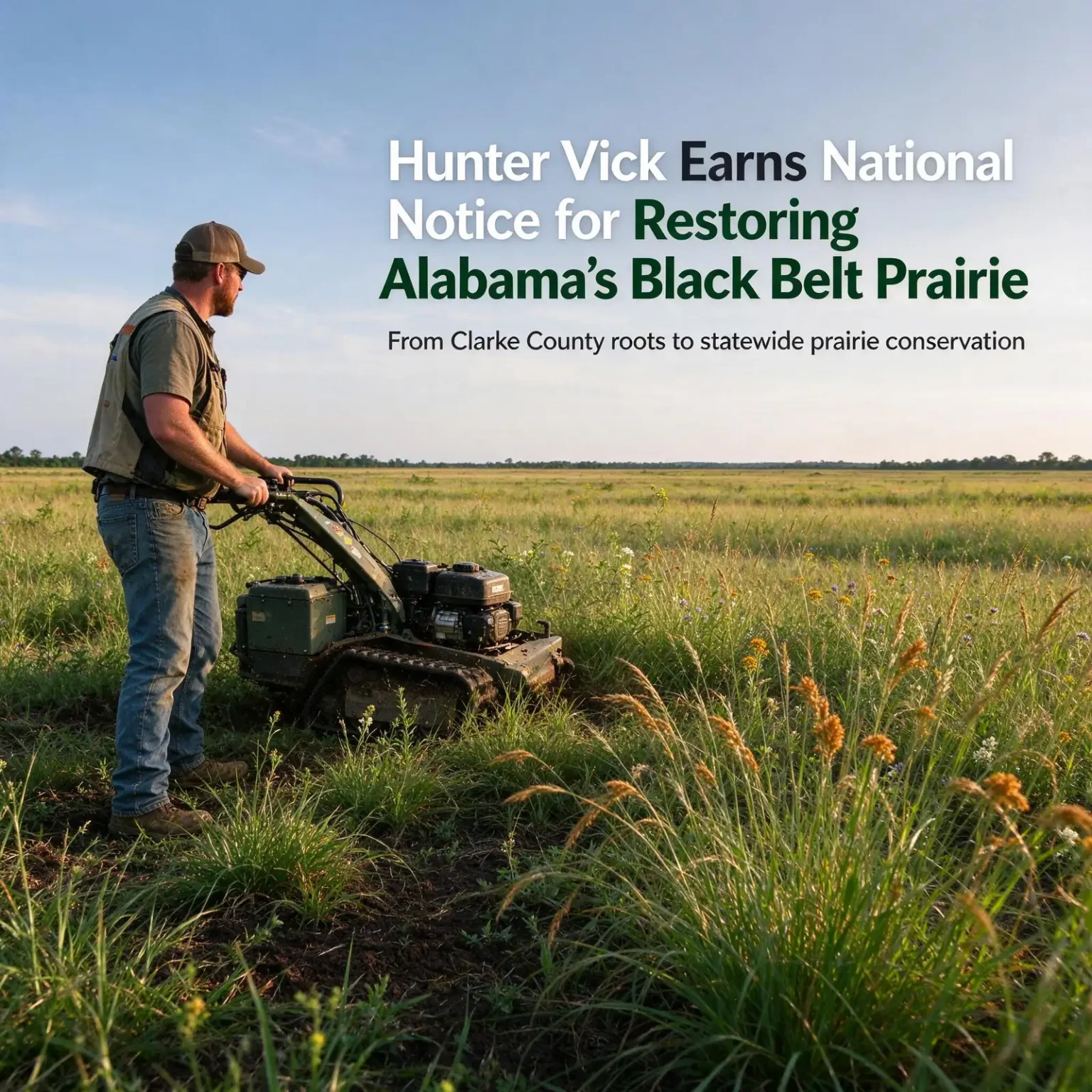
A man who spent his early years in Thomasville is drawing attention well beyond Clarke County for work aimed at bringing back one of Alabama’s rarest landscapes. Hunter Vick, who co-owns the land management company Land Revival LLC with his wife, has seen the business nominated in the conservation category of Soul Grown’s Soul of the South Awards, and he separately finished third in a seasonal round of ConEquip’s America’s Hardest Worker contest.
The recognition highlights years of effort to restore the historic Black Belt Prairie, a native grassland that once stretched across parts of west and central Alabama and has largely disappeared under farming, development and decades without natural fire.
From Clarke County roots to Tuscaloosa County
Vick was raised in Thomasville and in Pine Hill, a small town across the county line in Wilcox County. Both communities sit in the southwestern part of the state, in a region where timber, farming and outdoor work have long been part of everyday life.
He and his wife eventually made their home in Tuscaloosa County, where Land Revival is now based. From there, the couple runs a business built around a single goal: returning land to the kind of native plant communities that covered it before modern land use took hold.
For the couple, the work is both a way to earn a living and a personal commitment. Restoring native ground across the state is the core of what their company does, and it is also a cause they have taken up outside the business.
Two separate honors
The two recent recognitions come from very different places.
Soul of the South Awards nomination
Land Revival was nominated in the conservation category of the Soul of the South Awards, a program organized by Soul Grown. The nomination recognizes the company’s efforts to restore prairie habitat in the Black Belt.
America’s Hardest Worker contest
Vick also placed third in a seasonal round of America’s Hardest Worker, a contest run by ConEquip. The overall grand prize winner will be chosen through an online vote open to the public, which means supporters can play a part in the final outcome.
A family member said Vick has put in long hours not only to provide for his family but also to make a lasting difference in the Black Belt Prairie region. That person said he deserves to win because of what his work means for Alabama and for the generations who will inherit its land.
Setting the standard for a statewide initiative
Perhaps the most far-reaching result of Vick’s work has come through Alabama’s Black Belt Prairie Initiative. During a pilot program connected to the effort, his restoration projects were used as the benchmark for evaluation. That pilot helped secure funding for the initiative, giving the broader effort to protect and rebuild the region’s prairies a stronger footing.
In conservation work, a benchmark site serves as a reference point. It shows what a successful restoration can look like and gives scientists, agencies and landowners something concrete to measure other projects against. Having a working example on the ground can make it easier to explain the value of a program to people deciding whether to pay for it.
What the Black Belt Prairie is
Alabama’s Black Belt takes its name from the dark, fertile soils that run in a broad crescent across the middle and western part of the state. Much of that soil formed over chalk and marl deposits laid down when the area was covered by an ancient sea. Those alkaline soils supported open grasslands and prairie patches unlike the pine and hardwood forests found in much of the rest of the Southeast.
Native prairies in this part of Alabama were home to grasses and wildflowers adapted to sun, heat and periodic fire. Species such as little bluestem and Indiangrass, along with a variety of native flowering plants, once grew in these openings. The prairies also provided habitat for grassland birds, pollinating insects and other wildlife that depend on open, sunny ground.
Because the soils were so productive, much of the region was cleared for cotton and other crops during the 1800s. Over time, farmland was converted to pasture, timber plantations and developed land. Where the land was left alone, the lack of regular fire allowed trees and shrubs, including eastern red cedar, to move into former grasslands. Today, remnant patches of Black Belt prairie are considered some of the rarest natural communities in the state.
How prairie restoration works
Bringing a prairie back is slow, physical work. While each property is different, restoration projects in the Southeast commonly include several steps:
- Clearing encroaching woody growth. Trees and shrubs that have crowded into former grasslands are removed so sunlight can reach the ground again.
- Controlling invasive plants. Non-native species that outcompete native grasses and wildflowers often must be treated repeatedly over several years.
- Reintroducing native seed. Where native plants have vanished, seed from local sources may be planted to rebuild the plant community.
- Using prescribed fire. Carefully planned burns mimic the natural fires that once swept through the region, clearing thatch, setting back woody plants and encouraging native grasses to thrive.
- Monitoring results. Land managers track which plants return and how wildlife responds, adjusting their methods over time.
The job carries real physical demands and environmental hurdles, from heavy equipment work in the heat to managing fire safely. Even so, the efforts have produced visible results on the ground across the region.
Spreading the use of prescribed fire
Beyond running their company, Vick and his wife serve as west zone coordinators for the Central Alabama Prescribed Burn Association. In that role, they help promote safe and effective fire management across Alabama.
Prescribed burn associations are groups of landowners, volunteers and land managers who pool their knowledge, labor and equipment so that controlled burns can be carried out more safely and more often. Many private landowners want to use fire on their property but lack the training, crew or tools to do it alone. By working together, members can learn from experienced practitioners, help one another on burn days and build confidence in a practice that is essential for many Southern ecosystems.
Prescribed fire is widely used across the South to reduce the buildup of brush and dead vegetation that can fuel dangerous wildfires, improve habitat for game and non-game wildlife, and maintain fire-adapted forests and grasslands. In Alabama, people planning a prescribed burn generally must obtain a burn permit from the Alabama Forestry Commission and follow state rules on weather conditions, timing and safety.
Why it matters for the region
Restoration work in the Black Belt has benefits that reach beyond a single property. Healthy native grasslands can support pollinators that farms and gardens depend on, provide habitat for quail and other grassland wildlife, and help hold soil in place. Restored land can also create opportunities for landowners interested in hunting, wildlife viewing and other outdoor uses.
For communities across west Alabama, including Clarke County, the success of a Thomasville native in this field is a reminder that the region’s natural heritage is still within reach. Efforts like the Black Belt Prairie Initiative depend on people willing to do the hands-on work of clearing, burning and replanting, as well as on landowners willing to try new approaches on their own acreage.
How to follow along
The grand prize in the America’s Hardest Worker contest will be decided by online public voting, so residents who want to support Vick can look for the contest’s voting process.
Landowners curious about prescribed fire can learn more by connecting with a regional prescribed burn association or with the Alabama Forestry Commission, which oversees burn permits in the state. Those interested in prairie restoration on their own land may also find guidance through state conservation agencies and the extension system.
At a glance
- Who: Hunter Vick, raised in Thomasville and Pine Hill, and his wife
- Business: Land Revival LLC, a land management company based in Tuscaloosa County
- Mission: Restoring Alabama’s historic Black Belt Prairie
- Nomination: Conservation category, Soul of the South Awards, presented by Soul Grown
- Contest: Third place in a seasonal round of ConEquip’s America’s Hardest Worker; the grand prize winner will be picked by online public vote
- Volunteer role: West zone coordinators for the Central Alabama Prescribed Burn Association
- Statewide impact: His restoration work served as the benchmark in a pilot program that helped secure funding for Alabama’s Black Belt Prairie Initiative