Thomasville Pickleball Courts Taking Shape at Gates Drive Park, With Public Opening About Four Weeks Away
Thomasville is converting two tennis courts at Gates Drive Park into four pickleball courts. Resurfacing is finished, fencing is nearly done and the courts could open to the public in about four weeks.
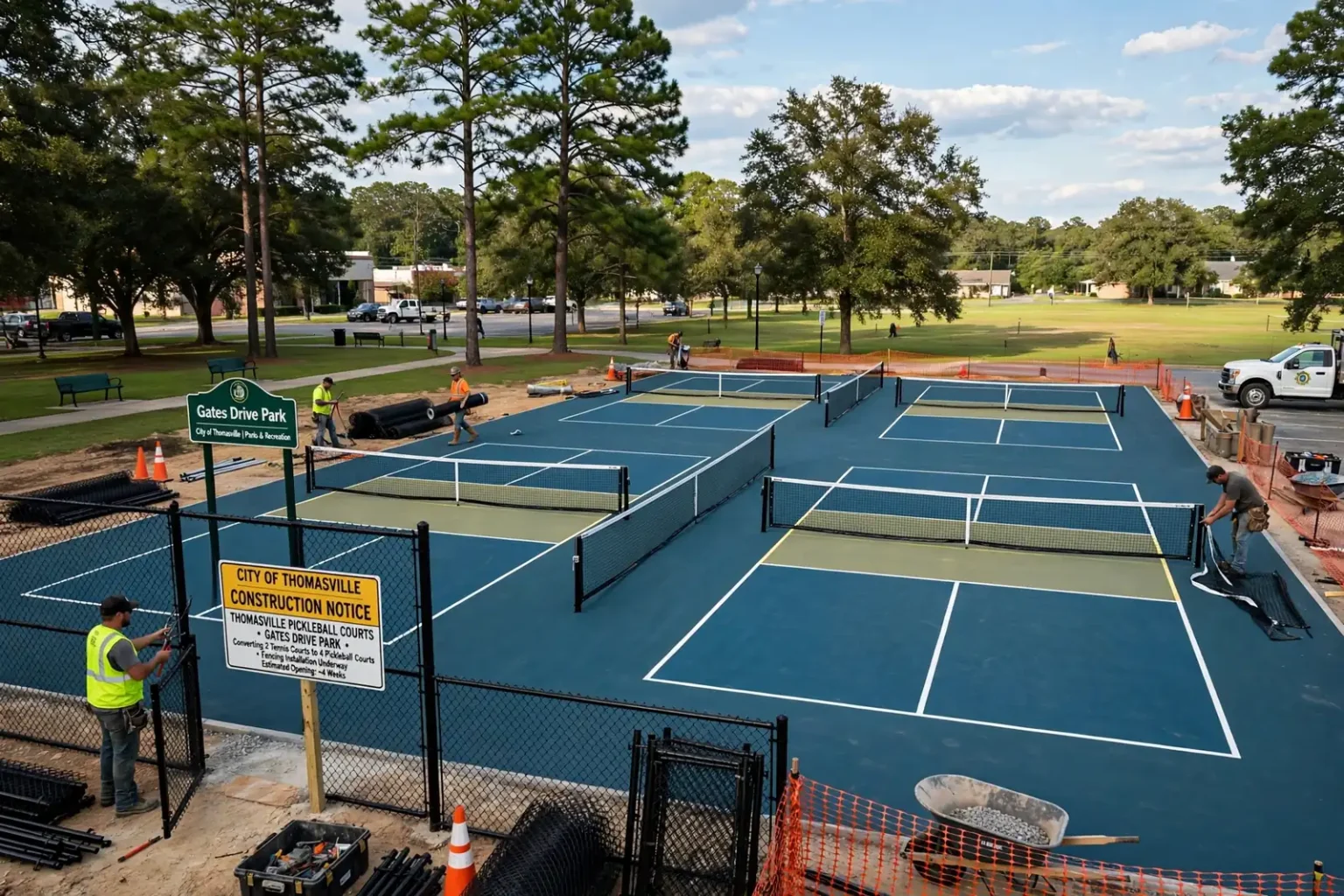
THOMASVILLE, Ala. — New Thomasville pickleball courts are on the way, giving local players a home base of their own. The city is turning the pair of tennis courts in Gates Drive Park into four dedicated pickleball courts, and with the resurfacing already done, officials expect the new facility to open to the public in roughly four weeks.
The remaining work centers on fencing and finishing touches. City officials said fence installation could wrap up as soon as this week, after which crews will complete the final details needed before players are allowed onto the courts.
Key Details at a Glance
- Location: Gates Drive Park, Thomasville
- What is changing: Two tennis courts are becoming four pickleball courts
- Completed so far: Resurfacing of the full court area
- Still to come: New painted court designs, perimeter fencing, fencing between each of the four courts and other finishing work
- Fencing timeline: Possibly complete this week
- Estimated public opening: In about four more weeks, according to city officials
What the Project Includes
The conversion covers the entire footprint of the old tennis area rather than a simple repainting of lines. Crews have already put down a new surface across the whole court area, giving the city a fresh base for the new layout.
On top of that surface, the city is adding new painted designs for the pickleball courts. Painted lines are what define each court, including its baselines, sidelines, center line and the non-volley zone near the net, so this step is what turns an open slab into four playable courts.
Fencing is the other major piece. The plan calls for fencing around the outside of the facility as well as fencing that separates the four courts from one another. City officials said the fencing could be finished this week, with other finishing work to follow.
Once that work is done, the city estimates the courts will be ready for public play in about four weeks. As with any outdoor construction project, that estimate could shift depending on weather and the pace of the final work.
How Two Tennis Courts Become Four
Turning tennis courts into pickleball courts is one of the most common ways cities and parks departments add space for the sport, because the existing courts already have a hard, level surface and a fenced, open area to work with.
The math works because a pickleball court is far smaller than a tennis court. A regulation pickleball court measures 20 feet wide by 44 feet long for both singles and doubles. A tennis court used for doubles, by comparison, measures 36 feet wide by 78 feet long, not counting the extra space behind the baselines and beside the sidelines.
That size difference leaves enough room to fit two pickleball courts within the footprint of a single tennis court while still keeping some space around each one for players to move. With two tennis courts available, the Gates Drive Park project yields four pickleball courts.
Nets are also different. A pickleball net stands 36 inches high at the sidelines and 34 inches at the center, slightly lower than a tennis net, which is why permanent conversions generally rely on dedicated pickleball nets rather than the old tennis setup.
Why the dividing fences matter
Pickleball is played with a lightweight plastic ball with holes in it, and those balls tend to bounce and roll freely into neighboring courts. On a site with several courts side by side, a ball rolling across an adjacent court can interrupt a point and create a tripping hazard for players moving quickly.
Fencing between courts helps contain those stray balls, keeps games from running into one another and gives each group of players a defined space. Perimeter fencing, meanwhile, keeps balls inside the facility and away from parking areas and walkways.
A Quick Primer on Pickleball
For residents who have heard the name but have never picked up a paddle, pickleball blends elements of tennis, badminton and table tennis. Players use solid paddles to hit a perforated plastic ball over a low net, and the game can be played as singles or, more commonly, as doubles.
The sport traces its roots to 1965, when it was invented on Bainbridge Island, Washington, by Joel Pritchard, Bill Bell and Barney McCallum as a backyard game for their families. In the decades since, it has spread to parks, schools, recreation centers and retirement communities across the country, and Washington named it the official state sport in 2022.
A few basics help explain why the game is popular with beginners:
- The serve is underhand. Serves are hit below the waist and travel diagonally across the court, which keeps the game approachable for new players.
- The ball must bounce first. Under the two-bounce rule, the serve and the return each have to bounce before either side may hit the ball out of the air.
- The kitchen. A 7-foot non-volley zone on each side of the net, often called the kitchen, is an area where players may not hit the ball out of the air.
- Short games. Games are traditionally played to 11 points, and a team must win by 2.
Because the court is small and the ball moves more slowly than a tennis ball, rallies tend to be long and social, and players of very different ages and skill levels can often enjoy a game together.
Why Communities Are Making Room for the Sport
Pickleball has been one of the fastest-growing sports in the United States in recent years, according to annual participation research from the Sports and Fitness Industry Association, a trade group that tracks how Americans play. That growth has pushed cities of every size to look for ways to add courts.
Converting underused tennis courts has become a popular solution because it reuses existing public space and infrastructure. Instead of clearing new land, a city can resurface a court area, repaint it and add nets and fencing to create several pickleball courts on the same footprint.
For smaller communities, the benefit is practical. Four courts in one place allow multiple games at once, so players are less likely to wait long for a turn, and organized groups can schedule round-robin play or lessons without tying up the entire facility.
Health Benefits and Tips for New Players
Many players are drawn to pickleball because it offers exercise in a lower-impact format than some other racket sports. The smaller court means less ground to cover, and the game still involves quick movement, hand-eye coordination and plenty of time on your feet.
Anyone planning to try the new courts once they open can keep a few general tips in mind:
- Start slowly. Warm up and stretch before playing, especially if you have not been active recently.
- Wear proper shoes. Court shoes with good lateral support help prevent ankle injuries during side-to-side movement. Running shoes are designed for forward motion and may not offer the same stability.
- Stay hydrated. Bring water, even on cooler days, and take breaks between games.
- Watch your footing. Most pickleball injuries involve falls, often while backpedaling. Turning and moving back toward a lob is safer than stepping backward.
- Talk to your doctor. People with heart, joint or balance concerns should check with a health care provider before starting any new activity.
Basic court courtesy also goes a long way at a busy facility. Players are generally expected to wait until a point is over before walking behind or across another court to retrieve a ball, to alert nearby players when a stray ball rolls onto their court and to rotate fairly when others are waiting to play.
Equipment is relatively inexpensive compared with many sports. A beginner typically needs only a paddle, a few outdoor pickleballs and comfortable athletic clothing. Outdoor balls are generally harder and have smaller holes than indoor balls, which helps them hold up better on hard courts and in the wind.
About Thomasville and Gates Drive Park
Thomasville is located in Clarke County in southwest Alabama, along U.S. Highway 43, roughly 100 miles north of Mobile. As in many small cities, its public parks serve as gathering spots for youth sports, family outings and community events.
Adding four pickleball courts at Gates Drive Park gives local residents a dedicated place to play a sport that has largely been available only on improvised or shared courts in many smaller towns. The new layout also replaces tennis courts that offered space for just two matches at a time with a facility that can host four games simultaneously.
What Happens Next
The immediate next step is finishing the fencing, which city officials said could happen this week. After that, the remaining finishing work must be completed before the courts open. Officials have estimated that the facility should be ready for public use in about four more weeks.
The city has not yet announced an opening date, hours of operation, reservation procedures or any rules for using the new courts. Residents interested in playing, or in organizing groups or lessons once the courts open, can reach out to Thomasville City Hall for updates.
South Alabama News will share details about the opening of the Gates Drive Park pickleball courts as soon as the city makes them available.