Thomasville Streaming Fundraiser Raises $3,300 for Local Theaters
Sawyer Knight's weeklong streaming fundraiser has raised more than $3,300 for two theater programs, with Thomasville Mayor Sheldon Day taking a pie to the face for the cause.
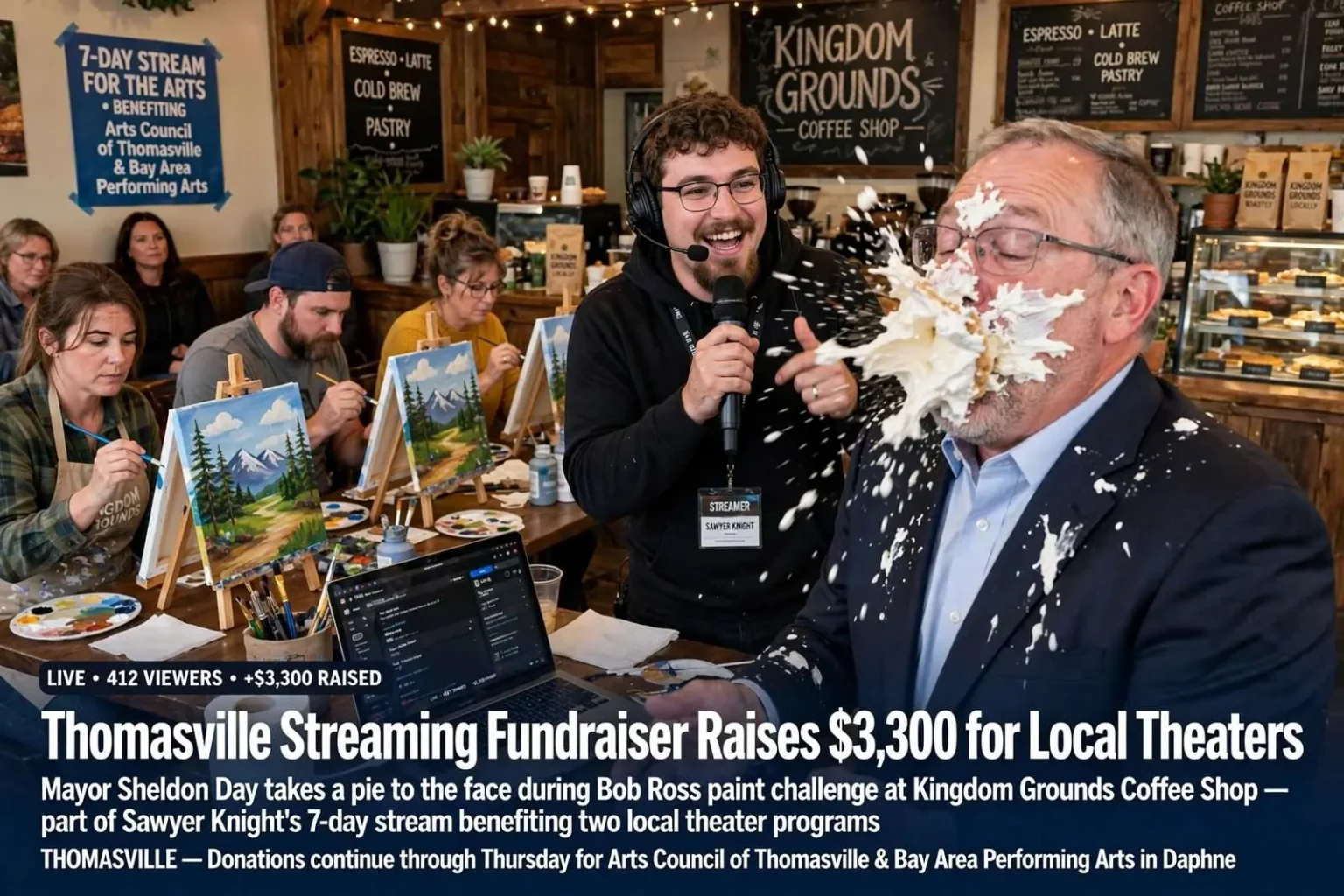
THOMASVILLE — Sawyer Knight’s weeklong streaming fundraiser continued Monday with a creative challenge that added a little Bob Ross flair and ended with Thomasville Mayor Sheldon Day taking a pie to the face in support of the arts.
Participants gathered at Kingdom Grounds Coffee Shop, where three competitors attempted to recreate a Bob Ross painting. The event is part of Knight’s seven-day streaming series of games, challenges and performances benefiting the Arts Council of Thomasville and Bay Area Performing Arts in Daphne. Knight has raised more than $3,300 for the two theater programs so far.
A fundraising goal that was reached also led to Mayor Day agreeing to take a pie to the face. Knight said donations will continue to be accepted through Thursday.
A Monday Afternoon of Happy Little Trees
The Monday challenge put a creative twist on the fundraiser’s usual format. Three competitors set up at Kingdom Grounds Coffee Shop and attempted to recreate a Bob Ross painting — the soft-edged, famously soothing landscapes made iconic by the late television painter, whose “happy little trees” and wet-on-wet technique have enjoyed an afterlife as internet shorthand for gentle, low-stakes creativity. Recreating a Ross landscape in front of an audience, with a clock running and money on the line, is exactly the kind of challenge a streaming-era fundraiser thrives on: recognizable, participatory and funny without requiring any particular skill from the crowd.
Kingdom Grounds Coffee Shop provided the physical stage for the event, continuing the pattern of the week in which the streaming series pairs its online audience with in-person gatherings at local spots. Competitors painted, spectators watched and contributed, and the proceedings were carried through the stream so that supporters who could not make it to the shop in person could follow along and give remotely — the dual-presence format that has defined Knight’s entire week.
The Bob Ross theme was more than a gimmick. Painting challenges translate naturally to an audience: everyone can judge a landscape, no one expects a masterpiece, and the gap between ambition and execution produces the comedy. With three competitors working side by side, the audience got a race, a punchline and a room full of people willing to embarrass themselves for a cause — the essential fuel of a successful fundraiser.
The Pie and the Mayor
The event’s most memorable moment came when the fundraiser crossed a goal that had been set in advance, triggering an agreement made before the week began: Thomasville Mayor Sheldon Day would take a pie to the face in support of the arts. The pie-throwing was carried out as promised, converting a donation milestone into a public spectacle that supporters could point to and say they helped cause.
Stunts of this kind are a staple of fundraising because they work. A stated goal with a attached consequence gives donors a tangible target and a reason to give now rather than eventually, and when the target is reached, the payoff is a shared, camera-ready moment that extends the fundraiser’s reach. A mayor willing to take a pie for the arts sends its own message too — that the town’s leadership considers the cause worth a little public indignity.
For Day, whose long tenure leading Thomasville has included a well-known emphasis on downtown revitalization and quality-of-life investments, appearing in the pie’s trajectory fits the pattern of a city administration that treats cultural life as infrastructure. Arts programming in a town of Thomasville’s size does not happen without this kind of support, and a mayor’s visible willingness to back it — even by forfeiting his own face to a cream pie — signals to donors and volunteers that the effort has backing at the top.
Seven Days, Two Theaters, One Streamer
The Monday event was one stop in a seven-day streaming series that Sawyer Knight built out of games, challenges and performances, with every bit of it aimed at a single target: money for two theater programs, the Arts Council of Thomasville and Bay Area Performing Arts in Daphne. The structure of the week — a new event each day, streamed and supplemented by in-person happenings — is designed to keep attention and donations accumulating, with each day’s momentum feeding the next one’s audience.
The beneficiaries sit on opposite sides of Mobile Bay geographically and organizationally, but they share the profile of small arts organizations for which a fundraiser of this size is genuinely meaningful. The Arts Council of Thomasville supports the performing and visual arts in a small southwest Alabama city, where a theater program’s annual budget can hinge on exactly the kind of community-driven fundraising Knight was running. Bay Area Performing Arts in Daphne, across the bay on the Eastern Shore, occupies similar territory: a community theater operation that serves its audience on a scale where thousands of dollars are the difference between seasons.
By the time the Bob Ross challenge wrapped, Knight had raised more than $3,300 for the two programs — a total built from a week of small contributions and steady effort rather than any single large gift. Fundraisers of this shape succeed through repetition: a streamer who shows up every day, tries something different each time, and gives the audience a running total keeps people coming back and keeps the number climbing.
Streaming as a Fundraising Engine
Knight’s week is a case study in how the streaming medium has changed grassroots fundraising. A generation ago, a benefit for local theaters meant a bake sale, a gala or a benefit performance — all limited to whoever could be in the room. A streamed series lifts that limit. Supporters can watch from anywhere, give in small amounts, and react in real time, and the streamer’s job is to keep generating reasons for them to do both: challenges, guests, goals and stunts, each one announced in advance so the audience has something to give toward.
The hybrid format — online stream plus physical gathering at Kingdom Grounds — captures both audiences at once. In-person events give a fundraiser local legitimacy and a scene worth filming; the stream gives the same events a reach no coffee shop could hold. Each element markets the other, and the content generated along the way — a mayor’s pie, a room of amateur Bob Rosses, the day’s running total — becomes the promotion for tomorrow’s installment.
The model also lowers the barrier to participation for the beneficiaries. Small theater programs rarely have development staff or fundraising infrastructure; what they have is community. A volunteer streamer with a following, a week of programming and a split that favors the cause turns that community into a fundraising engine without the overhead of a formal campaign.
Through Thursday, and What Comes After
Knight said donations will continue to be accepted through Thursday, meaning the week’s final days still carried weight for the two theater programs. Late-week momentum matters in a fundraiser of this shape: the running total, the accumulated stunts and the end date itself all conspire to push holdout donors toward the window’s close. For the Arts Council of Thomasville and Bay Area Performing Arts, the difference between the total on Monday and the final figure on Thursday was real money for real seasons.
What the week demonstrated, in the end, was the range of tools a single determined volunteer can assemble for a hometown cause: a streaming platform, a willing mayor, a coffee shop willing to host, a Rockwellian painting challenge, and two small theater programs on opposite sides of Mobile Bay that will spend every dollar raised. More than $3,300 in, with Thursday still ahead, the week stood as proof that the old-fashioned fundraiser — local, slightly silly, community-fed — had simply found a bigger room.
Small Towns and the Arts Economy
The fundraiser’s beneficiaries illustrate a quiet truth about cultural life in towns like Thomasville and cities like Daphne: the arts there run on narrow margins and broad goodwill. The Arts Council of Thomasville exists to keep performances, exhibits and arts education part of daily life in a city whose scale offers no commercial theater market to speak of. Every production, workshop and season is assembled from grants, ticket sales, sponsorships and donations — and a windfall of $3,300 or more from a single week of streaming lands as a significant line item, not a rounding error.
Bay Area Performing Arts in Daphne works the same problem from the Eastern Shore of Mobile Bay. Community theater in a suburban setting faces rising costs for space, sets, rights and insurance against a ticket base that can only grow so large. Organizations at this scale measure their seasons in volunteer hours as much as dollars, which is why fundraisers driven by individuals — a streamer, a church group, a school club — remain their financial backbone.
The mayor’s participation in the pie stunt speaks to how municipal leadership fits into that picture. In small cities, the line between city hall and civic life is short; mayors show up for the ribbon cuttings, the benefits and, when the cause warrants it, the pies. Day’s willingness to take one for the arts reflected the same priorities that have made downtown revitalization and cultural investment recurring themes in Thomasville’s public life: the belief that a town’s appeal — to residents, to visitors, to the businesses that might locate there — depends partly on whether the arts are visibly alive.
The Week’s Full Arc
By the time the Monday painting challenge concluded, Knight’s series had already demonstrated the format’s range: games, challenges and performances rotated across seven days, each event chosen to give the audience something new while the running total climbed. The structure rewarded loyal viewers who followed the whole week and casual donors who dropped in for a single spectacle — the pie, the paintings, or whatever the remaining days would bring before Thursday’s deadline.
Community venues like Kingdom Grounds Coffee Shop played their part in the arc as well. A coffee shop is the kind of neutral, familiar space where a fundraiser can gather people who might never attend a theater board meeting, and its willingness to host the Monday challenge tied the fundraiser physically to the town it was raising money for. Local businesses that open their doors for causes like this one collect no fee, but they collect something else: a standing in the community that advertising cannot buy.
When Thursday arrived and the donation window closed, the week’s work became simply money in the accounts of two theater programs — an amount built from $5 and $10 gifts, from paintings that bore only a passing resemblance to Bob Ross’s alders and mountains, and from one mayor’s good-sport moment with a cream pie. For the Arts Council of Thomasville and Bay Area Performing Arts in Daphne, it was the kind of week that keeps small-stage lights on across Alabama: local in every sense, streamed to anyone who cared to watch, and counted one donation at a time.