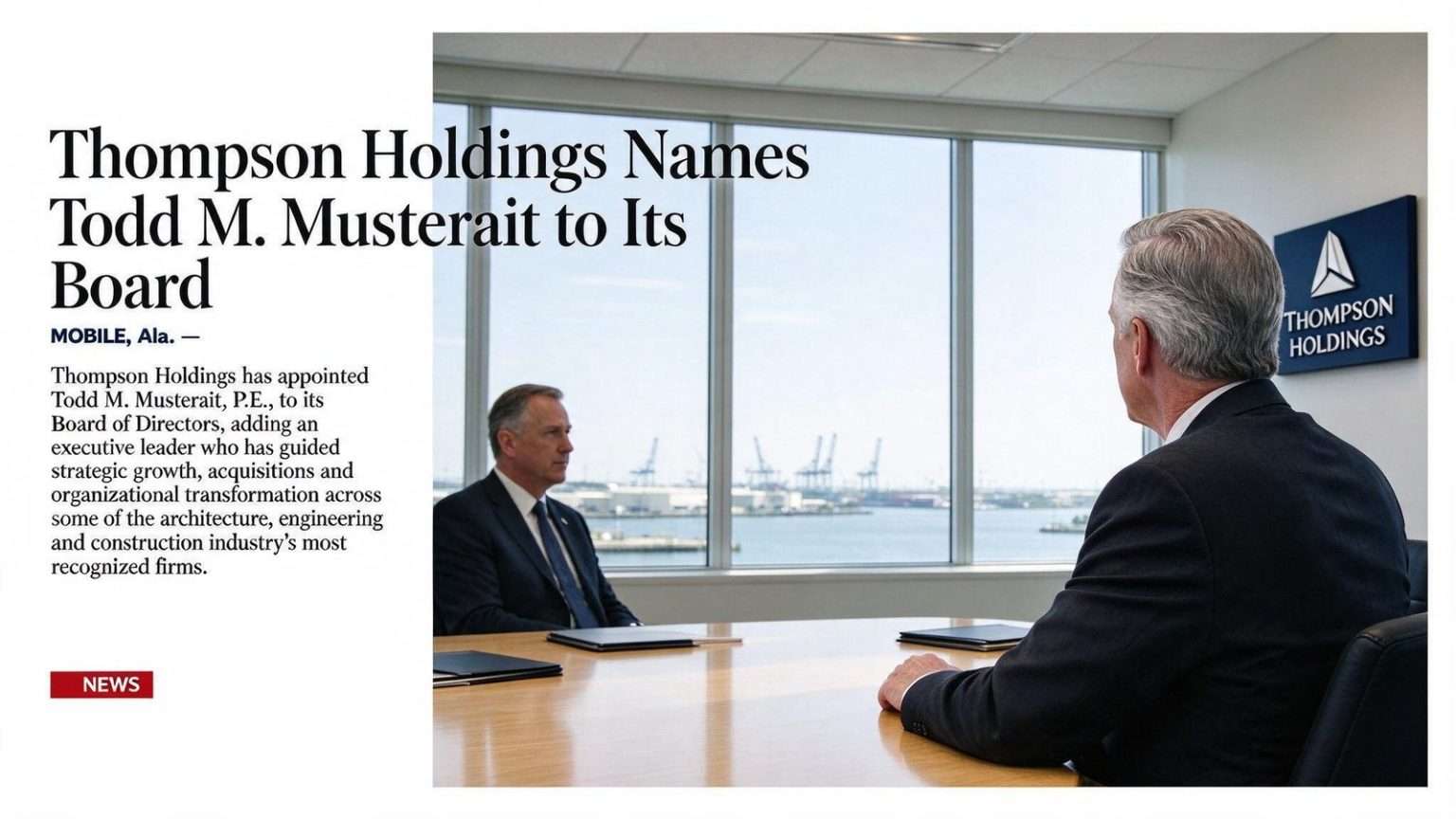
MOBILE, Ala. — Thompson Holdings has appointed Todd M. Musterait, P.E., to its Board of Directors, adding an executive leader who has guided strategic growth, acquisitions and organizational transformation across some of the architecture, engineering and construction industry’s most recognized firms.
Musterait is a licensed professional engineer and an accomplished civil and environmental engineering leader with more than 30 years of experience in the architecture, engineering and construction (AEC) industry. He has helped guide complex engineering and environmental programs while serving in executive leadership roles with WSP, Ecology & Environment, AECOM, Apex Companies, Hatch and BST Global.
His blend of technical expertise and industry leadership has made him a trusted advisor on both operational and strategic initiatives across the AEC sector. The firms on that résumé represent much of the modern history of the industry itself: AECOM and WSP rank among the largest engineering firms in the world, built substantially through the acquisition-driven consolidation that has reshaped the sector over the past two decades, while Ecology & Environment built a national reputation in environmental consulting before its own acquisition. An executive who has held leadership seats at firms of that scale brings firsthand knowledge of the acquisition process, the integration challenges that follow it, and the financial discipline that growth companies must master.
“Todd will bring an important point of view to the Thompson Holdings Board of Directors,” said Chad Brown, CEO of Thompson Holdings. “He has a strategic mindset and proven record of guiding growth-focused organizations. That will be a tremendous asset as we continue to dream big for the future of our employee-owners.”
“Thompson Holdings has built an impressive foundation, and I’m excited to join the Board at a time when the company is poised for continued growth,” said Musterait. “The AEC, disaster response, and technology industries are evolving rapidly, creating new opportunities for innovation, expansion and impact. I look forward to partnering with the leadership team to help navigate that future and support strategies that create lasting value for Thompson’s subsidiaries, employee-owners and the communities they serve.”
Who Thompson Holdings is
Thompson Holdings comprises four subsidiaries: Thompson Engineering, Watermark Design Group, Thompson Consulting Services and Sourcetoad. The company operates as an employee stock ownership plan (ESOP), in which every employee earns shares in the company as it grows.
The ESOP structure is the distinguishing feature of the company — and the reason the word “employee-owners” runs through its leadership’s public statements. In an ESOP, shares are held in a trust on behalf of the workforce, and employees accumulate value as the business grows, converting a career into an ownership stake that is realized at retirement or departure. The model ties every paycheck to the enterprise’s performance in a way a conventional corporation does not, and it changes how boards think: decisions are weighed not only against shareholder value in the abstract, but against the retirement security of the people sitting a few desks away.
Thompson’s roots run deep in Mobile. Thompson Engineering has served the Gulf Coast for decades from its hometown base, growing alongside the region’s port, shipbuilding, aerospace and coastal infrastructure economy into an engineering firm with reach well beyond Alabama. The holding-company structure that now houses Thompson Engineering alongside Watermark Design Group, Thompson Consulting Services and Sourcetoad reflects a deliberate strategy: assemble complementary capabilities — design, consulting, and technology — under one umbrella, and let each subsidiary draw on the others as client needs evolve.
The spread of those businesses is telling. Sourcetoad, a technology firm, gives the group capabilities that traditional engineering organizations have had to acquire rather than build, while the consulting arm positions the company for the advisory work that increasingly accompanies large public-sector projects. It is the same logic that drove the industry-wide consolidation Musterait watched from the inside at AECOM, WSP and the rest: clients want integrated answers, and firms that can supply them capture more of each project.
That background is precisely what the board appointment adds. Directors with operator experience at large AEC firms can pressure-test an acquisition target, evaluate integration risk, and recognize early when a growth strategy is outrunning the balance sheet — judgment that is difficult to source from outside the industry.
The industry moment
The appointment comes as the AEC industry confronts a generation of unusually strong demand. Federal infrastructure spending, coastal resilience and disaster recovery programs, and the growth of the Gulf Coast’s industrial and energy economy have all expanded the market for engineering and environmental services, while a persistent shortage of licensed engineers constrains how fast firms can grow. Firms across the sector are responding with acquisitions, new service lines and technology investment — the same forces Musterait cited in his statement.
Disaster response, in particular, has become a growth discipline of its own on the Gulf Coast. Hurricanes, storm surge and flooding events have made resilience planning, rapid damage assessment and recovery program management a standing line of work for engineering and consulting firms, and the federal dollars that follow disasters require firms capable of administering complex grant-funded programs. Thompson’s consulting and engineering arms sit squarely in that market, and the company’s leadership has made no secret of its ambitions there — Musterait’s statement names disaster response explicitly alongside AEC and technology.
Technology is the third leg. Engineering firms everywhere are absorbing drones, data analytics, GIS platforms and digital project management tools, and the firms that master the transition are pulling away from those that treat software as an afterthought. Owning a technology subsidiary rather than merely hiring technologists is a structural answer to that pressure, and it gives Thompson’s board a portfolio question most peers never face: how to value and grow a software business alongside a century-old engineering practice.
For a board of directors, appointments of this kind are about the next several years rather than the next quarter. Growth-focused ESOPs face a specific challenge: shares owed to retiring employee-owners must be funded, which means the enterprise must keep growing or generate substantial cash. Boards assembled with that arithmetic in mind — directors who have run acquisitions, integrations and expansion at scale — are a common feature of ESOP companies entering their most ambitious phases, and Thompson’s leadership described the appointment in exactly those terms.
The company’s leadership team, under Chad Brown, has been explicit that continued growth is the plan, and Musterait’s arrival gives that plan an additional set of experienced eyes. What the board does with the moment — which markets it pushes into, which acquisitions it weighs, how it balances expansion against the obligations of employee ownership — will shape the company’s next chapter and the value of the shares its workforce is earning.
ESOP companies also tend to approach governance differently from privately held or private-equity-owned firms. Because the trust representing employees is the shareholder, boards carry a fiduciary duty to that workforce, and regulatory rules govern how shares are valued and how repurchases are funded. Experienced outside directors who understand both the mechanics and the culture of employee ownership are highly sought after in the ESOP world, and firms frequently recruit them from larger corporate environments as they scale.
The professional credentials matter in this industry as well. A licensed professional engineer on the board of a company whose flagship subsidiary sells engineering judgment is a signal to clients and regulators alike, and it strengthens the peer review and quality culture that engineering firms live by. In a market where public agencies increasingly scrutinize the qualifications behind the proposals they evaluate, that credibility has commercial value.
The timing also follows a pattern familiar across the Gulf Coast business community. Firms that grew up serving the region’s port, industrial and municipal clients have reached the size where succession, ownership transition and expansion strategy all arrive at once, and boards are being rebuilt to handle the three simultaneously. Thompson’s move fits that moment: a growth-minded CEO adding a director whose career spans the consolidations, integrations and market shifts the company now intends to navigate on its own behalf.
Employees, ultimately, have the most direct stake in how it works out. In an ESOP, the board’s decisions about acquisitions, market entry and risk are decisions about the value of the account every worker is accumulating, which is why the company frames the appointment around “lasting value” rather than prestige alone. A board seat filled well is, quite literally, an investment in the workforce’s future.
For Mobile, meanwhile, the appointment is a reminder of how the region’s professional-services economy has matured. A hometown firm that began as a local engineering practice now operates a multi-subsidiary group with technology and consulting arms, and it recruits board talent from the largest firms in the world. The Gulf Coast’s growth has produced companies capable of competing far beyond it — and Thompson Holdings has made clear it intends to keep doing exactly that.