Toddler Wanders Across Busy Highway 43 in Creola, Found Safe at Gas Station
A 2-year-old wandered across busy Highway 43 in Creola and reached a BP station; police found no parental wrongdoing and the boy is safe.
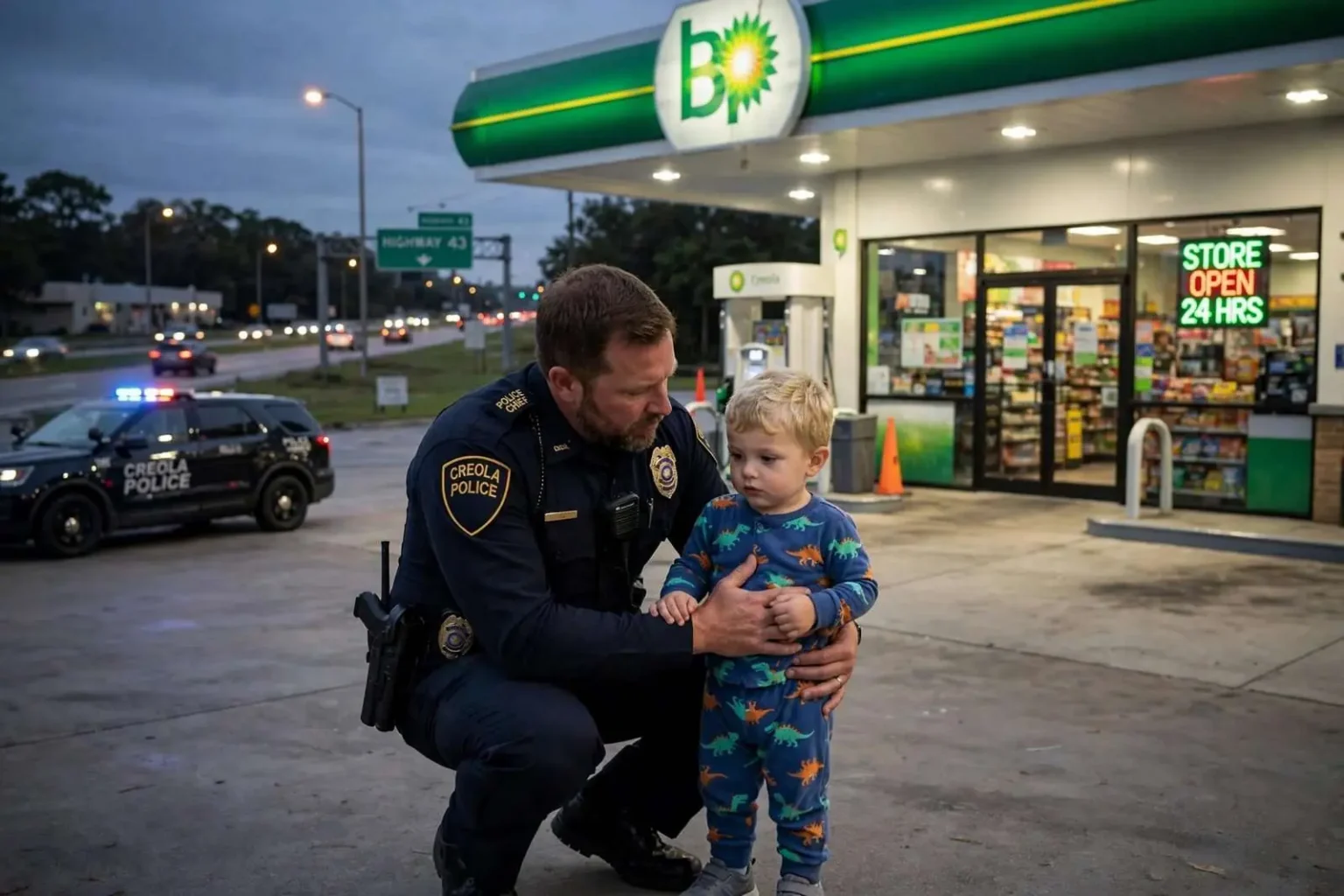
A 2-year-old boy is safe after wandering across busy Highway 43 in Creola Wednesday night, in what police are calling a miracle no one was hurt — an episode that ended at a gas station door but could easily have ended on the pavement of one of the county’s fastest rural highways.
Creola Police Chief Frank Hammond said the toddler walked roughly 500 to 1,000 feet from his home, crossing the highway to reach the BP gas station on the other side. Witnesses said drivers swerved to avoid the child as he stepped into traffic on the stretch of road, where the speed limit is 50 mph and traffic rarely slows. The image — a toddler the height of a car’s bumper walking into an evening stream of highway traffic — is the kind that stays with the officers who respond to it, and this one ended only because several strangers’ reflexes happened to be faster than a two-year-old’s timing.
Highway 43 through Creola is a working road: the four-lane route carries commuters between Mobile and the growing northern Mobile County communities, truck traffic heading toward the industrial facilities upriver, and local drivers running errands along a strip of businesses that lines the highway in Creola’s compact commercial center. The speed limit is 50 mph on the stretch, and as Hammond noted, traffic rarely slows — the combination that makes a pedestrian emergency on the road nearly unsurvivable, and a pedestrian toddler on it unthinkable.
Nine-Minute Search
Hammond said the mother was changing her other child’s diaper and, when she finished, could not find her son. The gap between the last time she saw him and the moment she noticed his absence was minutes — the kind of interval every parent of a toddler knows, in which a child silent in another room can be playing quietly or already somewhere he should not be. She called her husband immediately, then 911 at 8:28 p.m.
Less than ten minutes later, at 8:37 p.m., police received a call reporting that the boy had been spotted at the BP station. The nine-minute window encompassed the whole of the search — the 911 call, the deployment, and the discovery — and it was long enough for the toddler to cross a 50-mph highway and arrive at the opposite side. Police located the child at the gas station, physically unharmed, and reunited him with his family.
“It’s just a miracle the baby is home safe,” Hammond said — the summary of an incident whose every stage could have gone differently. A driver who did not swerve, a moment of darkness, a truck that couldn’t stop: the chief and the witnesses who watched drivers veer around the child understood exactly how narrow the margin was.
Police found no evidence of wrongdoing by the parents, and the department treated the episode as what it was — an accident of seconds — but Hammond urged caregivers to keep close watch on young children, especially in homes near busy roads. Toddlers are, developmentally, escape artists: quick, silent, fascinated by movement, and equipped with no concept of what a highway is. Fences, door locks, and sight lines matter in the seconds a parent’s attention is elsewhere.
Hammond admitted the close call kept him up that night. “My mind it was just tripping knowing a little child don’t know the difference,” he said. “They don’t see the danger.” The chief’s candor reflected the dimension of the incident that statistics don’t capture: everyone involved — the witnesses who swerved, the dispatcher who took the calls, the officers who drove to the BP station — understood that they had brushed against the worst outcome a small police department ever handles, and had been spared it.
Creola itself shaped the night’s logistics. The city of roughly 2,000 at the northern edge of Mobile County maintains a small police department whose officers know the town’s few streets and its single commercial strip. When a 911 call about a missing child comes in to a department that size, the response is immediate and personal — the responding officers may know the family, and the search area is measured in blocks. The distance between the child’s home and the BP station was, at most, 1,000 feet, but it was 1,000 feet containing a five-lane highway, and that distance defined the entire risk of the night.
The BP station’s role in the outcome was part coincidence, part the shape of Creola’s geography. A child drawn across a highway by the lights and movement of a commercial strip will predictably arrive at one of its businesses, and a gas station with staff and customers inside at 8:30 on a Wednesday night is a place where a wandering toddler gets noticed. The person who called police at 8:37 p.m. turned the station into the search’s endpoint — the second 911 call, nine minutes after the mother’s, that closed the incident safely.
Traffic safety on the Highway 43 corridor has been a recurring theme in the northern Mobile County communities it serves. The road’s combination of local errand traffic, commuter volume, and heavy truck movement makes its commercial stretches hazardous for pedestrians of any age, and the communities along it have long discussed crosswalks, lighting, and speed enforcement at the business clusters where drivers and pedestrians mix. A toddler crossing at large is a freak event; a family walking to the gas station from a nearby home is a routine one, and the difference in outcome between the two scenarios is exactly the infrastructure the corridor lacks.
The department’s closing message was aimed at every household within earshot of a highway. Toddlers disappear in the time it takes to change a diaper — Hammond’s account made the arithmetic plain, from the mother’s discovery to the 911 call at 8:28 p.m. to the sighting at the BP station at 8:37 p.m. The nine minutes in between contained a highway crossing, several near misses, and a community’s quick response. “It’s just a miracle the baby is home safe,” the chief said, and the record of the night supports the word: a 2-year-old in Creola walked across Highway 43 and came home, and everyone from the swerving drivers to the last caller is part of why.
Child-wandering incidents follow a pattern that safety educators know well, and the Creola case fits it almost exactly. The typical sequence involves a child between one and three years old, an interval of parental attention diverted to another task — a diaper, a sibling, a phone call, a stove — and an exit that the household assumed was beyond the child’s reach: an unlocked door, a screen door, a gap in a fence. Toddlers at that age are drawn to water, vehicles, and roads, and they move with a speed and silence that surprises even attentive parents. The window between departure and discovery is routinely five to fifteen minutes, which is precisely why the Creola search’s nine minutes, though it ended safely, began with a highway crossing already completed.
The safety guidance that follows such incidents is correspondingly concrete. Departments and child safety organizations urge families to install child-height locks or chain latches above toddler reach on exterior doors, to treat the door chime as a safety device rather than a convenience, and to maintain visual or audio contact with a child too young to understand danger whenever the parent’s attention must go elsewhere. For homes near busy roads — as a substantial share of homes along Highway 43 and its feeder streets are — the stakes of a two-minute lapse are different in kind from those in a quiet cul-de-sac, and the locks matter more accordingly.
Hammond’s department handled the aftermath the way small departments generally do in such cases: fact-finding with the family, no charges where no offense exists, and a public account aimed at prevention rather than blame. Alabama’s child neglect statutes turn on a caregiver’s gross deviation from reasonable care, and the facts here — a mother interrupted for the minutes a diaper change takes, immediate calls to her husband and 911, and a search resolved within ten minutes — sit nowhere near that line. The chief’s own framing, from the miracle of the outcome to his sleepless night, located the incident where it belonged: a family’s scare, a community’s good luck, and a warning delivered without a tragedy to point to.
The episode’s final lessons belong to two audiences. To drivers on Highway 43, the witnesses’ swerves are a reminder that the road’s business strips produce pedestrians who do not appear the way adult pedestrians do — low, fast, and unpredictable — and that the speed limit’s 50 mph leaves almost no margin when someone two feet tall steps out. To caregivers, the department’s message was Hammond’s own: a little child doesn’t know the difference, doesn’t see the danger, and the seconds of a parent’s divided attention are exactly the seconds it takes to cross a highway. In Creola on Wednesday night, all of those seconds came back safely — and the town’s police chief, like everyone who touched the story, made sure the telling carried the warning forward.