Tornado leaves trail of damage in Saraland
A tornado touched down in northern Mobile County, knocking down power lines and damaging a church and insurance agency in a Saraland strip mall.
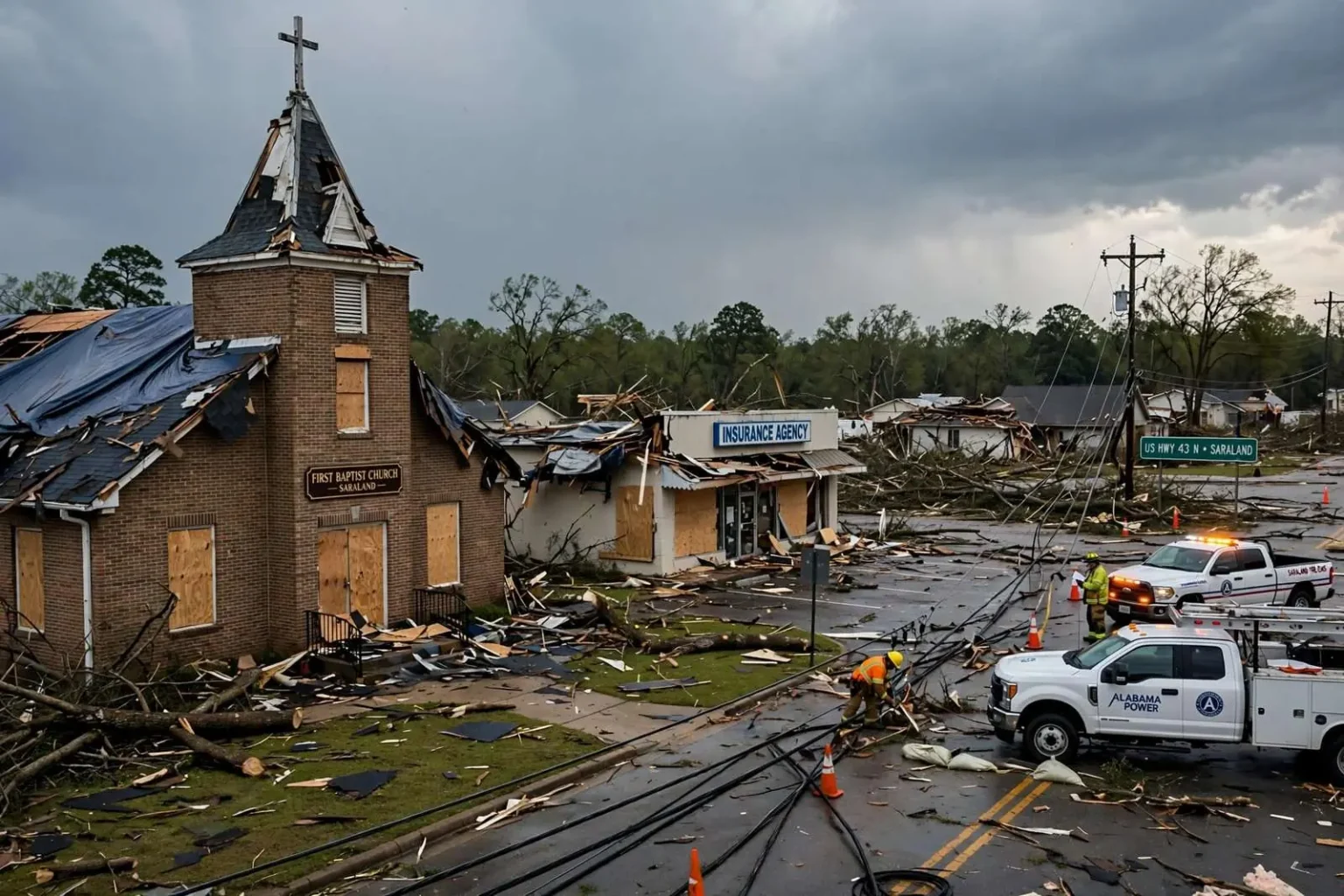
SARALAND, Ala. — A tornado touched down in northern Mobile County on Monday afternoon, leaving a trail of destruction in its path. News crews on the ground in the storm’s wake provided live reports on the damage and dramatic images from the scenes. Power lines were knocked down in the storm, leaving power out for many residents and businesses. A church and an insurance agency in a local strip mall sustained structural damage.
The storm swept through the Saraland area as the workday was winding down, and the images coming out of the city in the hours that followed told a familiar story for anyone who has lived along the Gulf Coast for long: snapped utility poles, downed lines stretched across roadways, debris scattered through neighborhoods, and business owners pulling tarps and plywood out of storage to cover broken windows and torn roofing. Emergency crews moved from street to street assessing damage, clearing blocked roads, and checking on residents as reports continued to come in from the hardest-hit areas.
Utility workers were dispatched to begin the long process of restoring electricity to customers who lost service when lines came down across the storm’s path. For many residents and businesses, the outage added another layer of disruption on top of the physical damage, keeping traffic signals dark, interrupting refrigeration at grocery stores and restaurants, and forcing families to dig out flashlights and battery-powered radios as evening approached.
A community familiar with severe weather
Saraland, a city of roughly 16,000 people in Mobile County, sits just north of Mobile along U.S. Highway 43, with Interstate 65 running nearby as it carries traffic between Mobile and points north. The community has grown steadily over the past several decades, drawing families who want access to Mobile’s job market while staying in one of the county’s smaller cities. That growth has spread homes and businesses across an area of northern Mobile County that sits squarely in the middle of one of the most tornado-prone regions of the United States.
South Alabama lies within the heart of the Gulf Coast’s tornado country. The region sees severe thunderstorms and tornado activity nearly year-round, with two peak seasons: the spring, when strong cold fronts clash with warm, moist air flowing north from the Gulf of Mexico, and the late fall and early winter, when a secondary round of strong storm systems tracks across the Deep South. Unlike the Great Plains, where tornadoes often move across open farmland, tornadoes here frequently strike developed areas — subdivisions, shopping centers, schools, and churches — because the population density of the Gulf Coast is far higher than that of the open prairie.
That reality has shaped how local governments prepare. Mobile County and its municipalities, including Saraland, Satsuma, Creola, and Prichard to the north and Mobile to the south, maintain emergency management operations that activate when the National Weather Service issues warnings. Outdoor warning sirens, weather radios, and cell phone alerts form layers of notification designed to give residents precious minutes to take shelter. The National Weather Service office that serves the central Gulf Coast routinely issues warnings for Mobile County, and meteorologists there have long emphasized that residents should know where they will go before a warning is ever issued — ideally a basement or an interior room on the lowest floor of a sturdy building, away from windows.
What the damage means for residents
For residents whose homes lost power, restoration is rarely instant. When storms knock down distribution lines, utility crews must first clear damaged equipment and downed lines from roadways, make repairs section by section, and prioritize critical facilities such as hospitals, water systems, and traffic signals before moving on to individual neighborhoods. Crews generally urge the public to treat every downed power line as live and dangerous, to stay far away and report it rather than approach or attempt to move it, and to keep children and pets clear of the area. Fallen lines can remain energized even when they appear inert, and lines tangled in trees or debris pose particular hazards to cleanup crews and residents alike.
Residents returning to damaged property after a tornado face a standard series of steps that safety officials and insurance professionals have refined over years of Gulf Coast storms. First comes a careful assessment: photograph all damage before moving or discarding anything, because those images form the foundation of any insurance claim. Next, prevent further damage where it is safe to do so — covering a breached roof or broken windows is generally considered a reasonable and reimbursable step under most homeowner policies. Insurance adjusters typically advise policyholders to keep receipts for any temporary repairs, hotel stays, or meals when a home becomes unlivable, since loss-of-use coverage can apply in significant storm events.
The damage to the church and to the insurance agency in the local strip mall illustrates how a single tornado can ripple through a community in ways that go beyond broken glass. When a house of worship is damaged, congregations often lose their gathering place at precisely the moment members need community support most. When a business that processes insurance claims is itself damaged, policyholders may face slower response times in the days after a storm, an irony not lost on longtime residents who have weathered previous rounds of severe weather along the Gulf Coast.
Businesses bear the brunt
Strip malls and commercial corridors along major arteries like U.S. 43 take a particular kind of pounding in tornado events. These long, low rows of connected storefronts, often with flat or gently sloped roofs and large glass facades, are vulnerable to the same wind forces that topple power lines, and damage to one unit can spread to neighbors through shared walls and roofs. After a tornado passes through a commercial district, the immediate days are filled with structural engineers evaluating whether buildings are safe to re-enter, contractors submitting bids for repairs, and business owners deciding whether to reopen quickly in temporary space or wait for full restoration.
For employees of damaged businesses, a storm can mean lost hours and lost pay in the short term. Many local employers in Saraland and surrounding communities are small businesses — restaurants, salons, service shops, and professional offices — that operate on thin margins and lack the corporate resources that help chain locations reopen quickly. Community support in the weeks after a damaging storm often makes the difference, as residents are encouraged to patronize businesses that manage to reopen and to be patient with those working through repairs.
Storm cleanup itself becomes a community-wide undertaking. Public works crews handle debris on public rights-of-way, while property owners are responsible for clearing their own lots. Municipalities typically announce debris pickup guidelines after significant storms, asking residents to sort vegetative debris, construction material, and household waste into separate piles along the curb so specialized contractors can haul it away efficiently. Rushing that process, or mixing debris types, can delay collection for an entire street — a lesson many Gulf Coast households learned during past hurricane and tornado recovery efforts.
Staying informed during and after the storm
News crews on the ground play a familiar role in these events, providing live reports that help residents understand the scope of the damage and which areas to avoid. Local television stations from Mobile routinely pre-empt regular programming when tornado warnings are issued, and their coverage in the hours after a tornado serves a practical function beyond news: identifying closed roads, sharing utility restoration information, and passing along messages from emergency management officials. In the social media era, residents also turn to official accounts maintained by city governments, county emergency management agencies, and utility companies for real-time updates.
Emergency managers consistently urge residents to verify information before sharing it. In the confused hours after a tornado touches down, rumors about the extent of damage, unverified reports of additional touchdowns, and outdated warnings can spread quickly and cause unnecessary panic or dangerous sightseeing. Officials ask the public to rely on confirmed sources — the National Weather Service, local emergency management, and established news organizations — rather than unverified social media posts, and to stay out of damaged areas so that first responders and utility crews can work without interference.
The Monday afternoon storm served as yet another reminder of the value of preparation. Emergency management officials across south Alabama recommend that every household maintain a basic severe weather kit: flashlights with fresh batteries, a battery-powered or hand-crank weather radio, bottled water, nonperishable food, first aid supplies, necessary medications, and sturdy shoes for walking through debris. They also recommend that families identify their shelter location in advance and practice getting there quickly, and that everyone keep phone batteries charged when severe weather is forecast — a simple step that becomes critical when power is out for days.
Looking ahead to recovery
As assessments continued in the hours and days after the tornado, attention in Saraland shifted from the immediate response to the longer work of recovery. Roofing contractors, tree services, and restoration companies typically see demand surge across the region after damaging storms, and officials warn property owners to be cautious about who they hire. Consumer protection agencies have long cautioned storm victims against high-pressure contractors who demand large upfront payments, lack local references, or cannot provide proof of insurance — a pattern of so-called storm-chaser fraud that appears after nearly every significant Gulf Coast weather event.
Homeowners with damage are generally encouraged to contact their insurance companies promptly, as claim volume after a widespread storm can create backlogs, and early filers are typically processed sooner. Keeping copies of all correspondence, noting adjuster names and claim numbers, and documenting every conversation helps keep claims moving and protects policyholders in the event of disputes over coverage or repair costs.
For the broader community, the tornado’s trail of damage — downed power lines, darkened homes and businesses, a damaged church, and a battered strip mall — will take time and money to fully repair. But Gulf Coast communities have rebuilt after such storms countless times, and Saraland’s residents have the shared experience of previous severe weather events to draw on as they clear debris, file claims, and put their city back in order. As one recovery effort gives way to the next, local officials continue to stress the fundamentals: stay away from downed lines, document damage before repairs, check on elderly neighbors, and keep weather awareness close at hand, because in south Alabama the next storm is never a matter of if, but when.